SUBSCRIBE TO OUR FREE NEWSLETTER
Daily news & progressive opinion—funded by the people, not the corporations—delivered straight to your inbox.
5
#000000
#FFFFFF
To donate by check, phone, or other method, see our More Ways to Give page.
Daily news & progressive opinion—funded by the people, not the corporations—delivered straight to your inbox.
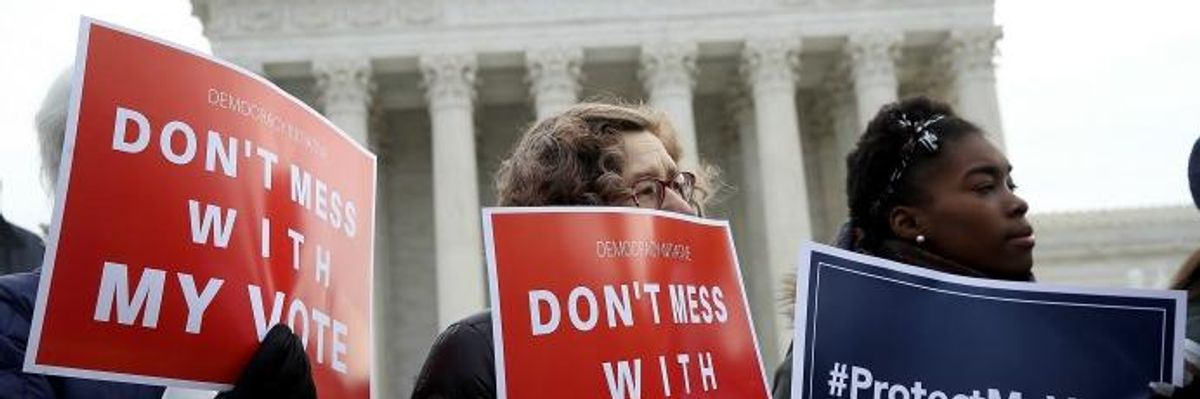
Protesters gather during a rally held by the group Common Cause in front of the U.S. Supreme Court January 10, 2018 in Washington, D.C. Voting rights activists rallied to oppose voter roll purges as the Supreme Court hears oral arguments in Husted v. A Philip Randolph Institute, a challenge to Ohio's voter roll purges. (Photo: Win McNamee/Getty Images)
Civil rights groups are calling the U.S. Supreme Court's ruling on Monday upholding Ohio's practice of purging voters from the rolls "a setback for voting rights."
In the 5-4 decision (pdf), the court found that the state, which drops people from the rolls if they don't vote and then don't respond to notices to confirm their residency, does not violate the National Voter Registration Act (NVRA).
That process, says advocacy group Demos, knocked hundreds of thousands of infrequent voting Ohioans off the rolls in 2015 alone.
"A state violates the failure-to-vote clause only if it removes registrants for no reason other than their failure to vote," Justice Samuel Alito, writing the majority opinion, argued.
According to Kristen Clarke, president and executive director of the Lawyers' Committee for Civil Rights Under Law, however, the decision not only "gets the law wrong," but also "sends the wrong message to state officials."
The ruling, she argued, "ignores the long history of purge programs in our country which have been used to unfairly and disproportionately target minority voters."
Justice Sonia Sotomayor, who joined with the liberal justices in dissenting and also wrote a separate dissenting opinion, spoke to that past as well.
She argued that the ruling from the conservative justices "entirely ignores the history of voter suppression against which the NVRA was enacted and upholds a program that appears to further the very disenfranchisement of minority and low-income voters that Congress set out to eradicate."
She added: "Communities that are disproportionately affected by unnecessarily harsh registration laws should not tolerate efforts to marginalize their influence in the political process, nor should allies who recognize blatant unfairness stand idly by. Today's decision forces these communities and their allies to be even more proactive and vigilant in holding their states accountable and working to dismantle the obstacles they face in exercising the fundamental right to vote."
The ruling was also rebuked by Chair of the Patriotic Millionaires Morris Pearl, who called it "the latest blow in a war over the fate of our democracy. On one side, the people. On the other, the conservative officials and wealthy oligarchs who wants more money in politics and less voting."
Left-leaning lawmakers weighed in as well:
Stuart Naifeh, senior counsel at Demos, which led the legal team challenging Ohio's voter-removing practice, cautioned against other states seeing the ruling as green light to engage in similar voter purging efforts.
"The fight does not stop here," he declared. "If states take today's decision as a sign that they can be even more reckless and kick eligible voters off the rolls, we will fight back in the courts, the legislatures, and with our community partners across the country."
Dear Common Dreams reader, It’s been nearly 30 years since I co-founded Common Dreams with my late wife, Lina Newhouser. We had the radical notion that journalism should serve the public good, not corporate profits. It was clear to us from the outset what it would take to build such a project. No paid advertisements. No corporate sponsors. No millionaire publisher telling us what to think or do. Many people said we wouldn't last a year, but we proved those doubters wrong. Together with a tremendous team of journalists and dedicated staff, we built an independent media outlet free from the constraints of profits and corporate control. Our mission has always been simple: To inform. To inspire. To ignite change for the common good. Building Common Dreams was not easy. Our survival was never guaranteed. When you take on the most powerful forces—Wall Street greed, fossil fuel industry destruction, Big Tech lobbyists, and uber-rich oligarchs who have spent billions upon billions rigging the economy and democracy in their favor—the only bulwark you have is supporters who believe in your work. But here’s the urgent message from me today. It's never been this bad out there. And it's never been this hard to keep us going. At the very moment Common Dreams is most needed, the threats we face are intensifying. We need your support now more than ever. We don't accept corporate advertising and never will. We don't have a paywall because we don't think people should be blocked from critical news based on their ability to pay. Everything we do is funded by the donations of readers like you. When everyone does the little they can afford, we are strong. But if that support retreats or dries up, so do we. Will you donate now to make sure Common Dreams not only survives but thrives? —Craig Brown, Co-founder |
Civil rights groups are calling the U.S. Supreme Court's ruling on Monday upholding Ohio's practice of purging voters from the rolls "a setback for voting rights."
In the 5-4 decision (pdf), the court found that the state, which drops people from the rolls if they don't vote and then don't respond to notices to confirm their residency, does not violate the National Voter Registration Act (NVRA).
That process, says advocacy group Demos, knocked hundreds of thousands of infrequent voting Ohioans off the rolls in 2015 alone.
"A state violates the failure-to-vote clause only if it removes registrants for no reason other than their failure to vote," Justice Samuel Alito, writing the majority opinion, argued.
According to Kristen Clarke, president and executive director of the Lawyers' Committee for Civil Rights Under Law, however, the decision not only "gets the law wrong," but also "sends the wrong message to state officials."
The ruling, she argued, "ignores the long history of purge programs in our country which have been used to unfairly and disproportionately target minority voters."
Justice Sonia Sotomayor, who joined with the liberal justices in dissenting and also wrote a separate dissenting opinion, spoke to that past as well.
She argued that the ruling from the conservative justices "entirely ignores the history of voter suppression against which the NVRA was enacted and upholds a program that appears to further the very disenfranchisement of minority and low-income voters that Congress set out to eradicate."
She added: "Communities that are disproportionately affected by unnecessarily harsh registration laws should not tolerate efforts to marginalize their influence in the political process, nor should allies who recognize blatant unfairness stand idly by. Today's decision forces these communities and their allies to be even more proactive and vigilant in holding their states accountable and working to dismantle the obstacles they face in exercising the fundamental right to vote."
The ruling was also rebuked by Chair of the Patriotic Millionaires Morris Pearl, who called it "the latest blow in a war over the fate of our democracy. On one side, the people. On the other, the conservative officials and wealthy oligarchs who wants more money in politics and less voting."
Left-leaning lawmakers weighed in as well:
Stuart Naifeh, senior counsel at Demos, which led the legal team challenging Ohio's voter-removing practice, cautioned against other states seeing the ruling as green light to engage in similar voter purging efforts.
"The fight does not stop here," he declared. "If states take today's decision as a sign that they can be even more reckless and kick eligible voters off the rolls, we will fight back in the courts, the legislatures, and with our community partners across the country."
Civil rights groups are calling the U.S. Supreme Court's ruling on Monday upholding Ohio's practice of purging voters from the rolls "a setback for voting rights."
In the 5-4 decision (pdf), the court found that the state, which drops people from the rolls if they don't vote and then don't respond to notices to confirm their residency, does not violate the National Voter Registration Act (NVRA).
That process, says advocacy group Demos, knocked hundreds of thousands of infrequent voting Ohioans off the rolls in 2015 alone.
"A state violates the failure-to-vote clause only if it removes registrants for no reason other than their failure to vote," Justice Samuel Alito, writing the majority opinion, argued.
According to Kristen Clarke, president and executive director of the Lawyers' Committee for Civil Rights Under Law, however, the decision not only "gets the law wrong," but also "sends the wrong message to state officials."
The ruling, she argued, "ignores the long history of purge programs in our country which have been used to unfairly and disproportionately target minority voters."
Justice Sonia Sotomayor, who joined with the liberal justices in dissenting and also wrote a separate dissenting opinion, spoke to that past as well.
She argued that the ruling from the conservative justices "entirely ignores the history of voter suppression against which the NVRA was enacted and upholds a program that appears to further the very disenfranchisement of minority and low-income voters that Congress set out to eradicate."
She added: "Communities that are disproportionately affected by unnecessarily harsh registration laws should not tolerate efforts to marginalize their influence in the political process, nor should allies who recognize blatant unfairness stand idly by. Today's decision forces these communities and their allies to be even more proactive and vigilant in holding their states accountable and working to dismantle the obstacles they face in exercising the fundamental right to vote."
The ruling was also rebuked by Chair of the Patriotic Millionaires Morris Pearl, who called it "the latest blow in a war over the fate of our democracy. On one side, the people. On the other, the conservative officials and wealthy oligarchs who wants more money in politics and less voting."
Left-leaning lawmakers weighed in as well:
Stuart Naifeh, senior counsel at Demos, which led the legal team challenging Ohio's voter-removing practice, cautioned against other states seeing the ruling as green light to engage in similar voter purging efforts.
"The fight does not stop here," he declared. "If states take today's decision as a sign that they can be even more reckless and kick eligible voters off the rolls, we will fight back in the courts, the legislatures, and with our community partners across the country."