
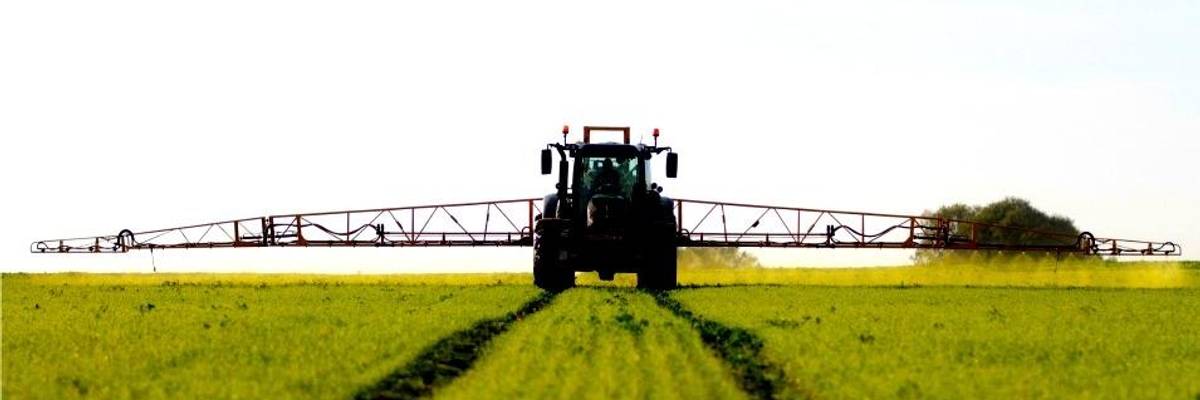
"We are calling on the Trump administration to put people's lives and their health over cutting corners for corporate gain," said one plaintiff to a lawsuit filed Wednesday against the Trump administration. (Photo: Chafer Machinery/flickr/cc)
As Trump EPA Attacks Workers and Environment, Trio of Lawsuits Takes Aim at "Outrageous" Pro-Pesticide Agenda
The suits, filed Wednesday, target the Trump administration's efforts to block federal rules on poisonous chemicals
Amid Environmental Protection Agency (EPA) Administrator Scott Pruitt's long list of personal scandals and the Trump administration's wide-ranging war on science, a trio of lawsuits filed Wednesday charge that the administration has actively endangered farmworkers and the environment by blocking pesticide regulations at the behest of chemical corporations.
" Pesticides are meant to be poisonous."
--New York Attorney General Barbara D. Underwood
The three suits offer a glimpse into the fight aimed at defeating President Donald Trump's pesticide agenda, largely enacted by Pruitt.
One case focuses on the EPA's decision to abandon an assessment of the dangers of malathion, which is among the most harmful pesticides available. The other two cases--brought by environmental groups and three state attorneys general--target the agency's indefinite suspension of a training mandate that's meant to help pesticide handlers avoid being poisoned on the job.
"Pesticides are meant to be poisonous," noted New York Attorney General Barbara D. Underwood. "Yet, Trump EPA is purposefully denying farmworkers the tools they need to protect themselves and their families from these dangerous chemicals."
The Obama administration revised the Agricultural Worker Protection Standard (WPS), the federal rulebook on pesticide safety, in 2015 to require enhanced training for anyone who handles pesticides--but in December, the Trump administration announced plans to gut the WPS, and suspended the training requirement.
Underwood, who is challenging the move along with the attorneys general from Maryland and California, called the suspension "reprehensible" and "illegal."
"This is outrageous and immoral," declared Richard Witt, executive director of the Rural & Migrant Ministry. Witt's group is one of many farmworker organizations that have joined with Earthjustice to issue a second challenge to the EPA suspension.
"We are calling on the Trump administration to put people's lives and their health over cutting corners for corporate gain."
--Monica Ramirez, Alianza Nacional de Campesina
"This should be a no-brainer," said Earthjustice attorney Hannah Chang about moving forward with the upgraded training materials. "But because of EPA's refusal, thousands of farmworkers will not receive the pesticide training they need to know their rights in the workplace, and to protect themselves and their families from pesticide exposure."
Monica Ramirez, president of Alianza Nacional de Campesina--which has also signed on to the Earthjustice suit--pointed out that "rigorous review by scientists and others has already determined that it was necessary to provide more training and increase regulation of these dangerous chemicals to protect the health of workers and community members."
"We are calling on the Trump administration to put people's lives and their health over cutting corners for corporate gain," Ramirez said. After all, as Worker Justice Center of New York executive director Lewis Papenfuse noted, the "EPA's mission is to protect public health."
But as demonstrated by the malathion lawsuit (pdf), the Trump administration seems far more inclined to cater to the demands of corporate chemical giants, regardless of the dire consequences for people and the planet.
That suit, filed by a coalition of public health and conservation groups, is about the EPA and U.S. Fish & Wildlife Service's (FWS) decision to halt a federal review of malathion, a pesticide tied to developmental disorders in children and that the World Health Organization (WHO) has deemed a probable human carcinogen.
"EPA's decisions must be based on sound science, not corporate politics."
--Caroline Cox, Center for Environmental Health
"Malathion is one of the most dangerous pesticides still available on the market," warned Sarah Aird, co-director of Californians for Pesticide Reform, a plaintiff in the case.
As the Center for Biological Diversity--another plaintiff--outlined in a statement, after EPA scientists determined last year that "97 percent of federally protected species are likely harmed by malathion," Dow requested the federal agencies "abandon years of work assessing the harms of several pesticides, including malathion." Within months, the EPA and FWS acquiesced.
"It's deplorable that the Trump administration is putting human health and endangered wildlife at risk to please Dow," concluded Jonathan Evans, the Center for Biological Diversity's environmental health legal director.
"EPA's decisions must be based on sound science, not corporate politics," added Caroline Cox of the Center for Environmental Health, another plaintiff in the case.
The Trump administration has a well documented cozy relationship with Dow. In March of 2017, Pruitt outraged environmentalists and public health advocates when he stuck down a ban on chlorpyrifos, a common pesticide manufactured by the company that harms children's brains. A few months after Pruitt's decision, reporting revealed the administrator had met with Dow's chief executive shortly before he killed the ban.
We are at a crossroads
This country and this world are at a monumental crossroads. In a few short weeks, US voters will have an opportunity to beat back the forces of fascism and confront the billionaires who are rigging the economy, our media system, and our democracy, making it increasingly impossible for ordinary people to get by. We’re not just talking about the election. We’re talking about what must be done once these fascist elements are vanquished from power. We need a bolder set of solutions than what either major party has so far been willing to offer and a working-class movement ready to fight like hell for it. Trump didn't emerge from nowhere. The conditions that fueled MAGA authoritarianism were created by decades of radical neoliberal economic policies and a corrupt political system dominated by corporate interests. They slashed taxes on the super-rich, promising that the benefits would trickle down. They said giveaways to the corporate titans would make life more affordable for the rest of us. It was all bullshit. And when a bitter, betrayed populace searches for someone to blame, right-wing demagogues have little trouble finding scapegoats. People know when they're being lied to, but you won't hear any of this from the corporate media. Only independent journalism—powered and funded by people who believe in building a better world—can deliver truly trustworthy daily news. Our Fall Campaign is underway, and we need your help. To power our newsroom through the rest of the year, we need to raise $125,000 by midnight on October 31. So if you share our vision, please contribute whatever you can to sustain our work. |
Amid Environmental Protection Agency (EPA) Administrator Scott Pruitt's long list of personal scandals and the Trump administration's wide-ranging war on science, a trio of lawsuits filed Wednesday charge that the administration has actively endangered farmworkers and the environment by blocking pesticide regulations at the behest of chemical corporations.
" Pesticides are meant to be poisonous."
--New York Attorney General Barbara D. Underwood
The three suits offer a glimpse into the fight aimed at defeating President Donald Trump's pesticide agenda, largely enacted by Pruitt.
One case focuses on the EPA's decision to abandon an assessment of the dangers of malathion, which is among the most harmful pesticides available. The other two cases--brought by environmental groups and three state attorneys general--target the agency's indefinite suspension of a training mandate that's meant to help pesticide handlers avoid being poisoned on the job.
"Pesticides are meant to be poisonous," noted New York Attorney General Barbara D. Underwood. "Yet, Trump EPA is purposefully denying farmworkers the tools they need to protect themselves and their families from these dangerous chemicals."
The Obama administration revised the Agricultural Worker Protection Standard (WPS), the federal rulebook on pesticide safety, in 2015 to require enhanced training for anyone who handles pesticides--but in December, the Trump administration announced plans to gut the WPS, and suspended the training requirement.
Underwood, who is challenging the move along with the attorneys general from Maryland and California, called the suspension "reprehensible" and "illegal."
"This is outrageous and immoral," declared Richard Witt, executive director of the Rural & Migrant Ministry. Witt's group is one of many farmworker organizations that have joined with Earthjustice to issue a second challenge to the EPA suspension.
"We are calling on the Trump administration to put people's lives and their health over cutting corners for corporate gain."
--Monica Ramirez, Alianza Nacional de Campesina
"This should be a no-brainer," said Earthjustice attorney Hannah Chang about moving forward with the upgraded training materials. "But because of EPA's refusal, thousands of farmworkers will not receive the pesticide training they need to know their rights in the workplace, and to protect themselves and their families from pesticide exposure."
Monica Ramirez, president of Alianza Nacional de Campesina--which has also signed on to the Earthjustice suit--pointed out that "rigorous review by scientists and others has already determined that it was necessary to provide more training and increase regulation of these dangerous chemicals to protect the health of workers and community members."
"We are calling on the Trump administration to put people's lives and their health over cutting corners for corporate gain," Ramirez said. After all, as Worker Justice Center of New York executive director Lewis Papenfuse noted, the "EPA's mission is to protect public health."
But as demonstrated by the malathion lawsuit (pdf), the Trump administration seems far more inclined to cater to the demands of corporate chemical giants, regardless of the dire consequences for people and the planet.
That suit, filed by a coalition of public health and conservation groups, is about the EPA and U.S. Fish & Wildlife Service's (FWS) decision to halt a federal review of malathion, a pesticide tied to developmental disorders in children and that the World Health Organization (WHO) has deemed a probable human carcinogen.
"EPA's decisions must be based on sound science, not corporate politics."
--Caroline Cox, Center for Environmental Health
"Malathion is one of the most dangerous pesticides still available on the market," warned Sarah Aird, co-director of Californians for Pesticide Reform, a plaintiff in the case.
As the Center for Biological Diversity--another plaintiff--outlined in a statement, after EPA scientists determined last year that "97 percent of federally protected species are likely harmed by malathion," Dow requested the federal agencies "abandon years of work assessing the harms of several pesticides, including malathion." Within months, the EPA and FWS acquiesced.
"It's deplorable that the Trump administration is putting human health and endangered wildlife at risk to please Dow," concluded Jonathan Evans, the Center for Biological Diversity's environmental health legal director.
"EPA's decisions must be based on sound science, not corporate politics," added Caroline Cox of the Center for Environmental Health, another plaintiff in the case.
The Trump administration has a well documented cozy relationship with Dow. In March of 2017, Pruitt outraged environmentalists and public health advocates when he stuck down a ban on chlorpyrifos, a common pesticide manufactured by the company that harms children's brains. A few months after Pruitt's decision, reporting revealed the administrator had met with Dow's chief executive shortly before he killed the ban.
Amid Environmental Protection Agency (EPA) Administrator Scott Pruitt's long list of personal scandals and the Trump administration's wide-ranging war on science, a trio of lawsuits filed Wednesday charge that the administration has actively endangered farmworkers and the environment by blocking pesticide regulations at the behest of chemical corporations.
" Pesticides are meant to be poisonous."
--New York Attorney General Barbara D. Underwood
The three suits offer a glimpse into the fight aimed at defeating President Donald Trump's pesticide agenda, largely enacted by Pruitt.
One case focuses on the EPA's decision to abandon an assessment of the dangers of malathion, which is among the most harmful pesticides available. The other two cases--brought by environmental groups and three state attorneys general--target the agency's indefinite suspension of a training mandate that's meant to help pesticide handlers avoid being poisoned on the job.
"Pesticides are meant to be poisonous," noted New York Attorney General Barbara D. Underwood. "Yet, Trump EPA is purposefully denying farmworkers the tools they need to protect themselves and their families from these dangerous chemicals."
The Obama administration revised the Agricultural Worker Protection Standard (WPS), the federal rulebook on pesticide safety, in 2015 to require enhanced training for anyone who handles pesticides--but in December, the Trump administration announced plans to gut the WPS, and suspended the training requirement.
Underwood, who is challenging the move along with the attorneys general from Maryland and California, called the suspension "reprehensible" and "illegal."
"This is outrageous and immoral," declared Richard Witt, executive director of the Rural & Migrant Ministry. Witt's group is one of many farmworker organizations that have joined with Earthjustice to issue a second challenge to the EPA suspension.
"We are calling on the Trump administration to put people's lives and their health over cutting corners for corporate gain."
--Monica Ramirez, Alianza Nacional de Campesina
"This should be a no-brainer," said Earthjustice attorney Hannah Chang about moving forward with the upgraded training materials. "But because of EPA's refusal, thousands of farmworkers will not receive the pesticide training they need to know their rights in the workplace, and to protect themselves and their families from pesticide exposure."
Monica Ramirez, president of Alianza Nacional de Campesina--which has also signed on to the Earthjustice suit--pointed out that "rigorous review by scientists and others has already determined that it was necessary to provide more training and increase regulation of these dangerous chemicals to protect the health of workers and community members."
"We are calling on the Trump administration to put people's lives and their health over cutting corners for corporate gain," Ramirez said. After all, as Worker Justice Center of New York executive director Lewis Papenfuse noted, the "EPA's mission is to protect public health."
But as demonstrated by the malathion lawsuit (pdf), the Trump administration seems far more inclined to cater to the demands of corporate chemical giants, regardless of the dire consequences for people and the planet.
That suit, filed by a coalition of public health and conservation groups, is about the EPA and U.S. Fish & Wildlife Service's (FWS) decision to halt a federal review of malathion, a pesticide tied to developmental disorders in children and that the World Health Organization (WHO) has deemed a probable human carcinogen.
"EPA's decisions must be based on sound science, not corporate politics."
--Caroline Cox, Center for Environmental Health
"Malathion is one of the most dangerous pesticides still available on the market," warned Sarah Aird, co-director of Californians for Pesticide Reform, a plaintiff in the case.
As the Center for Biological Diversity--another plaintiff--outlined in a statement, after EPA scientists determined last year that "97 percent of federally protected species are likely harmed by malathion," Dow requested the federal agencies "abandon years of work assessing the harms of several pesticides, including malathion." Within months, the EPA and FWS acquiesced.
"It's deplorable that the Trump administration is putting human health and endangered wildlife at risk to please Dow," concluded Jonathan Evans, the Center for Biological Diversity's environmental health legal director.
"EPA's decisions must be based on sound science, not corporate politics," added Caroline Cox of the Center for Environmental Health, another plaintiff in the case.
The Trump administration has a well documented cozy relationship with Dow. In March of 2017, Pruitt outraged environmentalists and public health advocates when he stuck down a ban on chlorpyrifos, a common pesticide manufactured by the company that harms children's brains. A few months after Pruitt's decision, reporting revealed the administrator had met with Dow's chief executive shortly before he killed the ban.