SUBSCRIBE TO OUR FREE NEWSLETTER
Daily news & progressive opinion—funded by the people, not the corporations—delivered straight to your inbox.
5
#000000
#FFFFFF
To donate by check, phone, or other method, see our More Ways to Give page.
Daily news & progressive opinion—funded by the people, not the corporations—delivered straight to your inbox.
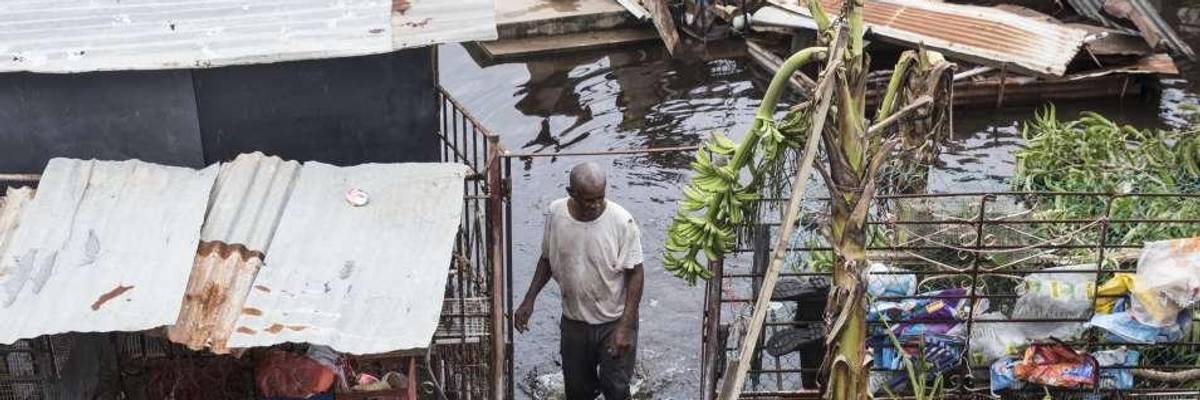
Hurricane Maria, which struck Puerto Rico on September 20, 2017, caused an estimated $90 billion in damage to the U.S. territory. (Photo: Alex Wroblewski/Getty Images)
A study published Tuesday in The New England Journal of Medicine estimates that nearly 6,000 people died in Puerto Rico after Hurricane Maria, with a survey indicating the mortality rate is likely more than 70 times the highly contested official death toll of 64.
Researchers with the Harvard T.H. Chan School of Public Health and Beth Israel Deaconess Medical Center surveyed thousands of survivors and initially estimated that at least 4,645 people died between when the storm struck the U.S. territory on September 20, 2017 and the end of the year.
However, considering that they could not survey people who lived alone and died due to the hurricane, researchers adjusted the estimate to 5,740. Citing the Centers for Disease Control and Prevention (CDC), the study says deaths can be attributed to the storm "if they are caused by forces related to the event, such as flying debris, or if they are caused by unsafe or unhealthy conditions resulting in injury, illness, or loss of necessary medical services."
The findings bolster a series of damning independent reports that have disputed the official death toll. Pressure from those reports pushed Puerto Rico Gov. Ricardo Rossello to recruit researchers from George Washington University to review the government's process of accessing deaths tied to the hurricane and produce an analysis that is expected to be released in the coming weeks.
Pointing to that government-funded analysis, the Harvard study notes that its findings "will serve as an important independent comparison to official statistics from death-registry data, which are currently being reevaluated, and underscore the inattention of the U.S. government to the frail infrastructure of Puerto Rico."
The hurricane decimated the island's infrastructure, particularly its debt-ridden electrical system. According to the National Hurricane Center (pdf), Maria caused an estimated $90 billion in damage, making it the third-costliest tropical storm since 1900, behind Katrina in 2005 and Harvey, which struck the Southern United States last year.
Despite the widespread devastation and the humanitarian crisis that followed, accounts from journalists and locals have shown that the response by the Trump administration and Republican-controlled Congress has been largely inadequate. The Harvard researchers found that "delayed or prevented access to medical care" was the "primary cause" of post-Maria deaths, accounting for about a third of all deaths reported by surviviors.
As San Juan Mayor Carmen Yulin Cruz, a fierce critic of the federal relief efforts, declared six months after the storm, "things are not what they should be...due to neglect and bureaucracy."
Rep. Luis Gutierrez (D-Ill.)--who has also sharply criticized the administration's response and spent months advocating for greater government investment in recovery efforts--said the Harvard study "confirms my worst nightmares," calling it "confirmation of an American tragedy."
While Puerto Ricans and sympathetic politicians fight for the funds to rebuild the island, the region is bracing for this year's hurricane season amid warnings that territory is not prepared for another intense tropical storm.
"This isn't over," tweeted novelist Laila Lalami in response to the study. "Puerto Rico is still struggling with services."
Dear Common Dreams reader, It’s been nearly 30 years since I co-founded Common Dreams with my late wife, Lina Newhouser. We had the radical notion that journalism should serve the public good, not corporate profits. It was clear to us from the outset what it would take to build such a project. No paid advertisements. No corporate sponsors. No millionaire publisher telling us what to think or do. Many people said we wouldn't last a year, but we proved those doubters wrong. Together with a tremendous team of journalists and dedicated staff, we built an independent media outlet free from the constraints of profits and corporate control. Our mission has always been simple: To inform. To inspire. To ignite change for the common good. Building Common Dreams was not easy. Our survival was never guaranteed. When you take on the most powerful forces—Wall Street greed, fossil fuel industry destruction, Big Tech lobbyists, and uber-rich oligarchs who have spent billions upon billions rigging the economy and democracy in their favor—the only bulwark you have is supporters who believe in your work. But here’s the urgent message from me today. It's never been this bad out there. And it's never been this hard to keep us going. At the very moment Common Dreams is most needed, the threats we face are intensifying. We need your support now more than ever. We don't accept corporate advertising and never will. We don't have a paywall because we don't think people should be blocked from critical news based on their ability to pay. Everything we do is funded by the donations of readers like you. When everyone does the little they can afford, we are strong. But if that support retreats or dries up, so do we. Will you donate now to make sure Common Dreams not only survives but thrives? —Craig Brown, Co-founder |
A study published Tuesday in The New England Journal of Medicine estimates that nearly 6,000 people died in Puerto Rico after Hurricane Maria, with a survey indicating the mortality rate is likely more than 70 times the highly contested official death toll of 64.
Researchers with the Harvard T.H. Chan School of Public Health and Beth Israel Deaconess Medical Center surveyed thousands of survivors and initially estimated that at least 4,645 people died between when the storm struck the U.S. territory on September 20, 2017 and the end of the year.
However, considering that they could not survey people who lived alone and died due to the hurricane, researchers adjusted the estimate to 5,740. Citing the Centers for Disease Control and Prevention (CDC), the study says deaths can be attributed to the storm "if they are caused by forces related to the event, such as flying debris, or if they are caused by unsafe or unhealthy conditions resulting in injury, illness, or loss of necessary medical services."
The findings bolster a series of damning independent reports that have disputed the official death toll. Pressure from those reports pushed Puerto Rico Gov. Ricardo Rossello to recruit researchers from George Washington University to review the government's process of accessing deaths tied to the hurricane and produce an analysis that is expected to be released in the coming weeks.
Pointing to that government-funded analysis, the Harvard study notes that its findings "will serve as an important independent comparison to official statistics from death-registry data, which are currently being reevaluated, and underscore the inattention of the U.S. government to the frail infrastructure of Puerto Rico."
The hurricane decimated the island's infrastructure, particularly its debt-ridden electrical system. According to the National Hurricane Center (pdf), Maria caused an estimated $90 billion in damage, making it the third-costliest tropical storm since 1900, behind Katrina in 2005 and Harvey, which struck the Southern United States last year.
Despite the widespread devastation and the humanitarian crisis that followed, accounts from journalists and locals have shown that the response by the Trump administration and Republican-controlled Congress has been largely inadequate. The Harvard researchers found that "delayed or prevented access to medical care" was the "primary cause" of post-Maria deaths, accounting for about a third of all deaths reported by surviviors.
As San Juan Mayor Carmen Yulin Cruz, a fierce critic of the federal relief efforts, declared six months after the storm, "things are not what they should be...due to neglect and bureaucracy."
Rep. Luis Gutierrez (D-Ill.)--who has also sharply criticized the administration's response and spent months advocating for greater government investment in recovery efforts--said the Harvard study "confirms my worst nightmares," calling it "confirmation of an American tragedy."
While Puerto Ricans and sympathetic politicians fight for the funds to rebuild the island, the region is bracing for this year's hurricane season amid warnings that territory is not prepared for another intense tropical storm.
"This isn't over," tweeted novelist Laila Lalami in response to the study. "Puerto Rico is still struggling with services."
A study published Tuesday in The New England Journal of Medicine estimates that nearly 6,000 people died in Puerto Rico after Hurricane Maria, with a survey indicating the mortality rate is likely more than 70 times the highly contested official death toll of 64.
Researchers with the Harvard T.H. Chan School of Public Health and Beth Israel Deaconess Medical Center surveyed thousands of survivors and initially estimated that at least 4,645 people died between when the storm struck the U.S. territory on September 20, 2017 and the end of the year.
However, considering that they could not survey people who lived alone and died due to the hurricane, researchers adjusted the estimate to 5,740. Citing the Centers for Disease Control and Prevention (CDC), the study says deaths can be attributed to the storm "if they are caused by forces related to the event, such as flying debris, or if they are caused by unsafe or unhealthy conditions resulting in injury, illness, or loss of necessary medical services."
The findings bolster a series of damning independent reports that have disputed the official death toll. Pressure from those reports pushed Puerto Rico Gov. Ricardo Rossello to recruit researchers from George Washington University to review the government's process of accessing deaths tied to the hurricane and produce an analysis that is expected to be released in the coming weeks.
Pointing to that government-funded analysis, the Harvard study notes that its findings "will serve as an important independent comparison to official statistics from death-registry data, which are currently being reevaluated, and underscore the inattention of the U.S. government to the frail infrastructure of Puerto Rico."
The hurricane decimated the island's infrastructure, particularly its debt-ridden electrical system. According to the National Hurricane Center (pdf), Maria caused an estimated $90 billion in damage, making it the third-costliest tropical storm since 1900, behind Katrina in 2005 and Harvey, which struck the Southern United States last year.
Despite the widespread devastation and the humanitarian crisis that followed, accounts from journalists and locals have shown that the response by the Trump administration and Republican-controlled Congress has been largely inadequate. The Harvard researchers found that "delayed or prevented access to medical care" was the "primary cause" of post-Maria deaths, accounting for about a third of all deaths reported by surviviors.
As San Juan Mayor Carmen Yulin Cruz, a fierce critic of the federal relief efforts, declared six months after the storm, "things are not what they should be...due to neglect and bureaucracy."
Rep. Luis Gutierrez (D-Ill.)--who has also sharply criticized the administration's response and spent months advocating for greater government investment in recovery efforts--said the Harvard study "confirms my worst nightmares," calling it "confirmation of an American tragedy."
While Puerto Ricans and sympathetic politicians fight for the funds to rebuild the island, the region is bracing for this year's hurricane season amid warnings that territory is not prepared for another intense tropical storm.
"This isn't over," tweeted novelist Laila Lalami in response to the study. "Puerto Rico is still struggling with services."