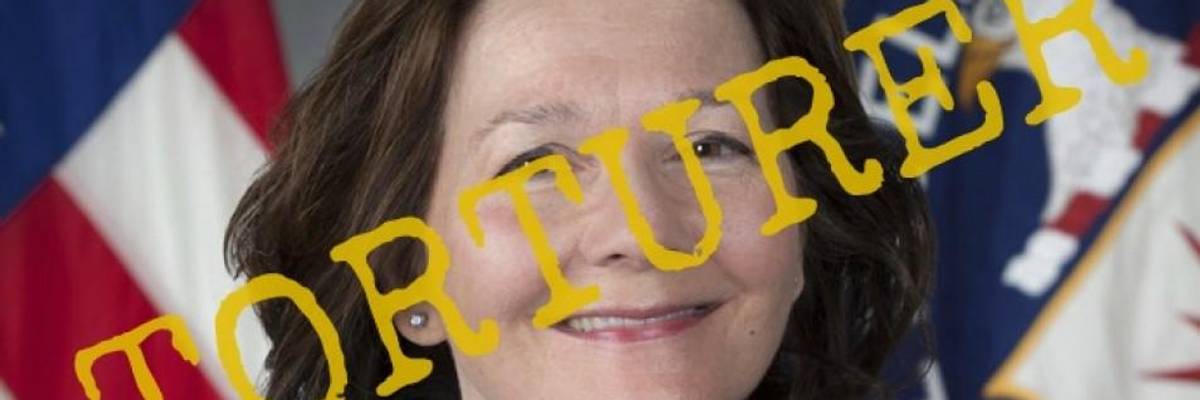
President Donald Trump has nominated Gina Haspel to run the Central Intelligence Agency. (Photo: CIA / with overlay)
CIA Propaganda Denounced as Durbin Sounds Alarm Over Agency Effort to Whitewash Haspel's Torturous Past
"The CIA's effort to promote the Haspel nomination appears to be without precedent in recent history."
As Gina Haspel faces mounting opposition ahead of her Wednesday confirmation hearing to head the CIA, the Senate's top Democrat is raising concerns about the agency's "robust" public relations campaign--which other critics have called a "domestic propaganda" operation--to distract from and downplay Haspel's role in the Bush administration's post-9/11 torture program.
"These efforts to promote a national security nomination appear to be without precedent in recent history," Sen. Dick Durbin (D-Ill.), vice chairman of the Defense Appropriations Subcommittee, wrote in a letter (pdf) to Director of National Intelligence Dan Coats on Tuesday. "Official resources of the CIA have been used for an extensive public relations campaign to newspapers and other media outlets to generate favorable coverage of Ms. Haspel's nomination."
After outlining the CIA's pro-Haspel campaign with a list of press releases and tweets from the agency's verified account, the senator urged Coats "to consider whether the CIA's efforts to promote this nomination are in keeping with the best interests of the intelligence community, and whether additional steps are warranted to review the public affairs postures of each component of the intelligence community."
Noting that "Congress has enacted several laws that prohibit the use of appropriated funds to attempt to influence congressional action on legislative matters," Durbin wrote that "while these laws do not specifically apply to nominations.... [o]ur intelligence agencies and our intelligence officers have the duty to provide objective intelligence to inform the policy making process."
The senator's letter comes amid growing frustration over the CIA's refusal to publicly disclose more details about Haspel's "highly secretive and reportedly torture-filled record." It also follows the CIA's decision to declassify a memo that "cleared" Haspel of any wrongdoing with regard to her role in destroying video recordings of agency operatives torturing people.
Leading up to the hearing scheduled for Wednesday, many other ethics experts, elected officials, and human rights advocates have expressed concerns about the CIA's efforts to pressure lawmakers to approve Haspel's nomination.
"I've been in and around politics and policy-making for about three decades now, and I certainly have not seen anything like this," Mark Keam, Durbin's former chief counsel and a current Democratic Virginia state delegate said on Jeremy Scahill's "Intercepted" podcast last week. However, Keam noted, the move isn't necessarily shocking.
"The CIA is excellent at propaganda," Keam pointed out. "Our nation's and global history is full of examples where the CIA went in and undermined governments across the world, and propped up regimes that they would like to see happen. And so to the extent that they are good at undermining society and building up and rebuilding reputations of certain members...that's something that the CIA has had many, many decades of experience [with]."
In addition to releasing documents designed to make Haspel appear more appealing, Scahill acknowledged that "the CIA has waged what I think can only be accurately described as a domestic propaganda campaign on Twitter that is aimed at the American public."
"On the CIA Twitter feed, Haspel is portrayed as a heroic, glass-ceiling breaking super spy," Scahill concluded. "It's really cringe-worthy stuff."
We are at a crossroads
This country and this world are at a monumental crossroads. In a few short weeks, US voters will have an opportunity to beat back the forces of fascism and confront the billionaires who are rigging the economy, our media system, and our democracy, making it increasingly impossible for ordinary people to get by. We’re not just talking about the election. We’re talking about what must be done once these fascist elements are vanquished from power. We need a bolder set of solutions than what either major party has so far been willing to offer and a working-class movement ready to fight like hell for it. Trump didn't emerge from nowhere. The conditions that fueled MAGA authoritarianism were created by decades of radical neoliberal economic policies and a corrupt political system dominated by corporate interests. They slashed taxes on the super-rich, promising that the benefits would trickle down. They said giveaways to the corporate titans would make life more affordable for the rest of us. It was all bullshit. And when a bitter, betrayed populace searches for someone to blame, right-wing demagogues have little trouble finding scapegoats. People know when they're being lied to, but you won't hear any of this from the corporate media. Only independent journalism—powered and funded by people who believe in building a better world—can deliver truly trustworthy daily news. Our Fall Campaign is underway, and we need your help. To power our newsroom through the rest of the year, we need to raise $125,000 by midnight on October 31. So if you share our vision, please contribute whatever you can to sustain our work. |
As Gina Haspel faces mounting opposition ahead of her Wednesday confirmation hearing to head the CIA, the Senate's top Democrat is raising concerns about the agency's "robust" public relations campaign--which other critics have called a "domestic propaganda" operation--to distract from and downplay Haspel's role in the Bush administration's post-9/11 torture program.
"These efforts to promote a national security nomination appear to be without precedent in recent history," Sen. Dick Durbin (D-Ill.), vice chairman of the Defense Appropriations Subcommittee, wrote in a letter (pdf) to Director of National Intelligence Dan Coats on Tuesday. "Official resources of the CIA have been used for an extensive public relations campaign to newspapers and other media outlets to generate favorable coverage of Ms. Haspel's nomination."
After outlining the CIA's pro-Haspel campaign with a list of press releases and tweets from the agency's verified account, the senator urged Coats "to consider whether the CIA's efforts to promote this nomination are in keeping with the best interests of the intelligence community, and whether additional steps are warranted to review the public affairs postures of each component of the intelligence community."
Noting that "Congress has enacted several laws that prohibit the use of appropriated funds to attempt to influence congressional action on legislative matters," Durbin wrote that "while these laws do not specifically apply to nominations.... [o]ur intelligence agencies and our intelligence officers have the duty to provide objective intelligence to inform the policy making process."
The senator's letter comes amid growing frustration over the CIA's refusal to publicly disclose more details about Haspel's "highly secretive and reportedly torture-filled record." It also follows the CIA's decision to declassify a memo that "cleared" Haspel of any wrongdoing with regard to her role in destroying video recordings of agency operatives torturing people.
Leading up to the hearing scheduled for Wednesday, many other ethics experts, elected officials, and human rights advocates have expressed concerns about the CIA's efforts to pressure lawmakers to approve Haspel's nomination.
"I've been in and around politics and policy-making for about three decades now, and I certainly have not seen anything like this," Mark Keam, Durbin's former chief counsel and a current Democratic Virginia state delegate said on Jeremy Scahill's "Intercepted" podcast last week. However, Keam noted, the move isn't necessarily shocking.
"The CIA is excellent at propaganda," Keam pointed out. "Our nation's and global history is full of examples where the CIA went in and undermined governments across the world, and propped up regimes that they would like to see happen. And so to the extent that they are good at undermining society and building up and rebuilding reputations of certain members...that's something that the CIA has had many, many decades of experience [with]."
In addition to releasing documents designed to make Haspel appear more appealing, Scahill acknowledged that "the CIA has waged what I think can only be accurately described as a domestic propaganda campaign on Twitter that is aimed at the American public."
"On the CIA Twitter feed, Haspel is portrayed as a heroic, glass-ceiling breaking super spy," Scahill concluded. "It's really cringe-worthy stuff."
As Gina Haspel faces mounting opposition ahead of her Wednesday confirmation hearing to head the CIA, the Senate's top Democrat is raising concerns about the agency's "robust" public relations campaign--which other critics have called a "domestic propaganda" operation--to distract from and downplay Haspel's role in the Bush administration's post-9/11 torture program.
"These efforts to promote a national security nomination appear to be without precedent in recent history," Sen. Dick Durbin (D-Ill.), vice chairman of the Defense Appropriations Subcommittee, wrote in a letter (pdf) to Director of National Intelligence Dan Coats on Tuesday. "Official resources of the CIA have been used for an extensive public relations campaign to newspapers and other media outlets to generate favorable coverage of Ms. Haspel's nomination."
After outlining the CIA's pro-Haspel campaign with a list of press releases and tweets from the agency's verified account, the senator urged Coats "to consider whether the CIA's efforts to promote this nomination are in keeping with the best interests of the intelligence community, and whether additional steps are warranted to review the public affairs postures of each component of the intelligence community."
Noting that "Congress has enacted several laws that prohibit the use of appropriated funds to attempt to influence congressional action on legislative matters," Durbin wrote that "while these laws do not specifically apply to nominations.... [o]ur intelligence agencies and our intelligence officers have the duty to provide objective intelligence to inform the policy making process."
The senator's letter comes amid growing frustration over the CIA's refusal to publicly disclose more details about Haspel's "highly secretive and reportedly torture-filled record." It also follows the CIA's decision to declassify a memo that "cleared" Haspel of any wrongdoing with regard to her role in destroying video recordings of agency operatives torturing people.
Leading up to the hearing scheduled for Wednesday, many other ethics experts, elected officials, and human rights advocates have expressed concerns about the CIA's efforts to pressure lawmakers to approve Haspel's nomination.
"I've been in and around politics and policy-making for about three decades now, and I certainly have not seen anything like this," Mark Keam, Durbin's former chief counsel and a current Democratic Virginia state delegate said on Jeremy Scahill's "Intercepted" podcast last week. However, Keam noted, the move isn't necessarily shocking.
"The CIA is excellent at propaganda," Keam pointed out. "Our nation's and global history is full of examples where the CIA went in and undermined governments across the world, and propped up regimes that they would like to see happen. And so to the extent that they are good at undermining society and building up and rebuilding reputations of certain members...that's something that the CIA has had many, many decades of experience [with]."
In addition to releasing documents designed to make Haspel appear more appealing, Scahill acknowledged that "the CIA has waged what I think can only be accurately described as a domestic propaganda campaign on Twitter that is aimed at the American public."
"On the CIA Twitter feed, Haspel is portrayed as a heroic, glass-ceiling breaking super spy," Scahill concluded. "It's really cringe-worthy stuff."