SUBSCRIBE TO OUR FREE NEWSLETTER
Daily news & progressive opinion—funded by the people, not the corporations—delivered straight to your inbox.
5
#000000
#FFFFFF
To donate by check, phone, or other method, see our More Ways to Give page.
Daily news & progressive opinion—funded by the people, not the corporations—delivered straight to your inbox.
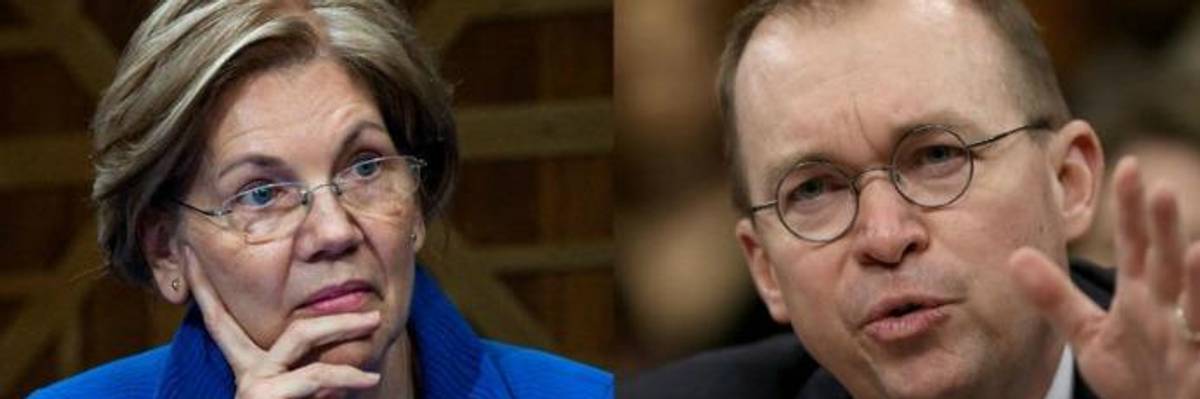
"Do you have a hierarchy that favors lobbyists that have contributed to your congressional campaigns or to any other campaigns?" Warren asked Mulvaney in a letter sent on Thursday. (Photo: Pete Marovich/Getty Images; Win McNamee/Getty Images)
White House budget chief Mick Mulvaney has already admitted that he sold access to lobbyists as a member of Congress, but now Sen. Elizabeth Warren (D-Mass.) is demanding to know whether he's doing the same as acting head of the Consumer Financial Protection Bureau (CFPB), given that "almost every major decision he's made" at the agency has rewarded his campaign donors.
"Almost every one of your major decisions at the CFPB has fulfilled a request of a lobbying organization that has donated tens of thousands of dollars to your political campaigns."
--Sen. Elizabeth Warren (D-Mass.)
In a letter (pdf) to the CFPB on Thursday, Warren wrote that Mulvaney "owe[s] the public straight answers" about whether "financial contributions have affected" his policy moves made since President Donald Trump controversially--many say illegally--placed him at the head of the consumer bureau.
"Almost every one of your major decisions at the CFPB has fulfilled a request of a lobbying organization that has donated tens of thousands of dollars to your political campaigns," Warren noted, alluding to the nearly $63,000 Mulvaney received from payday lenders while representing South Carolina in the House of Representatives. "The public deserves to know whether this is a coincidence or is a reflection of the same kind of 'hierarchy' you created when you ran your congressional office."
Warren's letter comes just days after Mulvaney admitted before an audience of over a thousand bankers that he only met with lobbyists who donated to his campaign.
"We had a hierarchy in my office in Congress," Mulvaney explained. "If you're a lobbyist who never gave us money, I didn't talk to you. If you're a lobbyist who gave us money, I might talk to you."
"America is a pay-to-play political system. When the lobbyists pay up, they're at the table."
-- Jeffrey Sachs, Columbia University
While Mulvaney's remarks were an "open and flagrant" display of the corruption at the heart of the Trump administration, Jeffrey Sachs--director of Columbia University's Earth Institute--argued in an op-ed for CNN on Friday that the comments laid bare "clearly and succinctly the evil that drives Washington" as a whole.
"America is a pay-to-play political system," Sachs argued. "When the lobbyists pay up, they're at the table."
In her letter on Thursday, Warren pointed to several rule changes and policy decisions Mulvaney has made over the past several months as possible evidence that Mulvaney is running a "pay-to-play system" of his own at the CFPB.
On top of his move to gut a rule protecting consumers from predatory payday lenders, Warren also highlights Mulvaney's efforts to roll back the CFPB's ability to enforce laws against discriminatory lending--policy changes that "no doubt pleased" bank lobbyists.
"Do you have a hierarchy that favors lobbyists that have contributed to your congressional campaigns or to any other campaigns?" Warren wrote. "Please provide copies of any documentation, including email or other correspondence, which refers to campaign contributions from lobbyists and their access to or ability to meet with you or your staff."
Dear Common Dreams reader, It’s been nearly 30 years since I co-founded Common Dreams with my late wife, Lina Newhouser. We had the radical notion that journalism should serve the public good, not corporate profits. It was clear to us from the outset what it would take to build such a project. No paid advertisements. No corporate sponsors. No millionaire publisher telling us what to think or do. Many people said we wouldn't last a year, but we proved those doubters wrong. Together with a tremendous team of journalists and dedicated staff, we built an independent media outlet free from the constraints of profits and corporate control. Our mission has always been simple: To inform. To inspire. To ignite change for the common good. Building Common Dreams was not easy. Our survival was never guaranteed. When you take on the most powerful forces—Wall Street greed, fossil fuel industry destruction, Big Tech lobbyists, and uber-rich oligarchs who have spent billions upon billions rigging the economy and democracy in their favor—the only bulwark you have is supporters who believe in your work. But here’s the urgent message from me today. It's never been this bad out there. And it's never been this hard to keep us going. At the very moment Common Dreams is most needed, the threats we face are intensifying. We need your support now more than ever. We don't accept corporate advertising and never will. We don't have a paywall because we don't think people should be blocked from critical news based on their ability to pay. Everything we do is funded by the donations of readers like you. When everyone does the little they can afford, we are strong. But if that support retreats or dries up, so do we. Will you donate now to make sure Common Dreams not only survives but thrives? —Craig Brown, Co-founder |
White House budget chief Mick Mulvaney has already admitted that he sold access to lobbyists as a member of Congress, but now Sen. Elizabeth Warren (D-Mass.) is demanding to know whether he's doing the same as acting head of the Consumer Financial Protection Bureau (CFPB), given that "almost every major decision he's made" at the agency has rewarded his campaign donors.
"Almost every one of your major decisions at the CFPB has fulfilled a request of a lobbying organization that has donated tens of thousands of dollars to your political campaigns."
--Sen. Elizabeth Warren (D-Mass.)
In a letter (pdf) to the CFPB on Thursday, Warren wrote that Mulvaney "owe[s] the public straight answers" about whether "financial contributions have affected" his policy moves made since President Donald Trump controversially--many say illegally--placed him at the head of the consumer bureau.
"Almost every one of your major decisions at the CFPB has fulfilled a request of a lobbying organization that has donated tens of thousands of dollars to your political campaigns," Warren noted, alluding to the nearly $63,000 Mulvaney received from payday lenders while representing South Carolina in the House of Representatives. "The public deserves to know whether this is a coincidence or is a reflection of the same kind of 'hierarchy' you created when you ran your congressional office."
Warren's letter comes just days after Mulvaney admitted before an audience of over a thousand bankers that he only met with lobbyists who donated to his campaign.
"We had a hierarchy in my office in Congress," Mulvaney explained. "If you're a lobbyist who never gave us money, I didn't talk to you. If you're a lobbyist who gave us money, I might talk to you."
"America is a pay-to-play political system. When the lobbyists pay up, they're at the table."
-- Jeffrey Sachs, Columbia University
While Mulvaney's remarks were an "open and flagrant" display of the corruption at the heart of the Trump administration, Jeffrey Sachs--director of Columbia University's Earth Institute--argued in an op-ed for CNN on Friday that the comments laid bare "clearly and succinctly the evil that drives Washington" as a whole.
"America is a pay-to-play political system," Sachs argued. "When the lobbyists pay up, they're at the table."
In her letter on Thursday, Warren pointed to several rule changes and policy decisions Mulvaney has made over the past several months as possible evidence that Mulvaney is running a "pay-to-play system" of his own at the CFPB.
On top of his move to gut a rule protecting consumers from predatory payday lenders, Warren also highlights Mulvaney's efforts to roll back the CFPB's ability to enforce laws against discriminatory lending--policy changes that "no doubt pleased" bank lobbyists.
"Do you have a hierarchy that favors lobbyists that have contributed to your congressional campaigns or to any other campaigns?" Warren wrote. "Please provide copies of any documentation, including email or other correspondence, which refers to campaign contributions from lobbyists and their access to or ability to meet with you or your staff."
White House budget chief Mick Mulvaney has already admitted that he sold access to lobbyists as a member of Congress, but now Sen. Elizabeth Warren (D-Mass.) is demanding to know whether he's doing the same as acting head of the Consumer Financial Protection Bureau (CFPB), given that "almost every major decision he's made" at the agency has rewarded his campaign donors.
"Almost every one of your major decisions at the CFPB has fulfilled a request of a lobbying organization that has donated tens of thousands of dollars to your political campaigns."
--Sen. Elizabeth Warren (D-Mass.)
In a letter (pdf) to the CFPB on Thursday, Warren wrote that Mulvaney "owe[s] the public straight answers" about whether "financial contributions have affected" his policy moves made since President Donald Trump controversially--many say illegally--placed him at the head of the consumer bureau.
"Almost every one of your major decisions at the CFPB has fulfilled a request of a lobbying organization that has donated tens of thousands of dollars to your political campaigns," Warren noted, alluding to the nearly $63,000 Mulvaney received from payday lenders while representing South Carolina in the House of Representatives. "The public deserves to know whether this is a coincidence or is a reflection of the same kind of 'hierarchy' you created when you ran your congressional office."
Warren's letter comes just days after Mulvaney admitted before an audience of over a thousand bankers that he only met with lobbyists who donated to his campaign.
"We had a hierarchy in my office in Congress," Mulvaney explained. "If you're a lobbyist who never gave us money, I didn't talk to you. If you're a lobbyist who gave us money, I might talk to you."
"America is a pay-to-play political system. When the lobbyists pay up, they're at the table."
-- Jeffrey Sachs, Columbia University
While Mulvaney's remarks were an "open and flagrant" display of the corruption at the heart of the Trump administration, Jeffrey Sachs--director of Columbia University's Earth Institute--argued in an op-ed for CNN on Friday that the comments laid bare "clearly and succinctly the evil that drives Washington" as a whole.
"America is a pay-to-play political system," Sachs argued. "When the lobbyists pay up, they're at the table."
In her letter on Thursday, Warren pointed to several rule changes and policy decisions Mulvaney has made over the past several months as possible evidence that Mulvaney is running a "pay-to-play system" of his own at the CFPB.
On top of his move to gut a rule protecting consumers from predatory payday lenders, Warren also highlights Mulvaney's efforts to roll back the CFPB's ability to enforce laws against discriminatory lending--policy changes that "no doubt pleased" bank lobbyists.
"Do you have a hierarchy that favors lobbyists that have contributed to your congressional campaigns or to any other campaigns?" Warren wrote. "Please provide copies of any documentation, including email or other correspondence, which refers to campaign contributions from lobbyists and their access to or ability to meet with you or your staff."