SUBSCRIBE TO OUR FREE NEWSLETTER
Daily news & progressive opinion—funded by the people, not the corporations—delivered straight to your inbox.
5
#000000
#FFFFFF
To donate by check, phone, or other method, see our More Ways to Give page.
Daily news & progressive opinion—funded by the people, not the corporations—delivered straight to your inbox.
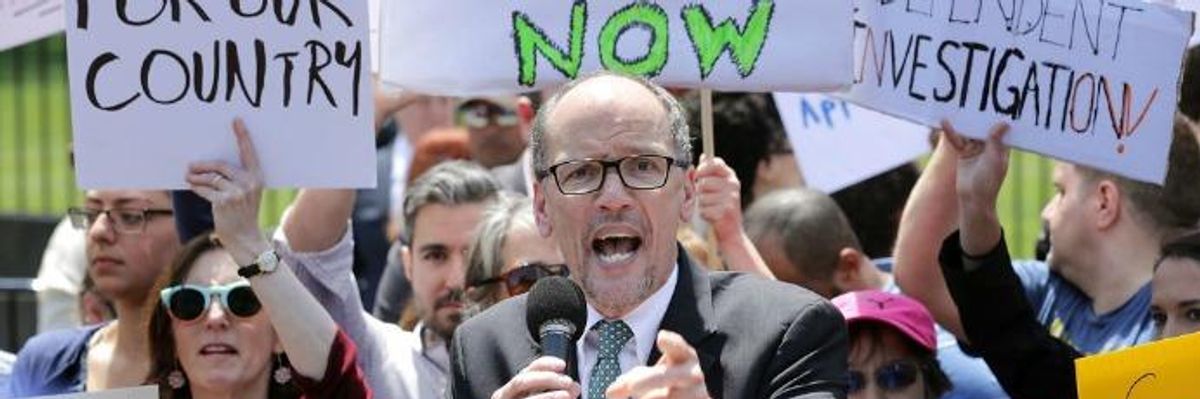
Democratic National Party Chirman Tom Perez speaks as about 300 people rally to protest against President Donald Trump's firing of Federal Bureau of Investigation Director James Comey outside the White House May 10, 2017 in Washington, D.C. (Photo: Chip Somodevilla/Getty Images)
"[Eighteen] months after their crushing defeat at the hands of a game show host, Democrats have still published no public autopsy about why they lost or have collapsed at all levels. They did, though, just file a lawsuit blaming Russia and WikiLeaks for their loss."
"It is hard to put into words how insane and self-destructive it is for any journalist to cheer the DNC's theory: that someone can be liable by publishing or disclosing someone else's secret information."
-- Glenn Greenwald, The Intercept
That was how The Intercept's Glenn Greenwald reacted to news on Friday that the Democratic National Committee (DNC) is suing the Russian government, Donald Trump's presidential campaign, and WikiLeaks over what it claims was a "far-reaching conspiracy" to damage Hillary Clinton and hand the 2016 election to Trump.
Particularly alarming, say free speech advocates and journalists, are the DNC's claims against Wikileaks, which is accused of "economic espionage" for publishing a trove of hacked emails from the DNC and Clinton campaign chairman John Podesta.
Trevor Timm, executive director of the Freedom of the Press Foundation, denounced "some of these theories in the DNC lawsuit against WikiLeaks" as "crazy," as they would implicate journalists and newspapers that report on or publish classified information.
Echoing Timm's critique, Greenwald argued "it is hard to put into words how insane and self-destructive it is for any journalist to cheer the DNC's theory: that someone can be liable by publishing or disclosing someone else's secret information."
When a commenter responded that there is a distinction to be made between publishing stolen material and publishing "leaks," Greenwald responded: "Could you explain the difference to me? Were the Pentagon Papers "stolen" or leaked? How about the Snowden documents? How about Trump's tax returns?"
In a tweet on Friday, WikiLeaks itself responded to the lawsuit, writing that "as an accurate publisher of newsworthy information WikiLeaks is constitutionally protected from such suits."
In addition to the potential legal holes in the DNC's arguments and the "dangerous" implications of the multi-million dollar lawsuit's claims, critics also slammed the suit on pragmatic political grounds, arguing that the Democratic Party should be focusing its resources on taking back Congress with midterms rapidly approaching.
"It has been 17 months since the 2016 election. Democrats have just seven months to try to flip the House of Representatives in the midterm elections," Splinter's Emma Roller noted in an article on Friday. "Investing in getting out the vote for the millions of Americans who stayed home on Election Day 2016 is an infinitely better use of the DNC's time and money than this lawsuit is. Throwing more lawsuits and more money at the problem will never change what happened on November 8, 2016."
Dear Common Dreams reader, It’s been nearly 30 years since I co-founded Common Dreams with my late wife, Lina Newhouser. We had the radical notion that journalism should serve the public good, not corporate profits. It was clear to us from the outset what it would take to build such a project. No paid advertisements. No corporate sponsors. No millionaire publisher telling us what to think or do. Many people said we wouldn't last a year, but we proved those doubters wrong. Together with a tremendous team of journalists and dedicated staff, we built an independent media outlet free from the constraints of profits and corporate control. Our mission has always been simple: To inform. To inspire. To ignite change for the common good. Building Common Dreams was not easy. Our survival was never guaranteed. When you take on the most powerful forces—Wall Street greed, fossil fuel industry destruction, Big Tech lobbyists, and uber-rich oligarchs who have spent billions upon billions rigging the economy and democracy in their favor—the only bulwark you have is supporters who believe in your work. But here’s the urgent message from me today. It's never been this bad out there. And it's never been this hard to keep us going. At the very moment Common Dreams is most needed, the threats we face are intensifying. We need your support now more than ever. We don't accept corporate advertising and never will. We don't have a paywall because we don't think people should be blocked from critical news based on their ability to pay. Everything we do is funded by the donations of readers like you. When everyone does the little they can afford, we are strong. But if that support retreats or dries up, so do we. Will you donate now to make sure Common Dreams not only survives but thrives? —Craig Brown, Co-founder |
"[Eighteen] months after their crushing defeat at the hands of a game show host, Democrats have still published no public autopsy about why they lost or have collapsed at all levels. They did, though, just file a lawsuit blaming Russia and WikiLeaks for their loss."
"It is hard to put into words how insane and self-destructive it is for any journalist to cheer the DNC's theory: that someone can be liable by publishing or disclosing someone else's secret information."
-- Glenn Greenwald, The Intercept
That was how The Intercept's Glenn Greenwald reacted to news on Friday that the Democratic National Committee (DNC) is suing the Russian government, Donald Trump's presidential campaign, and WikiLeaks over what it claims was a "far-reaching conspiracy" to damage Hillary Clinton and hand the 2016 election to Trump.
Particularly alarming, say free speech advocates and journalists, are the DNC's claims against Wikileaks, which is accused of "economic espionage" for publishing a trove of hacked emails from the DNC and Clinton campaign chairman John Podesta.
Trevor Timm, executive director of the Freedom of the Press Foundation, denounced "some of these theories in the DNC lawsuit against WikiLeaks" as "crazy," as they would implicate journalists and newspapers that report on or publish classified information.
Echoing Timm's critique, Greenwald argued "it is hard to put into words how insane and self-destructive it is for any journalist to cheer the DNC's theory: that someone can be liable by publishing or disclosing someone else's secret information."
When a commenter responded that there is a distinction to be made between publishing stolen material and publishing "leaks," Greenwald responded: "Could you explain the difference to me? Were the Pentagon Papers "stolen" or leaked? How about the Snowden documents? How about Trump's tax returns?"
In a tweet on Friday, WikiLeaks itself responded to the lawsuit, writing that "as an accurate publisher of newsworthy information WikiLeaks is constitutionally protected from such suits."
In addition to the potential legal holes in the DNC's arguments and the "dangerous" implications of the multi-million dollar lawsuit's claims, critics also slammed the suit on pragmatic political grounds, arguing that the Democratic Party should be focusing its resources on taking back Congress with midterms rapidly approaching.
"It has been 17 months since the 2016 election. Democrats have just seven months to try to flip the House of Representatives in the midterm elections," Splinter's Emma Roller noted in an article on Friday. "Investing in getting out the vote for the millions of Americans who stayed home on Election Day 2016 is an infinitely better use of the DNC's time and money than this lawsuit is. Throwing more lawsuits and more money at the problem will never change what happened on November 8, 2016."
"[Eighteen] months after their crushing defeat at the hands of a game show host, Democrats have still published no public autopsy about why they lost or have collapsed at all levels. They did, though, just file a lawsuit blaming Russia and WikiLeaks for their loss."
"It is hard to put into words how insane and self-destructive it is for any journalist to cheer the DNC's theory: that someone can be liable by publishing or disclosing someone else's secret information."
-- Glenn Greenwald, The Intercept
That was how The Intercept's Glenn Greenwald reacted to news on Friday that the Democratic National Committee (DNC) is suing the Russian government, Donald Trump's presidential campaign, and WikiLeaks over what it claims was a "far-reaching conspiracy" to damage Hillary Clinton and hand the 2016 election to Trump.
Particularly alarming, say free speech advocates and journalists, are the DNC's claims against Wikileaks, which is accused of "economic espionage" for publishing a trove of hacked emails from the DNC and Clinton campaign chairman John Podesta.
Trevor Timm, executive director of the Freedom of the Press Foundation, denounced "some of these theories in the DNC lawsuit against WikiLeaks" as "crazy," as they would implicate journalists and newspapers that report on or publish classified information.
Echoing Timm's critique, Greenwald argued "it is hard to put into words how insane and self-destructive it is for any journalist to cheer the DNC's theory: that someone can be liable by publishing or disclosing someone else's secret information."
When a commenter responded that there is a distinction to be made between publishing stolen material and publishing "leaks," Greenwald responded: "Could you explain the difference to me? Were the Pentagon Papers "stolen" or leaked? How about the Snowden documents? How about Trump's tax returns?"
In a tweet on Friday, WikiLeaks itself responded to the lawsuit, writing that "as an accurate publisher of newsworthy information WikiLeaks is constitutionally protected from such suits."
In addition to the potential legal holes in the DNC's arguments and the "dangerous" implications of the multi-million dollar lawsuit's claims, critics also slammed the suit on pragmatic political grounds, arguing that the Democratic Party should be focusing its resources on taking back Congress with midterms rapidly approaching.
"It has been 17 months since the 2016 election. Democrats have just seven months to try to flip the House of Representatives in the midterm elections," Splinter's Emma Roller noted in an article on Friday. "Investing in getting out the vote for the millions of Americans who stayed home on Election Day 2016 is an infinitely better use of the DNC's time and money than this lawsuit is. Throwing more lawsuits and more money at the problem will never change what happened on November 8, 2016."