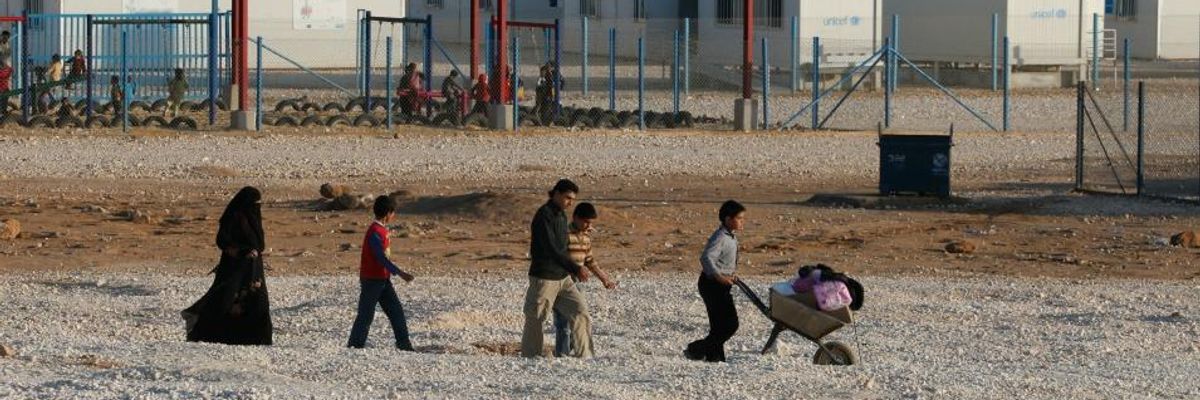
The civil war in Syria, exacerbated by military intervention by countries including the U.S., has left 5.5 million Syrians seeking asylum. (Photo: World Bank Photo Collection/Flickr/cc)
As Trump and May Claim Concern for Syrian Civilians, Critics Slam Leaders for Anti-Refugee Stance
"If the Trump administration truly cares about the fate of Syrian civilians, it can do far better in resettling Syrian refugees."
While President Donald Trump's address to the nation suggested that he and his counterparts in France and the United Kingdom launched airstrikes out of concern for Syrian civilians, a number of critics pointed out that the leaders have shown little compassion for those same innocent people as nations have debated taking in Syrian refugees in recent months.
Under Trump, the number of Syrian refugees who have been granted asylum and resettled by the U.S. has plummeted, dropping from more than 12,000 in 2016 to half that number last year. Less than 100 of the war-torn nation's 5.5 million refugees are expected to be allowed into the U.S. by the end of the current fiscal year in September.
"If the Trump administration truly cares about the fate of Syrian civilians, it can do far better in resettling Syrian refugees," wrote the International Rescue Committee on Friday evening. "More than 40 people were reportedly killed in the suspected chemical attack on Douma, in the Damascus suburb of Eastern Ghouta. That is as many Syrians who have been admitted to the United States as refugees this year."
In the UK, Labour politician David Lammy condemned his fellow members of Parliament for opposing the resettlement of refugee children, as some officials supported Prime Minister Theresa May's decision to march in lockstep with Trump, launching airstrikes on Syrian President Bashar al-Assad's chemical weapons infrastructure.
In both the U.S. and the U.K., public opinion has strongly favored resettling refugees from Syria. Fifty-seven percent of Americans surveyed by Quinnipiac University urged their government to take in Syrians a year ago, after Trump launched airstrikes in the country following another suspected chemical attack.
Grassroots activists in the U.K. have urged their government to welcome more asylum-seekers from Syria, while May has resisted, preferring to send aid to Middle Eastern countries to keep refugees in the region.
In a poll taken by the Clarion Project this week, more than 58 percent of Americans responded that the U.S. should not launch strikes against Syria in the wake of the apparent attack on Douma, while a similar poll by Verdict in the U.K. showed that only 22 percent of Britons supported military intervention.
Trump critics on social media expressed doubt that the president's concerned rhetoric regarding Syrian civilians would give way to a policy change regarding their resettlement.
We are at a crossroads
This country and this world are at a monumental crossroads. In a few short weeks, US voters will have an opportunity to beat back the forces of fascism and confront the billionaires who are rigging the economy, our media system, and our democracy, making it increasingly impossible for ordinary people to get by. We’re not just talking about the election. We’re talking about what must be done once these fascist elements are vanquished from power. We need a bolder set of solutions than what either major party has so far been willing to offer and a working-class movement ready to fight like hell for it. Trump didn't emerge from nowhere. The conditions that fueled MAGA authoritarianism were created by decades of radical neoliberal economic policies and a corrupt political system dominated by corporate interests. They slashed taxes on the super-rich, promising that the benefits would trickle down. They said giveaways to the corporate titans would make life more affordable for the rest of us. It was all bullshit. And when a bitter, betrayed populace searches for someone to blame, right-wing demagogues have little trouble finding scapegoats. People know when they're being lied to, but you won't hear any of this from the corporate media. Only independent journalism—powered and funded by people who believe in building a better world—can deliver truly trustworthy daily news. Our Fall Campaign is underway, and we need your help. To power our newsroom through the rest of the year, we need to raise $125,000 by midnight on October 31. So if you share our vision, please contribute whatever you can to sustain our work. |
While President Donald Trump's address to the nation suggested that he and his counterparts in France and the United Kingdom launched airstrikes out of concern for Syrian civilians, a number of critics pointed out that the leaders have shown little compassion for those same innocent people as nations have debated taking in Syrian refugees in recent months.
Under Trump, the number of Syrian refugees who have been granted asylum and resettled by the U.S. has plummeted, dropping from more than 12,000 in 2016 to half that number last year. Less than 100 of the war-torn nation's 5.5 million refugees are expected to be allowed into the U.S. by the end of the current fiscal year in September.
"If the Trump administration truly cares about the fate of Syrian civilians, it can do far better in resettling Syrian refugees," wrote the International Rescue Committee on Friday evening. "More than 40 people were reportedly killed in the suspected chemical attack on Douma, in the Damascus suburb of Eastern Ghouta. That is as many Syrians who have been admitted to the United States as refugees this year."
In the UK, Labour politician David Lammy condemned his fellow members of Parliament for opposing the resettlement of refugee children, as some officials supported Prime Minister Theresa May's decision to march in lockstep with Trump, launching airstrikes on Syrian President Bashar al-Assad's chemical weapons infrastructure.
In both the U.S. and the U.K., public opinion has strongly favored resettling refugees from Syria. Fifty-seven percent of Americans surveyed by Quinnipiac University urged their government to take in Syrians a year ago, after Trump launched airstrikes in the country following another suspected chemical attack.
Grassroots activists in the U.K. have urged their government to welcome more asylum-seekers from Syria, while May has resisted, preferring to send aid to Middle Eastern countries to keep refugees in the region.
In a poll taken by the Clarion Project this week, more than 58 percent of Americans responded that the U.S. should not launch strikes against Syria in the wake of the apparent attack on Douma, while a similar poll by Verdict in the U.K. showed that only 22 percent of Britons supported military intervention.
Trump critics on social media expressed doubt that the president's concerned rhetoric regarding Syrian civilians would give way to a policy change regarding their resettlement.