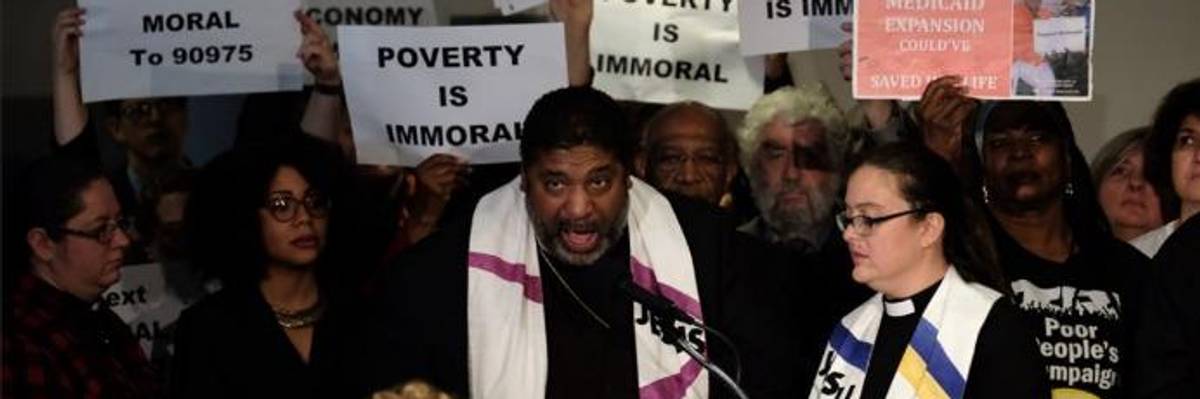
"Here we're proving--with data and analysis spanning 50 years--that the problem is both structural barriers for the poor in hiring, housing, policing, and more, as well as a system that prioritizes war and the wealthy over people and the environment they live in," said John Cavanagh, director of the Institute for Policy Studies. (Photo: Poor People's Campaign/Twitter)
Decrying System That Favors 'War and the Wealthy,' Poor People's Campaign Unveils Agenda to Combat Poverty, Racism, and Militarism
"The Democrats talk about the middle class. The Republicans talk about the military. No one's talking about the poor."
In the spirit of Dr. Martin Luther King Jr.'s original campaign against poverty that kicked off 50 years ago next month, leaders of the Poor People's Campaign (PPC) on Tuesday announced plans to revive Dr. King's radical moral vision with mass action nationwide and unveiled a series of ambitious demands aimed at combating the economic, racial, and environmental injustices that afflict tens of millions of people in the world's wealthiest nation.
"We are coming together to break the silence and tell the truth about the interlocking evils of systemic racism, poverty, ecological devastation, the war economy, and our distorted moral narrative."
--Poor People's Campaign
Titled the "Declaration of Fundamental Rights and Poor People's Moral Agenda," the document argues--as Dr. King did--that the crises of poverty, militarism, racism, and environmental degradation are interconnected and that all must be confronted if justice for the disenfranchised is to be achieved.
"The truth is that systemic racism allows us to deny the humanity of others; by denying the humanity of others, we are given permission to exploit or exclude people economically; by exploiting and excluding people economically, we are emboldened to abuse our military powers and, through violence and war, control resources; this quest for the control of resources leads to the potential destruction of our entire ecosystem and everything living in it," PPC declares.
Below is a list of just a handful of the movement's demands, which PPC leader Rev. William Barber argued during a press conference on Monday can only be achieved through "power-building from the bottom up":
- Full restoration and expansion of the Voting Rights Act of 1965 and "an end to racist gerrymandering and redistricting";
- Automatic voter registration;
- Federal and state living wage laws;
- Full implementation of single-payer healthcare;
- Complete repeal of the GOP tax law and "reinvestment of those funds into social programming that helps all";
- A ban on fracking and a just transition to 100 percent renewable energy; and
- An "end to military aggression and war-mongering" and reallocation of resources from the military budget to education, healthcare, jobs and green infrastructure needs, and strengthening a VA system that remains public."
"We are coming together to break the silence and tell the truth about the interlocking evils of systemic racism, poverty, ecological devastation, the war economy, and our distorted moral narrative," the document concludes. "We loudly proclaim that we will move forward together, not one step back!"
Watch Barber and other PPC leaders deliver the demands at a press conference on Tuesday:
In addition to its series of demands, PPC also released a report in conjunction with the Institute for Policy Studies (IPS) detailing the widespread destitution and collapsing living standards that make such an ambitious agenda necessary.
Titled "The Souls of Poor Folks," the report examines the crippling poverty that afflicts tens of millions of Americans, but rarely receives more than a few moments of attention from the corporate media or America's establishment politicians.
"The Democrats talk about the middle class. The Republicans talk about the military," Barber told the Associated Press in an interview on Monday. "No one's talking about the poor."
"The problem is both structural barriers for the poor in hiring, housing, policing, and more, as well as a system that prioritizes war and the wealthy over people and the environment they live in."
--John Cavanagh, Institute for Policy Studies
According to the report, more than 40 million Americans subsist below the poverty line and closer to 140 million people are dealing with some combination of structural racism, economic inequality, and ecological degradation every day.
"Nearly half of our population cannot afford a $400 emergency, which presents a structural crisis of national proportion that ties poverty to things like healthcare and housing," the analysis continues. "The devastation cuts across race, gender, age, and geography."
And while a large swath of the population faces stagnant or declining incomes and standards of living, the report notes that an ever-growing percentage of America's vast wealth is being siphon by those at the top.
"Instead of going to workers, massive gains from economic growth have been going to a smaller and smaller share of society," the report notes. "Since 1968, the top one percent's share of national income has nearly doubled while the official poverty rate for all U.S. families has merely inched up and down."
In a statement on Tuesday, IPS director John Cavanagh said the report's findings thoroughly debunk the "enduring narrative that if the millions of people in poverty in the U.S. just worked harder they would be lifted up out of their condition."
"Here we're proving--with data and analysis spanning 50 years--that the problem is both structural barriers for the poor in hiring, housing, policing, and more, as well as a system that prioritizes war and the wealthy over people and the environment they live in," Cavanagh concluded. "It is unfathomable, for example, that in the wealthiest nation in the world, medical debt is the number one cause of personal bankruptcy filings, and one and a half million people don't have access to plumbing."
We are at a crossroads
This country and this world are at a monumental crossroads. In a few short weeks, US voters will have an opportunity to beat back the forces of fascism and confront the billionaires who are rigging the economy, our media system, and our democracy, making it increasingly impossible for ordinary people to get by. We’re not just talking about the election. We’re talking about what must be done once these fascist elements are vanquished from power. We need a bolder set of solutions than what either major party has so far been willing to offer and a working-class movement ready to fight like hell for it. Trump didn't emerge from nowhere. The conditions that fueled MAGA authoritarianism were created by decades of radical neoliberal economic policies and a corrupt political system dominated by corporate interests. They slashed taxes on the super-rich, promising that the benefits would trickle down. They said giveaways to the corporate titans would make life more affordable for the rest of us. It was all bullshit. And when a bitter, betrayed populace searches for someone to blame, right-wing demagogues have little trouble finding scapegoats. People know when they're being lied to, but you won't hear any of this from the corporate media. Only independent journalism—powered and funded by people who believe in building a better world—can deliver truly trustworthy daily news. Our Fall Campaign is underway, and we need your help. To power our newsroom through the rest of the year, we need to raise $125,000 by midnight on October 31. So if you share our vision, please contribute whatever you can to sustain our work. |
In the spirit of Dr. Martin Luther King Jr.'s original campaign against poverty that kicked off 50 years ago next month, leaders of the Poor People's Campaign (PPC) on Tuesday announced plans to revive Dr. King's radical moral vision with mass action nationwide and unveiled a series of ambitious demands aimed at combating the economic, racial, and environmental injustices that afflict tens of millions of people in the world's wealthiest nation.
"We are coming together to break the silence and tell the truth about the interlocking evils of systemic racism, poverty, ecological devastation, the war economy, and our distorted moral narrative."
--Poor People's Campaign
Titled the "Declaration of Fundamental Rights and Poor People's Moral Agenda," the document argues--as Dr. King did--that the crises of poverty, militarism, racism, and environmental degradation are interconnected and that all must be confronted if justice for the disenfranchised is to be achieved.
"The truth is that systemic racism allows us to deny the humanity of others; by denying the humanity of others, we are given permission to exploit or exclude people economically; by exploiting and excluding people economically, we are emboldened to abuse our military powers and, through violence and war, control resources; this quest for the control of resources leads to the potential destruction of our entire ecosystem and everything living in it," PPC declares.
Below is a list of just a handful of the movement's demands, which PPC leader Rev. William Barber argued during a press conference on Monday can only be achieved through "power-building from the bottom up":
- Full restoration and expansion of the Voting Rights Act of 1965 and "an end to racist gerrymandering and redistricting";
- Automatic voter registration;
- Federal and state living wage laws;
- Full implementation of single-payer healthcare;
- Complete repeal of the GOP tax law and "reinvestment of those funds into social programming that helps all";
- A ban on fracking and a just transition to 100 percent renewable energy; and
- An "end to military aggression and war-mongering" and reallocation of resources from the military budget to education, healthcare, jobs and green infrastructure needs, and strengthening a VA system that remains public."
"We are coming together to break the silence and tell the truth about the interlocking evils of systemic racism, poverty, ecological devastation, the war economy, and our distorted moral narrative," the document concludes. "We loudly proclaim that we will move forward together, not one step back!"
Watch Barber and other PPC leaders deliver the demands at a press conference on Tuesday:
In addition to its series of demands, PPC also released a report in conjunction with the Institute for Policy Studies (IPS) detailing the widespread destitution and collapsing living standards that make such an ambitious agenda necessary.
Titled "The Souls of Poor Folks," the report examines the crippling poverty that afflicts tens of millions of Americans, but rarely receives more than a few moments of attention from the corporate media or America's establishment politicians.
"The Democrats talk about the middle class. The Republicans talk about the military," Barber told the Associated Press in an interview on Monday. "No one's talking about the poor."
"The problem is both structural barriers for the poor in hiring, housing, policing, and more, as well as a system that prioritizes war and the wealthy over people and the environment they live in."
--John Cavanagh, Institute for Policy Studies
According to the report, more than 40 million Americans subsist below the poverty line and closer to 140 million people are dealing with some combination of structural racism, economic inequality, and ecological degradation every day.
"Nearly half of our population cannot afford a $400 emergency, which presents a structural crisis of national proportion that ties poverty to things like healthcare and housing," the analysis continues. "The devastation cuts across race, gender, age, and geography."
And while a large swath of the population faces stagnant or declining incomes and standards of living, the report notes that an ever-growing percentage of America's vast wealth is being siphon by those at the top.
"Instead of going to workers, massive gains from economic growth have been going to a smaller and smaller share of society," the report notes. "Since 1968, the top one percent's share of national income has nearly doubled while the official poverty rate for all U.S. families has merely inched up and down."
In a statement on Tuesday, IPS director John Cavanagh said the report's findings thoroughly debunk the "enduring narrative that if the millions of people in poverty in the U.S. just worked harder they would be lifted up out of their condition."
"Here we're proving--with data and analysis spanning 50 years--that the problem is both structural barriers for the poor in hiring, housing, policing, and more, as well as a system that prioritizes war and the wealthy over people and the environment they live in," Cavanagh concluded. "It is unfathomable, for example, that in the wealthiest nation in the world, medical debt is the number one cause of personal bankruptcy filings, and one and a half million people don't have access to plumbing."
In the spirit of Dr. Martin Luther King Jr.'s original campaign against poverty that kicked off 50 years ago next month, leaders of the Poor People's Campaign (PPC) on Tuesday announced plans to revive Dr. King's radical moral vision with mass action nationwide and unveiled a series of ambitious demands aimed at combating the economic, racial, and environmental injustices that afflict tens of millions of people in the world's wealthiest nation.
"We are coming together to break the silence and tell the truth about the interlocking evils of systemic racism, poverty, ecological devastation, the war economy, and our distorted moral narrative."
--Poor People's Campaign
Titled the "Declaration of Fundamental Rights and Poor People's Moral Agenda," the document argues--as Dr. King did--that the crises of poverty, militarism, racism, and environmental degradation are interconnected and that all must be confronted if justice for the disenfranchised is to be achieved.
"The truth is that systemic racism allows us to deny the humanity of others; by denying the humanity of others, we are given permission to exploit or exclude people economically; by exploiting and excluding people economically, we are emboldened to abuse our military powers and, through violence and war, control resources; this quest for the control of resources leads to the potential destruction of our entire ecosystem and everything living in it," PPC declares.
Below is a list of just a handful of the movement's demands, which PPC leader Rev. William Barber argued during a press conference on Monday can only be achieved through "power-building from the bottom up":
- Full restoration and expansion of the Voting Rights Act of 1965 and "an end to racist gerrymandering and redistricting";
- Automatic voter registration;
- Federal and state living wage laws;
- Full implementation of single-payer healthcare;
- Complete repeal of the GOP tax law and "reinvestment of those funds into social programming that helps all";
- A ban on fracking and a just transition to 100 percent renewable energy; and
- An "end to military aggression and war-mongering" and reallocation of resources from the military budget to education, healthcare, jobs and green infrastructure needs, and strengthening a VA system that remains public."
"We are coming together to break the silence and tell the truth about the interlocking evils of systemic racism, poverty, ecological devastation, the war economy, and our distorted moral narrative," the document concludes. "We loudly proclaim that we will move forward together, not one step back!"
Watch Barber and other PPC leaders deliver the demands at a press conference on Tuesday:
In addition to its series of demands, PPC also released a report in conjunction with the Institute for Policy Studies (IPS) detailing the widespread destitution and collapsing living standards that make such an ambitious agenda necessary.
Titled "The Souls of Poor Folks," the report examines the crippling poverty that afflicts tens of millions of Americans, but rarely receives more than a few moments of attention from the corporate media or America's establishment politicians.
"The Democrats talk about the middle class. The Republicans talk about the military," Barber told the Associated Press in an interview on Monday. "No one's talking about the poor."
"The problem is both structural barriers for the poor in hiring, housing, policing, and more, as well as a system that prioritizes war and the wealthy over people and the environment they live in."
--John Cavanagh, Institute for Policy Studies
According to the report, more than 40 million Americans subsist below the poverty line and closer to 140 million people are dealing with some combination of structural racism, economic inequality, and ecological degradation every day.
"Nearly half of our population cannot afford a $400 emergency, which presents a structural crisis of national proportion that ties poverty to things like healthcare and housing," the analysis continues. "The devastation cuts across race, gender, age, and geography."
And while a large swath of the population faces stagnant or declining incomes and standards of living, the report notes that an ever-growing percentage of America's vast wealth is being siphon by those at the top.
"Instead of going to workers, massive gains from economic growth have been going to a smaller and smaller share of society," the report notes. "Since 1968, the top one percent's share of national income has nearly doubled while the official poverty rate for all U.S. families has merely inched up and down."
In a statement on Tuesday, IPS director John Cavanagh said the report's findings thoroughly debunk the "enduring narrative that if the millions of people in poverty in the U.S. just worked harder they would be lifted up out of their condition."
"Here we're proving--with data and analysis spanning 50 years--that the problem is both structural barriers for the poor in hiring, housing, policing, and more, as well as a system that prioritizes war and the wealthy over people and the environment they live in," Cavanagh concluded. "It is unfathomable, for example, that in the wealthiest nation in the world, medical debt is the number one cause of personal bankruptcy filings, and one and a half million people don't have access to plumbing."