SUBSCRIBE TO OUR FREE NEWSLETTER
Daily news & progressive opinion—funded by the people, not the corporations—delivered straight to your inbox.
5
#000000
#FFFFFF
To donate by check, phone, or other method, see our More Ways to Give page.
Daily news & progressive opinion—funded by the people, not the corporations—delivered straight to your inbox.
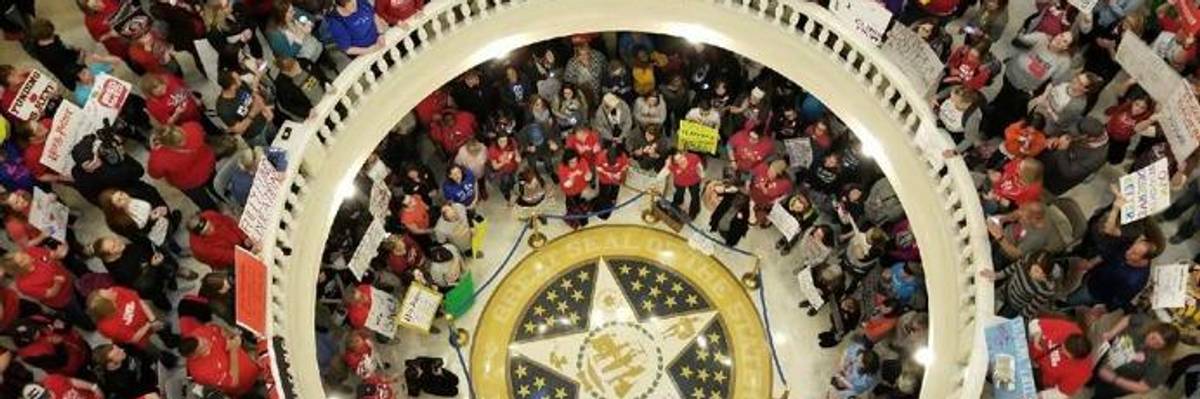
Oklahoma educators rallied at the State Capitol on Tuesday April 3, 2018. (Photo: Stephanie Price/Twitter)
As teachers in the historically red states of Oklahoma, Kentucky, and Arizona are following in the footsteps of educators in West Virginia and turning out in droves to demand higher pay, reliable pensions, and greater government investments in the public school system, some Republican state leaders are sticking to their narrative that teachers are simply asking for too much--a strategy that could backfire during the November midterm elections.
Oklahoma's Republican Gov. Mary Fallin on Tuesday compared the protesting teachers to spoiled children.
"Teachers want more," Fallin told CBS News. "But it's kind of like a teenager wanting a better car."
Her comments followed fiery remarks by Kentucky Republican Gov. Matt Bevin, who last month said that educators who were protesting legislation that would slash their retirement benefits were "ignorant," "remarkably selfish," and "throwing a temper tantrum."
Sen. Bernie Sanders (I-Vt.), meanwhile, pushed back against the notion that these mass mobilizations are taking place in "red" states and thanked the protesting teachers for the "leading the nation in the fight for workers' rights and adequate funding for education."
Even as Republican state leaders dismiss and insult the educators rallying for their and their students' futures, the teachers insist they won't be backing down any time soon--bolstering the argument by advocates such as Jeff Bryant that "this grassroots upsurge is right on time for primary season," and "education could be a key issue for Democrats to use against their Republican opponents in midterm general elections in November."
"We're going to have a lot of teachers at the ballot box who I don't think would normally go in a midterm year," Oklahoma teacher Noah Karvelis told the New York Times. "If I were a legislator right now, I'd be honestly sweating bullets."
"You have to be persistent to sustain," Oklahoma history teacher Jack Reavis told the Guardian as he circled the State Capitol carrying a 10-foot sign that read "Persist like Clara Luper," in reference to a high school teacher who worked for decades to desegregate Oklahoma City.
"Most of these legislators don't think we will last a week," Reavis added, "but I think we will last longer."
In this segment that aired on the "Today" show Wednesday, one Oklahoma teacher described the struggle as one of "life and death" for him and his family:
As the strike in Oklahoma entered its third day on Wednesday, teachers in Arizona are organizing "walk-ins" and planning for aimed at educating their communities on the struggles for adequate pay that they face across the state.
Although Arizona teachers have not yet called for a statewide walk-out, Derek Harris, a band teacher at Dietz K-8 school in the Tucson Unified School District and a lead organizer with Arizona Educators United, told the Arizona Daily Star he believes that it "is an inevitability unless something very drastic happens."
"We know there's more money in the budget that could be given to us than what is being offered," Harris added. "We've said that we don't want to strike, but we will. And the Legislature still hasn't finalized their budget yet. So it's their move."
Dear Common Dreams reader, It’s been nearly 30 years since I co-founded Common Dreams with my late wife, Lina Newhouser. We had the radical notion that journalism should serve the public good, not corporate profits. It was clear to us from the outset what it would take to build such a project. No paid advertisements. No corporate sponsors. No millionaire publisher telling us what to think or do. Many people said we wouldn't last a year, but we proved those doubters wrong. Together with a tremendous team of journalists and dedicated staff, we built an independent media outlet free from the constraints of profits and corporate control. Our mission has always been simple: To inform. To inspire. To ignite change for the common good. Building Common Dreams was not easy. Our survival was never guaranteed. When you take on the most powerful forces—Wall Street greed, fossil fuel industry destruction, Big Tech lobbyists, and uber-rich oligarchs who have spent billions upon billions rigging the economy and democracy in their favor—the only bulwark you have is supporters who believe in your work. But here’s the urgent message from me today. It's never been this bad out there. And it's never been this hard to keep us going. At the very moment Common Dreams is most needed, the threats we face are intensifying. We need your support now more than ever. We don't accept corporate advertising and never will. We don't have a paywall because we don't think people should be blocked from critical news based on their ability to pay. Everything we do is funded by the donations of readers like you. When everyone does the little they can afford, we are strong. But if that support retreats or dries up, so do we. Will you donate now to make sure Common Dreams not only survives but thrives? —Craig Brown, Co-founder |
As teachers in the historically red states of Oklahoma, Kentucky, and Arizona are following in the footsteps of educators in West Virginia and turning out in droves to demand higher pay, reliable pensions, and greater government investments in the public school system, some Republican state leaders are sticking to their narrative that teachers are simply asking for too much--a strategy that could backfire during the November midterm elections.
Oklahoma's Republican Gov. Mary Fallin on Tuesday compared the protesting teachers to spoiled children.
"Teachers want more," Fallin told CBS News. "But it's kind of like a teenager wanting a better car."
Her comments followed fiery remarks by Kentucky Republican Gov. Matt Bevin, who last month said that educators who were protesting legislation that would slash their retirement benefits were "ignorant," "remarkably selfish," and "throwing a temper tantrum."
Sen. Bernie Sanders (I-Vt.), meanwhile, pushed back against the notion that these mass mobilizations are taking place in "red" states and thanked the protesting teachers for the "leading the nation in the fight for workers' rights and adequate funding for education."
Even as Republican state leaders dismiss and insult the educators rallying for their and their students' futures, the teachers insist they won't be backing down any time soon--bolstering the argument by advocates such as Jeff Bryant that "this grassroots upsurge is right on time for primary season," and "education could be a key issue for Democrats to use against their Republican opponents in midterm general elections in November."
"We're going to have a lot of teachers at the ballot box who I don't think would normally go in a midterm year," Oklahoma teacher Noah Karvelis told the New York Times. "If I were a legislator right now, I'd be honestly sweating bullets."
"You have to be persistent to sustain," Oklahoma history teacher Jack Reavis told the Guardian as he circled the State Capitol carrying a 10-foot sign that read "Persist like Clara Luper," in reference to a high school teacher who worked for decades to desegregate Oklahoma City.
"Most of these legislators don't think we will last a week," Reavis added, "but I think we will last longer."
In this segment that aired on the "Today" show Wednesday, one Oklahoma teacher described the struggle as one of "life and death" for him and his family:
As the strike in Oklahoma entered its third day on Wednesday, teachers in Arizona are organizing "walk-ins" and planning for aimed at educating their communities on the struggles for adequate pay that they face across the state.
Although Arizona teachers have not yet called for a statewide walk-out, Derek Harris, a band teacher at Dietz K-8 school in the Tucson Unified School District and a lead organizer with Arizona Educators United, told the Arizona Daily Star he believes that it "is an inevitability unless something very drastic happens."
"We know there's more money in the budget that could be given to us than what is being offered," Harris added. "We've said that we don't want to strike, but we will. And the Legislature still hasn't finalized their budget yet. So it's their move."
As teachers in the historically red states of Oklahoma, Kentucky, and Arizona are following in the footsteps of educators in West Virginia and turning out in droves to demand higher pay, reliable pensions, and greater government investments in the public school system, some Republican state leaders are sticking to their narrative that teachers are simply asking for too much--a strategy that could backfire during the November midterm elections.
Oklahoma's Republican Gov. Mary Fallin on Tuesday compared the protesting teachers to spoiled children.
"Teachers want more," Fallin told CBS News. "But it's kind of like a teenager wanting a better car."
Her comments followed fiery remarks by Kentucky Republican Gov. Matt Bevin, who last month said that educators who were protesting legislation that would slash their retirement benefits were "ignorant," "remarkably selfish," and "throwing a temper tantrum."
Sen. Bernie Sanders (I-Vt.), meanwhile, pushed back against the notion that these mass mobilizations are taking place in "red" states and thanked the protesting teachers for the "leading the nation in the fight for workers' rights and adequate funding for education."
Even as Republican state leaders dismiss and insult the educators rallying for their and their students' futures, the teachers insist they won't be backing down any time soon--bolstering the argument by advocates such as Jeff Bryant that "this grassroots upsurge is right on time for primary season," and "education could be a key issue for Democrats to use against their Republican opponents in midterm general elections in November."
"We're going to have a lot of teachers at the ballot box who I don't think would normally go in a midterm year," Oklahoma teacher Noah Karvelis told the New York Times. "If I were a legislator right now, I'd be honestly sweating bullets."
"You have to be persistent to sustain," Oklahoma history teacher Jack Reavis told the Guardian as he circled the State Capitol carrying a 10-foot sign that read "Persist like Clara Luper," in reference to a high school teacher who worked for decades to desegregate Oklahoma City.
"Most of these legislators don't think we will last a week," Reavis added, "but I think we will last longer."
In this segment that aired on the "Today" show Wednesday, one Oklahoma teacher described the struggle as one of "life and death" for him and his family:
As the strike in Oklahoma entered its third day on Wednesday, teachers in Arizona are organizing "walk-ins" and planning for aimed at educating their communities on the struggles for adequate pay that they face across the state.
Although Arizona teachers have not yet called for a statewide walk-out, Derek Harris, a band teacher at Dietz K-8 school in the Tucson Unified School District and a lead organizer with Arizona Educators United, told the Arizona Daily Star he believes that it "is an inevitability unless something very drastic happens."
"We know there's more money in the budget that could be given to us than what is being offered," Harris added. "We've said that we don't want to strike, but we will. And the Legislature still hasn't finalized their budget yet. So it's their move."