SUBSCRIBE TO OUR FREE NEWSLETTER
Daily news & progressive opinion—funded by the people, not the corporations—delivered straight to your inbox.
5
#000000
#FFFFFF
To donate by check, phone, or other method, see our More Ways to Give page.
Daily news & progressive opinion—funded by the people, not the corporations—delivered straight to your inbox.
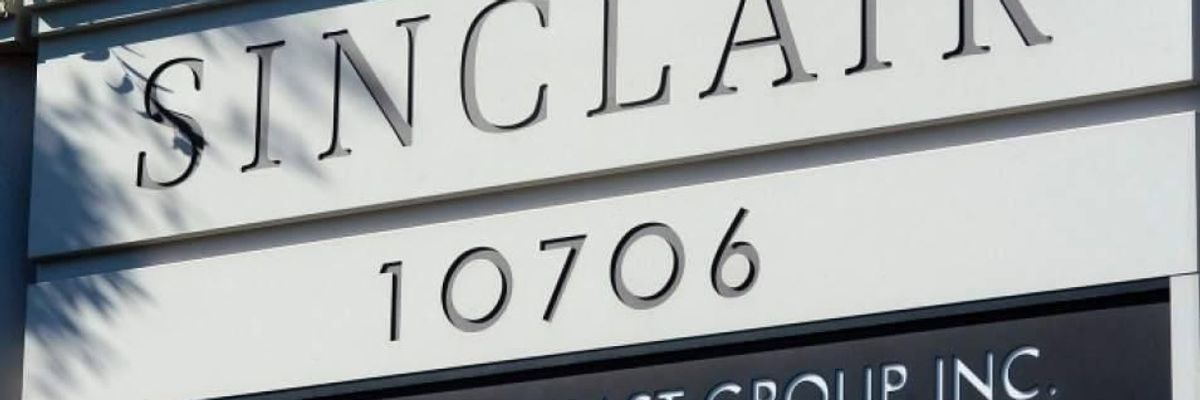
A sign for the Sinclair Broadcast Group building is seen in a business district in Hunt Valley, Maryland. Sinclair Broadcast Group, the owner of the largest chain of television stations in the nation, hopes to buy Tribune Media's 42 stations for $3.9 billion. (Photo: William Thomas Cain/Getty Images)
Some local broadcast news staff at stations owned by Sinclair Broadcast Group are speaking out against the company and President Donald Trump after he defended the right-wing broadcaster, which has come under fire following a viral video that showed how anchors across the country were forced to deliver a scripted statement condemning "fake" news stories "in a distinctly Trumpian fashion."
After the Deadspin video made national headlines and spread virally on social media over the weekend, Trump praised Sinclair on Twitter:
Mary Nam, an anchor who works for the Sinclair-owned KOMO in Seattle, challenged the president's defense of the company and noted its pending merger with Tribune Media that requires regulatory approval from the Republican-controlled FCC--which is headed by a Trump appointee with ties to Sinclair:
While Sinclair's senior vice president of news, Scott Livingston, has responded to the criticism by framing the scripted message as a promotion of "our journalistic initiative for fair and objective reporting," other employees and stations have sought to distance themselves from the company, which has been repeatedly ridiculed for, in the words of John Oliver, "injecting Fox-worthy content into the mouths of your local news anchors--the two people who you know, and who you trust."
Bob Herzog, an anchor at Sinclair's Cincinnati, Ohio station WKRC, responded in a series of tweets that acknowledged viewers' concerns: "I understand there are concerns about the promo as evidenced by social media reaction. I suggest you contact the station as mentioned in the spot itself. I will simply share this."
A Sinclair-owned station in Madison, Wisconsin, meanwhile, spoke out against the mandated message on Twitter Monday evening, pointing out that local station leaders had opted not to run it:
Despite reassurances from some local anchors and stations that they aim to provide accurate news to their communities, in the age of Trump, critiques of Sinclair's right-wing bias have intensified--particularly after reports that during the presidential campaign, the company cut a deal with Trump's son-in-law and senior adviser Jared Kushner--and former employees continue to speak out about what it's like to work for Sinclair.
Kirk Clyatt, a former anchor at a Sinclair-owned station Baltimore, Maryland, told MSNBC on Monday that local affiliates have been required to replace regionally focused stories with "these forced, must-run, lockstep with the Trump administration commentaries."
"Over the course of my 14-year career in broadcasting, I worked for multiple corporate owners, large and small... Only Sinclair forces those trusted local journalists to lend their credibility to shoddy reporting and commentary that, if it ran in other countries, we would rightly dismiss as state propaganda."
--Aaron Weiss, former Sinclair news director
"You have these extreme commentaries coming from this station," Cylatt said, in "a very cookie-cutter way that is certainly not good for America."
In the midst of this latest controversy, former Sinclair news director Aaron Weiss reflected on his short time with the company and "must-run" stories that he says "barely passed as journalism."
"In 2013, I was a young news director at a struggling small station in the Midwest, having worked my way up the ranks as a producer in larger markets," Weiss wrote for The Huffington Post on Monday. "Sinclair executives made it clear that the must-run scripts were not to be touched by producers or anchors. I didn't last long after that."
"Over the course of my 14-year career in broadcasting, I worked for multiple corporate owners, large and small," added Weiss, who quit his job after his station was bought by Sinclair. "I have good friends who are anchors, reporters and executives at other station groups across the country. Only Sinclair forces those trusted local journalists to lend their credibility to shoddy reporting and commentary that, if it ran in other countries, we would rightly dismiss as state propaganda."
Dear Common Dreams reader, It’s been nearly 30 years since I co-founded Common Dreams with my late wife, Lina Newhouser. We had the radical notion that journalism should serve the public good, not corporate profits. It was clear to us from the outset what it would take to build such a project. No paid advertisements. No corporate sponsors. No millionaire publisher telling us what to think or do. Many people said we wouldn't last a year, but we proved those doubters wrong. Together with a tremendous team of journalists and dedicated staff, we built an independent media outlet free from the constraints of profits and corporate control. Our mission has always been simple: To inform. To inspire. To ignite change for the common good. Building Common Dreams was not easy. Our survival was never guaranteed. When you take on the most powerful forces—Wall Street greed, fossil fuel industry destruction, Big Tech lobbyists, and uber-rich oligarchs who have spent billions upon billions rigging the economy and democracy in their favor—the only bulwark you have is supporters who believe in your work. But here’s the urgent message from me today. It's never been this bad out there. And it's never been this hard to keep us going. At the very moment Common Dreams is most needed, the threats we face are intensifying. We need your support now more than ever. We don't accept corporate advertising and never will. We don't have a paywall because we don't think people should be blocked from critical news based on their ability to pay. Everything we do is funded by the donations of readers like you. When everyone does the little they can afford, we are strong. But if that support retreats or dries up, so do we. Will you donate now to make sure Common Dreams not only survives but thrives? —Craig Brown, Co-founder |
Some local broadcast news staff at stations owned by Sinclair Broadcast Group are speaking out against the company and President Donald Trump after he defended the right-wing broadcaster, which has come under fire following a viral video that showed how anchors across the country were forced to deliver a scripted statement condemning "fake" news stories "in a distinctly Trumpian fashion."
After the Deadspin video made national headlines and spread virally on social media over the weekend, Trump praised Sinclair on Twitter:
Mary Nam, an anchor who works for the Sinclair-owned KOMO in Seattle, challenged the president's defense of the company and noted its pending merger with Tribune Media that requires regulatory approval from the Republican-controlled FCC--which is headed by a Trump appointee with ties to Sinclair:
While Sinclair's senior vice president of news, Scott Livingston, has responded to the criticism by framing the scripted message as a promotion of "our journalistic initiative for fair and objective reporting," other employees and stations have sought to distance themselves from the company, which has been repeatedly ridiculed for, in the words of John Oliver, "injecting Fox-worthy content into the mouths of your local news anchors--the two people who you know, and who you trust."
Bob Herzog, an anchor at Sinclair's Cincinnati, Ohio station WKRC, responded in a series of tweets that acknowledged viewers' concerns: "I understand there are concerns about the promo as evidenced by social media reaction. I suggest you contact the station as mentioned in the spot itself. I will simply share this."
A Sinclair-owned station in Madison, Wisconsin, meanwhile, spoke out against the mandated message on Twitter Monday evening, pointing out that local station leaders had opted not to run it:
Despite reassurances from some local anchors and stations that they aim to provide accurate news to their communities, in the age of Trump, critiques of Sinclair's right-wing bias have intensified--particularly after reports that during the presidential campaign, the company cut a deal with Trump's son-in-law and senior adviser Jared Kushner--and former employees continue to speak out about what it's like to work for Sinclair.
Kirk Clyatt, a former anchor at a Sinclair-owned station Baltimore, Maryland, told MSNBC on Monday that local affiliates have been required to replace regionally focused stories with "these forced, must-run, lockstep with the Trump administration commentaries."
"Over the course of my 14-year career in broadcasting, I worked for multiple corporate owners, large and small... Only Sinclair forces those trusted local journalists to lend their credibility to shoddy reporting and commentary that, if it ran in other countries, we would rightly dismiss as state propaganda."
--Aaron Weiss, former Sinclair news director
"You have these extreme commentaries coming from this station," Cylatt said, in "a very cookie-cutter way that is certainly not good for America."
In the midst of this latest controversy, former Sinclair news director Aaron Weiss reflected on his short time with the company and "must-run" stories that he says "barely passed as journalism."
"In 2013, I was a young news director at a struggling small station in the Midwest, having worked my way up the ranks as a producer in larger markets," Weiss wrote for The Huffington Post on Monday. "Sinclair executives made it clear that the must-run scripts were not to be touched by producers or anchors. I didn't last long after that."
"Over the course of my 14-year career in broadcasting, I worked for multiple corporate owners, large and small," added Weiss, who quit his job after his station was bought by Sinclair. "I have good friends who are anchors, reporters and executives at other station groups across the country. Only Sinclair forces those trusted local journalists to lend their credibility to shoddy reporting and commentary that, if it ran in other countries, we would rightly dismiss as state propaganda."
Some local broadcast news staff at stations owned by Sinclair Broadcast Group are speaking out against the company and President Donald Trump after he defended the right-wing broadcaster, which has come under fire following a viral video that showed how anchors across the country were forced to deliver a scripted statement condemning "fake" news stories "in a distinctly Trumpian fashion."
After the Deadspin video made national headlines and spread virally on social media over the weekend, Trump praised Sinclair on Twitter:
Mary Nam, an anchor who works for the Sinclair-owned KOMO in Seattle, challenged the president's defense of the company and noted its pending merger with Tribune Media that requires regulatory approval from the Republican-controlled FCC--which is headed by a Trump appointee with ties to Sinclair:
While Sinclair's senior vice president of news, Scott Livingston, has responded to the criticism by framing the scripted message as a promotion of "our journalistic initiative for fair and objective reporting," other employees and stations have sought to distance themselves from the company, which has been repeatedly ridiculed for, in the words of John Oliver, "injecting Fox-worthy content into the mouths of your local news anchors--the two people who you know, and who you trust."
Bob Herzog, an anchor at Sinclair's Cincinnati, Ohio station WKRC, responded in a series of tweets that acknowledged viewers' concerns: "I understand there are concerns about the promo as evidenced by social media reaction. I suggest you contact the station as mentioned in the spot itself. I will simply share this."
A Sinclair-owned station in Madison, Wisconsin, meanwhile, spoke out against the mandated message on Twitter Monday evening, pointing out that local station leaders had opted not to run it:
Despite reassurances from some local anchors and stations that they aim to provide accurate news to their communities, in the age of Trump, critiques of Sinclair's right-wing bias have intensified--particularly after reports that during the presidential campaign, the company cut a deal with Trump's son-in-law and senior adviser Jared Kushner--and former employees continue to speak out about what it's like to work for Sinclair.
Kirk Clyatt, a former anchor at a Sinclair-owned station Baltimore, Maryland, told MSNBC on Monday that local affiliates have been required to replace regionally focused stories with "these forced, must-run, lockstep with the Trump administration commentaries."
"Over the course of my 14-year career in broadcasting, I worked for multiple corporate owners, large and small... Only Sinclair forces those trusted local journalists to lend their credibility to shoddy reporting and commentary that, if it ran in other countries, we would rightly dismiss as state propaganda."
--Aaron Weiss, former Sinclair news director
"You have these extreme commentaries coming from this station," Cylatt said, in "a very cookie-cutter way that is certainly not good for America."
In the midst of this latest controversy, former Sinclair news director Aaron Weiss reflected on his short time with the company and "must-run" stories that he says "barely passed as journalism."
"In 2013, I was a young news director at a struggling small station in the Midwest, having worked my way up the ranks as a producer in larger markets," Weiss wrote for The Huffington Post on Monday. "Sinclair executives made it clear that the must-run scripts were not to be touched by producers or anchors. I didn't last long after that."
"Over the course of my 14-year career in broadcasting, I worked for multiple corporate owners, large and small," added Weiss, who quit his job after his station was bought by Sinclair. "I have good friends who are anchors, reporters and executives at other station groups across the country. Only Sinclair forces those trusted local journalists to lend their credibility to shoddy reporting and commentary that, if it ran in other countries, we would rightly dismiss as state propaganda."