SUBSCRIBE TO OUR FREE NEWSLETTER
Daily news & progressive opinion—funded by the people, not the corporations—delivered straight to your inbox.
5
#000000
#FFFFFF
To donate by check, phone, or other method, see our More Ways to Give page.
Daily news & progressive opinion—funded by the people, not the corporations—delivered straight to your inbox.
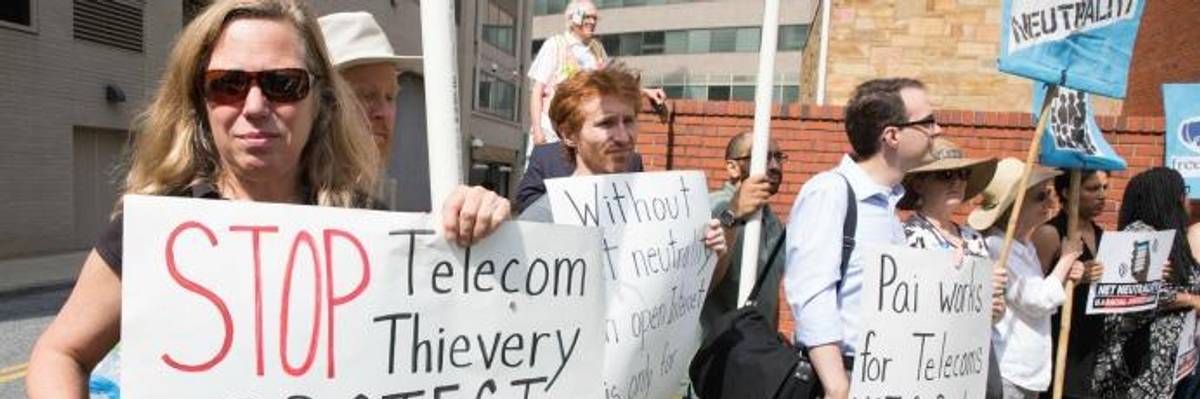
"Internet users and businesses cannot afford to be left unprotected while Congress decides what they're going to do about the FCC's deeply unpopular repeal," Evan Greer of Fight for the Future said in a statement. (Photo: Free Press/Flickr)
With the deadline for Congress to repeal the Republican-controlled FCC's attack on net neutrality rapidly approaching, California lawmakers on Wednesday introduced what is being applauded as the "strongest and most comprehensive" state-level net neutrality bill in the nation.
"People are looking for net neutrality protections wherever they can find them, at city hall, their statehouses, and in Congress."
--Matt Wood, Free Press
If passed, the legislation would in some ways go even further than the 2015 net neutrality protections that the FCC voted to repeal last December.
In addition to prohibiting internet service providers (ISPs) from throttling and blocking web content, the California bill (SB-822)--spearheaded by Democratic state Sen. Scott Wiener--would also "in many cases ban broadband providers from exempting certain content from data limits, a concept known as 'zero rating,'" noted Klint Finley of Wired in a summary of the measure on Wednesday.
While acknowledging that the ultimate goal remains protecting net neutrality at the federal level, the advocacy group Free Press celebrated California's aggressive effort to defend the open internet from the FCC's attack as "a strong message to holdouts in Washington, where too many politicians and bureaucrats are ignoring the widespread public support for net neutrality."
"People are looking for net neutrality protections wherever they can find them, at city hall, their statehouses, and in Congress," Matt Wood, policy director at the Free Press Action Fund, said in a statement on Thursday. "These diverse measures in cities and states across the country pose a direct challenge to failed policies and flawed legal arguments underpinning the Trump FCC's harmful and wrong-headed decision to gut Net Neutrality protections."
"Internet users and businesses cannot afford to be left unprotected while Congress decides what they're going to do about the FCC's deeply unpopular repeal."
--Evan Greer, Fight for the Future
In taking steps toward safeguarding net neutrality from the FCC's repeal--which was officially published in the Federal Register last month--California joins more than 30 states that have introduced or are considering either legislation or executive actions to shield the open internet from corporate manipulation.
As Common Dreams reported earlier this week, a growing number municipalities--by signing the Cities Open Internet Pledge (pdf)--have also vowed to refuse to do business with ISPs that don't support net neutrality.
At the national level, the Sen. Ed Markey (D-Mass.) needs just one more Republican vote for his Congressional Review Act (CRA) resolution to clear the Senate. If passed, the measure will move to the House, where it will need 218 votes to reach President Donald Trump's desk. The deadline for Congress to pass the CRA--which would restore net neutrality protections--is April 23.
"Internet users and businesses cannot afford to be left unprotected while Congress decides what they're going to do about the FCC's deeply unpopular repeal," Evan Greer, deputy director of Fight for the Future, said in a statement on Wednesday. "Thankfully states like California are stepping up, but Congress needs to follow suit and support the CRA to restore protections for all."
Dear Common Dreams reader, It’s been nearly 30 years since I co-founded Common Dreams with my late wife, Lina Newhouser. We had the radical notion that journalism should serve the public good, not corporate profits. It was clear to us from the outset what it would take to build such a project. No paid advertisements. No corporate sponsors. No millionaire publisher telling us what to think or do. Many people said we wouldn't last a year, but we proved those doubters wrong. Together with a tremendous team of journalists and dedicated staff, we built an independent media outlet free from the constraints of profits and corporate control. Our mission has always been simple: To inform. To inspire. To ignite change for the common good. Building Common Dreams was not easy. Our survival was never guaranteed. When you take on the most powerful forces—Wall Street greed, fossil fuel industry destruction, Big Tech lobbyists, and uber-rich oligarchs who have spent billions upon billions rigging the economy and democracy in their favor—the only bulwark you have is supporters who believe in your work. But here’s the urgent message from me today. It's never been this bad out there. And it's never been this hard to keep us going. At the very moment Common Dreams is most needed, the threats we face are intensifying. We need your support now more than ever. We don't accept corporate advertising and never will. We don't have a paywall because we don't think people should be blocked from critical news based on their ability to pay. Everything we do is funded by the donations of readers like you. When everyone does the little they can afford, we are strong. But if that support retreats or dries up, so do we. Will you donate now to make sure Common Dreams not only survives but thrives? —Craig Brown, Co-founder |
With the deadline for Congress to repeal the Republican-controlled FCC's attack on net neutrality rapidly approaching, California lawmakers on Wednesday introduced what is being applauded as the "strongest and most comprehensive" state-level net neutrality bill in the nation.
"People are looking for net neutrality protections wherever they can find them, at city hall, their statehouses, and in Congress."
--Matt Wood, Free Press
If passed, the legislation would in some ways go even further than the 2015 net neutrality protections that the FCC voted to repeal last December.
In addition to prohibiting internet service providers (ISPs) from throttling and blocking web content, the California bill (SB-822)--spearheaded by Democratic state Sen. Scott Wiener--would also "in many cases ban broadband providers from exempting certain content from data limits, a concept known as 'zero rating,'" noted Klint Finley of Wired in a summary of the measure on Wednesday.
While acknowledging that the ultimate goal remains protecting net neutrality at the federal level, the advocacy group Free Press celebrated California's aggressive effort to defend the open internet from the FCC's attack as "a strong message to holdouts in Washington, where too many politicians and bureaucrats are ignoring the widespread public support for net neutrality."
"People are looking for net neutrality protections wherever they can find them, at city hall, their statehouses, and in Congress," Matt Wood, policy director at the Free Press Action Fund, said in a statement on Thursday. "These diverse measures in cities and states across the country pose a direct challenge to failed policies and flawed legal arguments underpinning the Trump FCC's harmful and wrong-headed decision to gut Net Neutrality protections."
"Internet users and businesses cannot afford to be left unprotected while Congress decides what they're going to do about the FCC's deeply unpopular repeal."
--Evan Greer, Fight for the Future
In taking steps toward safeguarding net neutrality from the FCC's repeal--which was officially published in the Federal Register last month--California joins more than 30 states that have introduced or are considering either legislation or executive actions to shield the open internet from corporate manipulation.
As Common Dreams reported earlier this week, a growing number municipalities--by signing the Cities Open Internet Pledge (pdf)--have also vowed to refuse to do business with ISPs that don't support net neutrality.
At the national level, the Sen. Ed Markey (D-Mass.) needs just one more Republican vote for his Congressional Review Act (CRA) resolution to clear the Senate. If passed, the measure will move to the House, where it will need 218 votes to reach President Donald Trump's desk. The deadline for Congress to pass the CRA--which would restore net neutrality protections--is April 23.
"Internet users and businesses cannot afford to be left unprotected while Congress decides what they're going to do about the FCC's deeply unpopular repeal," Evan Greer, deputy director of Fight for the Future, said in a statement on Wednesday. "Thankfully states like California are stepping up, but Congress needs to follow suit and support the CRA to restore protections for all."
With the deadline for Congress to repeal the Republican-controlled FCC's attack on net neutrality rapidly approaching, California lawmakers on Wednesday introduced what is being applauded as the "strongest and most comprehensive" state-level net neutrality bill in the nation.
"People are looking for net neutrality protections wherever they can find them, at city hall, their statehouses, and in Congress."
--Matt Wood, Free Press
If passed, the legislation would in some ways go even further than the 2015 net neutrality protections that the FCC voted to repeal last December.
In addition to prohibiting internet service providers (ISPs) from throttling and blocking web content, the California bill (SB-822)--spearheaded by Democratic state Sen. Scott Wiener--would also "in many cases ban broadband providers from exempting certain content from data limits, a concept known as 'zero rating,'" noted Klint Finley of Wired in a summary of the measure on Wednesday.
While acknowledging that the ultimate goal remains protecting net neutrality at the federal level, the advocacy group Free Press celebrated California's aggressive effort to defend the open internet from the FCC's attack as "a strong message to holdouts in Washington, where too many politicians and bureaucrats are ignoring the widespread public support for net neutrality."
"People are looking for net neutrality protections wherever they can find them, at city hall, their statehouses, and in Congress," Matt Wood, policy director at the Free Press Action Fund, said in a statement on Thursday. "These diverse measures in cities and states across the country pose a direct challenge to failed policies and flawed legal arguments underpinning the Trump FCC's harmful and wrong-headed decision to gut Net Neutrality protections."
"Internet users and businesses cannot afford to be left unprotected while Congress decides what they're going to do about the FCC's deeply unpopular repeal."
--Evan Greer, Fight for the Future
In taking steps toward safeguarding net neutrality from the FCC's repeal--which was officially published in the Federal Register last month--California joins more than 30 states that have introduced or are considering either legislation or executive actions to shield the open internet from corporate manipulation.
As Common Dreams reported earlier this week, a growing number municipalities--by signing the Cities Open Internet Pledge (pdf)--have also vowed to refuse to do business with ISPs that don't support net neutrality.
At the national level, the Sen. Ed Markey (D-Mass.) needs just one more Republican vote for his Congressional Review Act (CRA) resolution to clear the Senate. If passed, the measure will move to the House, where it will need 218 votes to reach President Donald Trump's desk. The deadline for Congress to pass the CRA--which would restore net neutrality protections--is April 23.
"Internet users and businesses cannot afford to be left unprotected while Congress decides what they're going to do about the FCC's deeply unpopular repeal," Evan Greer, deputy director of Fight for the Future, said in a statement on Wednesday. "Thankfully states like California are stepping up, but Congress needs to follow suit and support the CRA to restore protections for all."