

SUBSCRIBE TO OUR FREE NEWSLETTER
Daily news & progressive opinion—funded by the people, not the corporations—delivered straight to your inbox.
5
#000000
#FFFFFF
To donate by check, phone, or other method, see our More Ways to Give page.
Daily news & progressive opinion—funded by the people, not the corporations—delivered straight to your inbox.
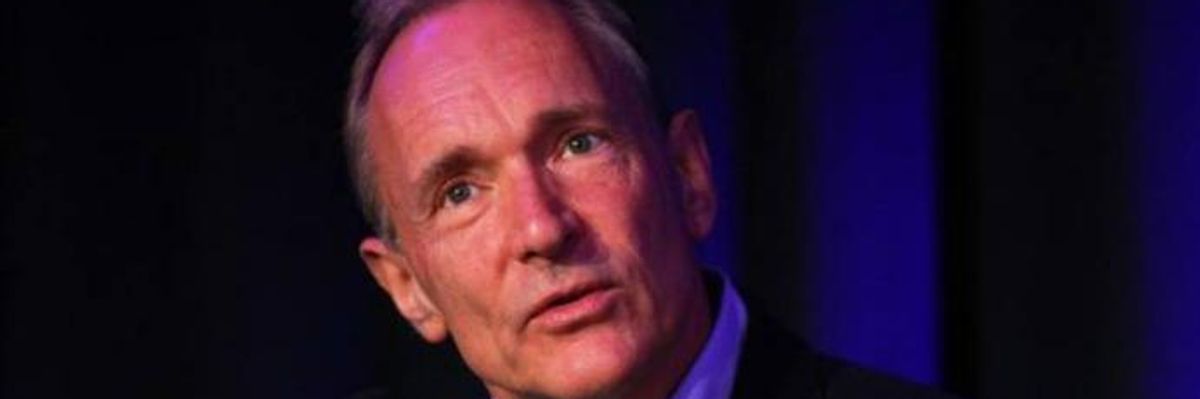
Tim Berners-Lee, founder of the World Wide Web, believes "today's powerful digital economy calls for strong standards that balance the interests of both companies and online citizens." (Photo: Belinda Lawley/Southbank Centre/Flickr/cc)
On the 29th anniversary of the founding of the World Wide Web, British computer scientist Tim Berners-Lee--the inventor of the internet as we know it and a long-time advocate of digital rights--penned an open letter to call for stricter regulations of the major tech corporations that aim to control the web.
"This concentration of power creates a new set of gatekeepers, allowing a handful of platforms to control which ideas and opinions are seen and shared."
--Tim Berners-Lee, internet founder
"What was once a rich selection of blogs and websites has been compressed under the powerful weight of a few dominant platforms," laments Berners-Lee, writing for the Guardian. "This concentration of power creates a new set of gatekeepers, allowing a handful of platforms to control which ideas and opinions are seen and shared."
"The fact that power is concentrated among so few companies has made it possible to weaponize the web at scale," he warns, pointing to how we have recently "seen conspiracy theories trend on social media platforms, fake Twitter and Facebook accounts stoke social tensions, external actors interfere in elections, and criminals steal troves of personal data."
Although internet users across the globe have "looked to the platforms themselves for answers," Berners-Lee reasons that a "legal or regulatory framework that accounts for social objectives may help ease those tensions."
His call for stricter rules to preserve the open internet follow the United States' rollback of federal net neutrality protections late last year--which Berners-Lee strongly opposed, calling Federal Communications Commission chair Ajit Pai's master plan to gut nationwide safeguards that prevented internet service providers from putting a premium on certain content "one of the greatest threats to the web in America."
Today, Berners-Lee runs the World Wide Web Foundation, which works to "advance the open web as a public good and a basic right." In his piece for the Guardian, in addition to demanding more regulations, he also emphasizes the needs for closing the digital divide and facilitating more inclusive conversations about the internet's future.
"Today's powerful digital economy calls for strong standards that balance the interests of both companies and online citizens."
--Berners-Lee
He notes that the United Nations declared internet access a basic human right in 2016, and while this year we're reaching the point where more than half of the global population is online, people who are female, poor, or living in rural regions--or some combination of those characteristics--are still much less likely to have internet access.
Berners-Lee also declares that "today's powerful digital economy calls for strong standards that balance the interests of both companies and online citizens," and emphasizes the importance of "consulting a diverse cross section of society in the process" of rethinking how the web works now.
Challenging "the myth that advertising is the only possible business model for online companies, and the myth that it's too late to change the way platforms operate," he concludes, "on both points, we need to be a little more creative."
Dear Common Dreams reader, It’s been nearly 30 years since I co-founded Common Dreams with my late wife, Lina Newhouser. We had the radical notion that journalism should serve the public good, not corporate profits. It was clear to us from the outset what it would take to build such a project. No paid advertisements. No corporate sponsors. No millionaire publisher telling us what to think or do. Many people said we wouldn't last a year, but we proved those doubters wrong. Together with a tremendous team of journalists and dedicated staff, we built an independent media outlet free from the constraints of profits and corporate control. Our mission has always been simple: To inform. To inspire. To ignite change for the common good. Building Common Dreams was not easy. Our survival was never guaranteed. When you take on the most powerful forces—Wall Street greed, fossil fuel industry destruction, Big Tech lobbyists, and uber-rich oligarchs who have spent billions upon billions rigging the economy and democracy in their favor—the only bulwark you have is supporters who believe in your work. But here’s the urgent message from me today. It's never been this bad out there. And it's never been this hard to keep us going. At the very moment Common Dreams is most needed, the threats we face are intensifying. We need your support now more than ever. We don't accept corporate advertising and never will. We don't have a paywall because we don't think people should be blocked from critical news based on their ability to pay. Everything we do is funded by the donations of readers like you. When everyone does the little they can afford, we are strong. But if that support retreats or dries up, so do we. Will you donate now to make sure Common Dreams not only survives but thrives? —Craig Brown, Co-founder |
On the 29th anniversary of the founding of the World Wide Web, British computer scientist Tim Berners-Lee--the inventor of the internet as we know it and a long-time advocate of digital rights--penned an open letter to call for stricter regulations of the major tech corporations that aim to control the web.
"This concentration of power creates a new set of gatekeepers, allowing a handful of platforms to control which ideas and opinions are seen and shared."
--Tim Berners-Lee, internet founder
"What was once a rich selection of blogs and websites has been compressed under the powerful weight of a few dominant platforms," laments Berners-Lee, writing for the Guardian. "This concentration of power creates a new set of gatekeepers, allowing a handful of platforms to control which ideas and opinions are seen and shared."
"The fact that power is concentrated among so few companies has made it possible to weaponize the web at scale," he warns, pointing to how we have recently "seen conspiracy theories trend on social media platforms, fake Twitter and Facebook accounts stoke social tensions, external actors interfere in elections, and criminals steal troves of personal data."
Although internet users across the globe have "looked to the platforms themselves for answers," Berners-Lee reasons that a "legal or regulatory framework that accounts for social objectives may help ease those tensions."
His call for stricter rules to preserve the open internet follow the United States' rollback of federal net neutrality protections late last year--which Berners-Lee strongly opposed, calling Federal Communications Commission chair Ajit Pai's master plan to gut nationwide safeguards that prevented internet service providers from putting a premium on certain content "one of the greatest threats to the web in America."
Today, Berners-Lee runs the World Wide Web Foundation, which works to "advance the open web as a public good and a basic right." In his piece for the Guardian, in addition to demanding more regulations, he also emphasizes the needs for closing the digital divide and facilitating more inclusive conversations about the internet's future.
"Today's powerful digital economy calls for strong standards that balance the interests of both companies and online citizens."
--Berners-Lee
He notes that the United Nations declared internet access a basic human right in 2016, and while this year we're reaching the point where more than half of the global population is online, people who are female, poor, or living in rural regions--or some combination of those characteristics--are still much less likely to have internet access.
Berners-Lee also declares that "today's powerful digital economy calls for strong standards that balance the interests of both companies and online citizens," and emphasizes the importance of "consulting a diverse cross section of society in the process" of rethinking how the web works now.
Challenging "the myth that advertising is the only possible business model for online companies, and the myth that it's too late to change the way platforms operate," he concludes, "on both points, we need to be a little more creative."
On the 29th anniversary of the founding of the World Wide Web, British computer scientist Tim Berners-Lee--the inventor of the internet as we know it and a long-time advocate of digital rights--penned an open letter to call for stricter regulations of the major tech corporations that aim to control the web.
"This concentration of power creates a new set of gatekeepers, allowing a handful of platforms to control which ideas and opinions are seen and shared."
--Tim Berners-Lee, internet founder
"What was once a rich selection of blogs and websites has been compressed under the powerful weight of a few dominant platforms," laments Berners-Lee, writing for the Guardian. "This concentration of power creates a new set of gatekeepers, allowing a handful of platforms to control which ideas and opinions are seen and shared."
"The fact that power is concentrated among so few companies has made it possible to weaponize the web at scale," he warns, pointing to how we have recently "seen conspiracy theories trend on social media platforms, fake Twitter and Facebook accounts stoke social tensions, external actors interfere in elections, and criminals steal troves of personal data."
Although internet users across the globe have "looked to the platforms themselves for answers," Berners-Lee reasons that a "legal or regulatory framework that accounts for social objectives may help ease those tensions."
His call for stricter rules to preserve the open internet follow the United States' rollback of federal net neutrality protections late last year--which Berners-Lee strongly opposed, calling Federal Communications Commission chair Ajit Pai's master plan to gut nationwide safeguards that prevented internet service providers from putting a premium on certain content "one of the greatest threats to the web in America."
Today, Berners-Lee runs the World Wide Web Foundation, which works to "advance the open web as a public good and a basic right." In his piece for the Guardian, in addition to demanding more regulations, he also emphasizes the needs for closing the digital divide and facilitating more inclusive conversations about the internet's future.
"Today's powerful digital economy calls for strong standards that balance the interests of both companies and online citizens."
--Berners-Lee
He notes that the United Nations declared internet access a basic human right in 2016, and while this year we're reaching the point where more than half of the global population is online, people who are female, poor, or living in rural regions--or some combination of those characteristics--are still much less likely to have internet access.
Berners-Lee also declares that "today's powerful digital economy calls for strong standards that balance the interests of both companies and online citizens," and emphasizes the importance of "consulting a diverse cross section of society in the process" of rethinking how the web works now.
Challenging "the myth that advertising is the only possible business model for online companies, and the myth that it's too late to change the way platforms operate," he concludes, "on both points, we need to be a little more creative."

