SUBSCRIBE TO OUR FREE NEWSLETTER
Daily news & progressive opinion—funded by the people, not the corporations—delivered straight to your inbox.
5
#000000
#FFFFFF
To donate by check, phone, or other method, see our More Ways to Give page.
Daily news & progressive opinion—funded by the people, not the corporations—delivered straight to your inbox.
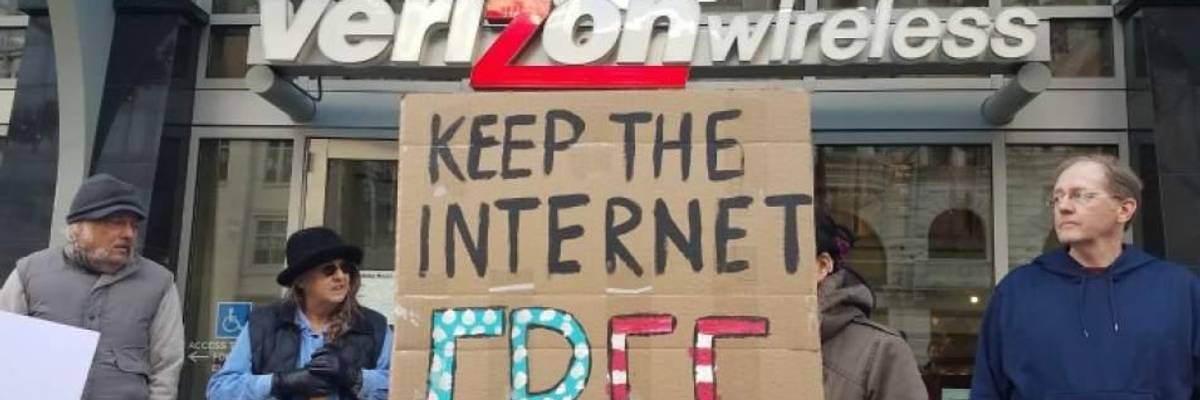
Protesters demonstrated outside Verizon stores across the country on Thursday, Dec. 7, 2017 to denounce the plan by Federal Communications Commission Chairman Ajit Pai to turn over control of the internet to major service providers. (Photo: shauna gm/Twitter)
While earlier this week Washington became the first state to enact a law to protect net neutrality from the Trump administration's attack, and at least 25 other states are considering similar moves, Republicans in Congress have introduced a bill that masquerades as a federal fix, but that free press and consumer advocates warn simply borrows "the language of net neutrality to allow a few unregulated monopolies to stifle competition and control the future of communications."
"Lawmakers should reject Kennedy's bill, pass the resolution of disapproval, and restore the vital bipartisan principles enshrined in the law by Title II."
--Craig Aaron, Free Press
Since the GOP-controlled FCC voted along party lines in December to repeal Title II regulations that classified the internet as a public utility and aimed to stop internet service providers (ISPs) from throttling traffic or blocking access to certain content, elected officials and advocacy groups have taken action at various levels to fight or reverse the rule changes.
Unfortunately for those working to restore net neutrality rules on a national scale, Sen. John Kennedy (R-La.) introduced on Wednesday what critics are calling "fake net neutrality legislation," a critique also levied against companion legislation in the House by Rep. Marsha Blackburn (R-Tenn.), who introduced the so-called "Open Internet Preservation Act" shortly after the FCC vote last December.
As Demand Progress communications director Mark Stanley put it, "This legislation would be disastrous for net neutrality, opening the door for large internet providers to create fast and slow lanes online, which would destroy innovation and stifle free expression."
Kennedy claimed Wednesday that "some cable companies and content providers aren't going to be happy with this bill because it prohibits them from blocking and throttling web content," but as Jon Brodkin at Ars Technica explained: "In reality, Comcast and other ISPs have generally said they won't block or throttle lawful Internet traffic. Allowing paid fast lanes would be a major concession to the broadband industry."
Fight for the Future, a coalition dedicated to restoring net neutrality protections, outlined the impacts of Kennedy's measure in a series of tweets:
If Congress adopted the Kennedy-Blackburn bill, critics warn it would preempt all the ongoing efforts to keep ISPs in check and restore Title II protections.
While advocates for net neutrality maintain that that passing a Congressional Review Act (CRA) resolution--an effort being led by Sen. Ed Markey (D-Mass.)--is the best to way battle the FCC decision, Kennedy's new bill could provide an easy out to lawmakers under pressure from constituents to take action on net neutrality.
"This cynical attempt to offer fake protections to internet users is an insult to the millions of people who have called on Congress to pass a Congressional Review Act resolution of disapproval," declared Craig Aaron, president and CEO of the Free Press. "It's a betrayal of Kennedy's own constituents, who have shown up week after week outside his offices urging him to do the right thing and back the CRA."
Stanley noted that "Senator Kennedy has indicated a willingness to support the CRA resolution from Senator Markey, which would restore the net neutrality protections gutted by the FCC," and urged Kennedy "to abandon this bill and support the CRA resolution."
"Public support for real net neutrality is greater than it has ever been--and internet users won't be fooled by half-measures or industry attempts to confuse the issue. They can see through this sham," Aaron added. "Lawmakers should reject Kennedy's bill, pass the resolution of disapproval, and restore the vital bipartisan principles enshrined in the law by Title II."
Dear Common Dreams reader, It’s been nearly 30 years since I co-founded Common Dreams with my late wife, Lina Newhouser. We had the radical notion that journalism should serve the public good, not corporate profits. It was clear to us from the outset what it would take to build such a project. No paid advertisements. No corporate sponsors. No millionaire publisher telling us what to think or do. Many people said we wouldn't last a year, but we proved those doubters wrong. Together with a tremendous team of journalists and dedicated staff, we built an independent media outlet free from the constraints of profits and corporate control. Our mission has always been simple: To inform. To inspire. To ignite change for the common good. Building Common Dreams was not easy. Our survival was never guaranteed. When you take on the most powerful forces—Wall Street greed, fossil fuel industry destruction, Big Tech lobbyists, and uber-rich oligarchs who have spent billions upon billions rigging the economy and democracy in their favor—the only bulwark you have is supporters who believe in your work. But here’s the urgent message from me today. It's never been this bad out there. And it's never been this hard to keep us going. At the very moment Common Dreams is most needed, the threats we face are intensifying. We need your support now more than ever. We don't accept corporate advertising and never will. We don't have a paywall because we don't think people should be blocked from critical news based on their ability to pay. Everything we do is funded by the donations of readers like you. When everyone does the little they can afford, we are strong. But if that support retreats or dries up, so do we. Will you donate now to make sure Common Dreams not only survives but thrives? —Craig Brown, Co-founder |
While earlier this week Washington became the first state to enact a law to protect net neutrality from the Trump administration's attack, and at least 25 other states are considering similar moves, Republicans in Congress have introduced a bill that masquerades as a federal fix, but that free press and consumer advocates warn simply borrows "the language of net neutrality to allow a few unregulated monopolies to stifle competition and control the future of communications."
"Lawmakers should reject Kennedy's bill, pass the resolution of disapproval, and restore the vital bipartisan principles enshrined in the law by Title II."
--Craig Aaron, Free Press
Since the GOP-controlled FCC voted along party lines in December to repeal Title II regulations that classified the internet as a public utility and aimed to stop internet service providers (ISPs) from throttling traffic or blocking access to certain content, elected officials and advocacy groups have taken action at various levels to fight or reverse the rule changes.
Unfortunately for those working to restore net neutrality rules on a national scale, Sen. John Kennedy (R-La.) introduced on Wednesday what critics are calling "fake net neutrality legislation," a critique also levied against companion legislation in the House by Rep. Marsha Blackburn (R-Tenn.), who introduced the so-called "Open Internet Preservation Act" shortly after the FCC vote last December.
As Demand Progress communications director Mark Stanley put it, "This legislation would be disastrous for net neutrality, opening the door for large internet providers to create fast and slow lanes online, which would destroy innovation and stifle free expression."
Kennedy claimed Wednesday that "some cable companies and content providers aren't going to be happy with this bill because it prohibits them from blocking and throttling web content," but as Jon Brodkin at Ars Technica explained: "In reality, Comcast and other ISPs have generally said they won't block or throttle lawful Internet traffic. Allowing paid fast lanes would be a major concession to the broadband industry."
Fight for the Future, a coalition dedicated to restoring net neutrality protections, outlined the impacts of Kennedy's measure in a series of tweets:
If Congress adopted the Kennedy-Blackburn bill, critics warn it would preempt all the ongoing efforts to keep ISPs in check and restore Title II protections.
While advocates for net neutrality maintain that that passing a Congressional Review Act (CRA) resolution--an effort being led by Sen. Ed Markey (D-Mass.)--is the best to way battle the FCC decision, Kennedy's new bill could provide an easy out to lawmakers under pressure from constituents to take action on net neutrality.
"This cynical attempt to offer fake protections to internet users is an insult to the millions of people who have called on Congress to pass a Congressional Review Act resolution of disapproval," declared Craig Aaron, president and CEO of the Free Press. "It's a betrayal of Kennedy's own constituents, who have shown up week after week outside his offices urging him to do the right thing and back the CRA."
Stanley noted that "Senator Kennedy has indicated a willingness to support the CRA resolution from Senator Markey, which would restore the net neutrality protections gutted by the FCC," and urged Kennedy "to abandon this bill and support the CRA resolution."
"Public support for real net neutrality is greater than it has ever been--and internet users won't be fooled by half-measures or industry attempts to confuse the issue. They can see through this sham," Aaron added. "Lawmakers should reject Kennedy's bill, pass the resolution of disapproval, and restore the vital bipartisan principles enshrined in the law by Title II."
While earlier this week Washington became the first state to enact a law to protect net neutrality from the Trump administration's attack, and at least 25 other states are considering similar moves, Republicans in Congress have introduced a bill that masquerades as a federal fix, but that free press and consumer advocates warn simply borrows "the language of net neutrality to allow a few unregulated monopolies to stifle competition and control the future of communications."
"Lawmakers should reject Kennedy's bill, pass the resolution of disapproval, and restore the vital bipartisan principles enshrined in the law by Title II."
--Craig Aaron, Free Press
Since the GOP-controlled FCC voted along party lines in December to repeal Title II regulations that classified the internet as a public utility and aimed to stop internet service providers (ISPs) from throttling traffic or blocking access to certain content, elected officials and advocacy groups have taken action at various levels to fight or reverse the rule changes.
Unfortunately for those working to restore net neutrality rules on a national scale, Sen. John Kennedy (R-La.) introduced on Wednesday what critics are calling "fake net neutrality legislation," a critique also levied against companion legislation in the House by Rep. Marsha Blackburn (R-Tenn.), who introduced the so-called "Open Internet Preservation Act" shortly after the FCC vote last December.
As Demand Progress communications director Mark Stanley put it, "This legislation would be disastrous for net neutrality, opening the door for large internet providers to create fast and slow lanes online, which would destroy innovation and stifle free expression."
Kennedy claimed Wednesday that "some cable companies and content providers aren't going to be happy with this bill because it prohibits them from blocking and throttling web content," but as Jon Brodkin at Ars Technica explained: "In reality, Comcast and other ISPs have generally said they won't block or throttle lawful Internet traffic. Allowing paid fast lanes would be a major concession to the broadband industry."
Fight for the Future, a coalition dedicated to restoring net neutrality protections, outlined the impacts of Kennedy's measure in a series of tweets:
If Congress adopted the Kennedy-Blackburn bill, critics warn it would preempt all the ongoing efforts to keep ISPs in check and restore Title II protections.
While advocates for net neutrality maintain that that passing a Congressional Review Act (CRA) resolution--an effort being led by Sen. Ed Markey (D-Mass.)--is the best to way battle the FCC decision, Kennedy's new bill could provide an easy out to lawmakers under pressure from constituents to take action on net neutrality.
"This cynical attempt to offer fake protections to internet users is an insult to the millions of people who have called on Congress to pass a Congressional Review Act resolution of disapproval," declared Craig Aaron, president and CEO of the Free Press. "It's a betrayal of Kennedy's own constituents, who have shown up week after week outside his offices urging him to do the right thing and back the CRA."
Stanley noted that "Senator Kennedy has indicated a willingness to support the CRA resolution from Senator Markey, which would restore the net neutrality protections gutted by the FCC," and urged Kennedy "to abandon this bill and support the CRA resolution."
"Public support for real net neutrality is greater than it has ever been--and internet users won't be fooled by half-measures or industry attempts to confuse the issue. They can see through this sham," Aaron added. "Lawmakers should reject Kennedy's bill, pass the resolution of disapproval, and restore the vital bipartisan principles enshrined in the law by Title II."