SUBSCRIBE TO OUR FREE NEWSLETTER
Daily news & progressive opinion—funded by the people, not the corporations—delivered straight to your inbox.
5
#000000
#FFFFFF
To donate by check, phone, or other method, see our More Ways to Give page.
Daily news & progressive opinion—funded by the people, not the corporations—delivered straight to your inbox.
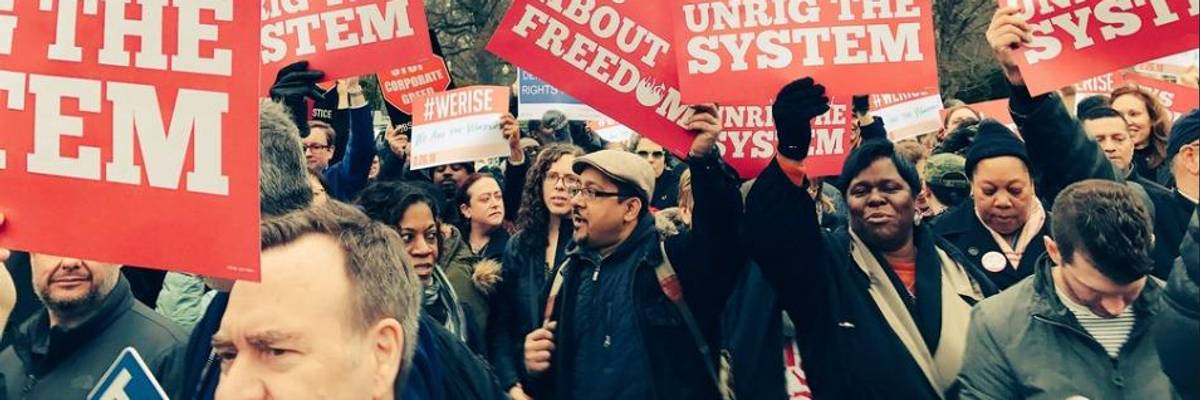
Union workers and advocates rallied outside the Supreme Court on Monday as justices heard the opening arguments in Janus vs. AFSCME. (Photo: @AlexMorash/Twitter)
The U.S. Supreme Court will hear the opening arguments on Monday in a case that workers and labor leaders fear could deliver a serious blow to public sector unions.
In Janus vs. AFSCME, the court will reconsider its 1977 decision stating that public employees who choose not to join unions can still be required to pay partial union dues, to help fund unions' collective bargaining negotiations, which hold benefits for all workers.
While AFSCME is the union that represents state and municipal workers, supporters fear that a decision in favor of Mark Janus--the individual plaintiff backed by a network of billionaires, corporate interests and right-wing ideologues determined to undermine organized workers--would threaten labor in all sectors across the country. As Andrew Hanna and Caitlin Emma wrote at Politico on Sunday:
The financial blow dealt by a Janus victory would far exceed the loss of nonmember fees, thanks to what economists call a "free rider" problem. Unions are compelled by law to represent all workers within a collective-bargaining unit--not just dues-paying union members. If workers are permitted to quit the union and still benefit from collective bargaining agreements without paying non-member fees, union non-membership will become much more attractive.
Wealthy conservative donors including the Bradley Foundation and the Koch brothers have contributed to the "right to work" cause represented by Janus for decades. The National Right to Work Foundation and the Illinois Policy Institute, which represent the plaintiff, have received hundreds of thousands of dollars in donations from the groups.
Public sector unions and labor advocates including the National Education Association (NEA), Jobs with Justice, and AFSCME rallied in front of the Supreme Court on Monday, keeping up the momentum started by protests in cities across the country on Saturday's Working People's Day of Action.
Using the rallying call, "Unrig the system," leaders including Sarita Gupta of Jobs with Justice spoke out at the Supreme Court against the corporate power behind efforts to weaken unions.
"This case is a culmination of years of attacks on working people," Gupta told the crowd. "It's an assault by wealthy elites on our freedom to create better lives and sustainable futures for our families. Greedy billionaires, divisive extremists, and the corrupt politicians who do their bidding are rigging the rules in their favor in an attempt to gain more power. And we're not going to let that happen."
A ruling in the Janus case is expected by June.
Dear Common Dreams reader, It’s been nearly 30 years since I co-founded Common Dreams with my late wife, Lina Newhouser. We had the radical notion that journalism should serve the public good, not corporate profits. It was clear to us from the outset what it would take to build such a project. No paid advertisements. No corporate sponsors. No millionaire publisher telling us what to think or do. Many people said we wouldn't last a year, but we proved those doubters wrong. Together with a tremendous team of journalists and dedicated staff, we built an independent media outlet free from the constraints of profits and corporate control. Our mission has always been simple: To inform. To inspire. To ignite change for the common good. Building Common Dreams was not easy. Our survival was never guaranteed. When you take on the most powerful forces—Wall Street greed, fossil fuel industry destruction, Big Tech lobbyists, and uber-rich oligarchs who have spent billions upon billions rigging the economy and democracy in their favor—the only bulwark you have is supporters who believe in your work. But here’s the urgent message from me today. It's never been this bad out there. And it's never been this hard to keep us going. At the very moment Common Dreams is most needed, the threats we face are intensifying. We need your support now more than ever. We don't accept corporate advertising and never will. We don't have a paywall because we don't think people should be blocked from critical news based on their ability to pay. Everything we do is funded by the donations of readers like you. When everyone does the little they can afford, we are strong. But if that support retreats or dries up, so do we. Will you donate now to make sure Common Dreams not only survives but thrives? —Craig Brown, Co-founder |
The U.S. Supreme Court will hear the opening arguments on Monday in a case that workers and labor leaders fear could deliver a serious blow to public sector unions.
In Janus vs. AFSCME, the court will reconsider its 1977 decision stating that public employees who choose not to join unions can still be required to pay partial union dues, to help fund unions' collective bargaining negotiations, which hold benefits for all workers.
While AFSCME is the union that represents state and municipal workers, supporters fear that a decision in favor of Mark Janus--the individual plaintiff backed by a network of billionaires, corporate interests and right-wing ideologues determined to undermine organized workers--would threaten labor in all sectors across the country. As Andrew Hanna and Caitlin Emma wrote at Politico on Sunday:
The financial blow dealt by a Janus victory would far exceed the loss of nonmember fees, thanks to what economists call a "free rider" problem. Unions are compelled by law to represent all workers within a collective-bargaining unit--not just dues-paying union members. If workers are permitted to quit the union and still benefit from collective bargaining agreements without paying non-member fees, union non-membership will become much more attractive.
Wealthy conservative donors including the Bradley Foundation and the Koch brothers have contributed to the "right to work" cause represented by Janus for decades. The National Right to Work Foundation and the Illinois Policy Institute, which represent the plaintiff, have received hundreds of thousands of dollars in donations from the groups.
Public sector unions and labor advocates including the National Education Association (NEA), Jobs with Justice, and AFSCME rallied in front of the Supreme Court on Monday, keeping up the momentum started by protests in cities across the country on Saturday's Working People's Day of Action.
Using the rallying call, "Unrig the system," leaders including Sarita Gupta of Jobs with Justice spoke out at the Supreme Court against the corporate power behind efforts to weaken unions.
"This case is a culmination of years of attacks on working people," Gupta told the crowd. "It's an assault by wealthy elites on our freedom to create better lives and sustainable futures for our families. Greedy billionaires, divisive extremists, and the corrupt politicians who do their bidding are rigging the rules in their favor in an attempt to gain more power. And we're not going to let that happen."
A ruling in the Janus case is expected by June.
The U.S. Supreme Court will hear the opening arguments on Monday in a case that workers and labor leaders fear could deliver a serious blow to public sector unions.
In Janus vs. AFSCME, the court will reconsider its 1977 decision stating that public employees who choose not to join unions can still be required to pay partial union dues, to help fund unions' collective bargaining negotiations, which hold benefits for all workers.
While AFSCME is the union that represents state and municipal workers, supporters fear that a decision in favor of Mark Janus--the individual plaintiff backed by a network of billionaires, corporate interests and right-wing ideologues determined to undermine organized workers--would threaten labor in all sectors across the country. As Andrew Hanna and Caitlin Emma wrote at Politico on Sunday:
The financial blow dealt by a Janus victory would far exceed the loss of nonmember fees, thanks to what economists call a "free rider" problem. Unions are compelled by law to represent all workers within a collective-bargaining unit--not just dues-paying union members. If workers are permitted to quit the union and still benefit from collective bargaining agreements without paying non-member fees, union non-membership will become much more attractive.
Wealthy conservative donors including the Bradley Foundation and the Koch brothers have contributed to the "right to work" cause represented by Janus for decades. The National Right to Work Foundation and the Illinois Policy Institute, which represent the plaintiff, have received hundreds of thousands of dollars in donations from the groups.
Public sector unions and labor advocates including the National Education Association (NEA), Jobs with Justice, and AFSCME rallied in front of the Supreme Court on Monday, keeping up the momentum started by protests in cities across the country on Saturday's Working People's Day of Action.
Using the rallying call, "Unrig the system," leaders including Sarita Gupta of Jobs with Justice spoke out at the Supreme Court against the corporate power behind efforts to weaken unions.
"This case is a culmination of years of attacks on working people," Gupta told the crowd. "It's an assault by wealthy elites on our freedom to create better lives and sustainable futures for our families. Greedy billionaires, divisive extremists, and the corrupt politicians who do their bidding are rigging the rules in their favor in an attempt to gain more power. And we're not going to let that happen."
A ruling in the Janus case is expected by June.