

SUBSCRIBE TO OUR FREE NEWSLETTER
Daily news & progressive opinion—funded by the people, not the corporations—delivered straight to your inbox.
5
#000000
#FFFFFF
To donate by check, phone, or other method, see our More Ways to Give page.
In its new annual report, Amnesty International documents "the struggle of many people to claim their rights, and the failures of governments to respect, protect, and fulfill human rights," in 159 countries and territories over the past year.
"As we enter 2018, the year in which the Universal Declaration of Human Rights turns 70, it is abundantly clear that none of us can take any of our human rights for granted."
--Salil Shetty, Amnesty International
"As we enter 2018, the year in which the Universal Declaration of Human Rights turns 70, it is abundantly clear that none of us can take any of our human rights for granted," Amnesty International secretary general Salil Shetty writes in the foreward of the report, which details how, "faced with unprecedented challenges across the world, people have shown repeatedly that their thirst for justice, dignity, and equality will not be extinguished."
Shetty outlines human rights abuses around the globe, while also noting that 2017 "demonstrated the enduring willingness of people to stand up for their rights and for the values they want to see in the world." He urges advocates to continue their fights.
"We certainly cannot take for granted that we will be free to gather together in protest or to criticize our governments. Neither can we take for granted that social security will be available when we are old or incapacitated; that our babies can grow up in cities with clean, breathable air; or that as young people we will leave school to find jobs that enable us to buy a home," he concludes. "The coming year provides a vital opportunity for a renewed commitment to the transformative idea of human rights, as we ask what kind of societies we want to live in. We must not squander it."
The report includes five regional overviews--one each for Africa, the Americas, Asia-Pacific, Europe and Central Asia, and the Middle East and North Africa--in addition to detailed reports from various nations and territories. It also features a "Spotlight on Austerity," which describes the impacts of cuts to government spending and tax increases through which officials aim to reduce public debt.
"Since the financial crisis of 2008, austerity has become a familiar term and experience for millions of people," the report notes. "Austerity is a human rights issue. It affects people's access to education, health, housing, social security, and other economic and social rights. It also leads to abuses of civil and political rights, as governments respond to protests and other dissent in draconian ways or cut services that affect access to justice, such as legal aid."
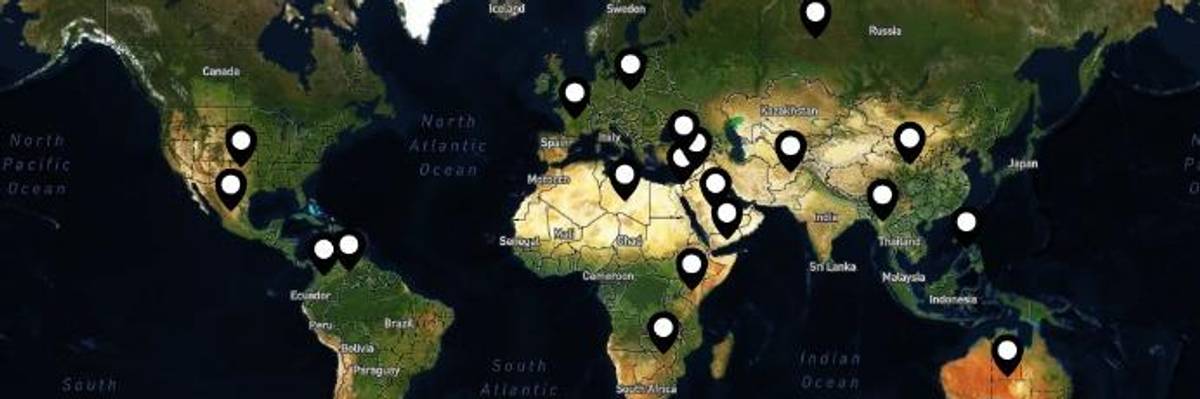
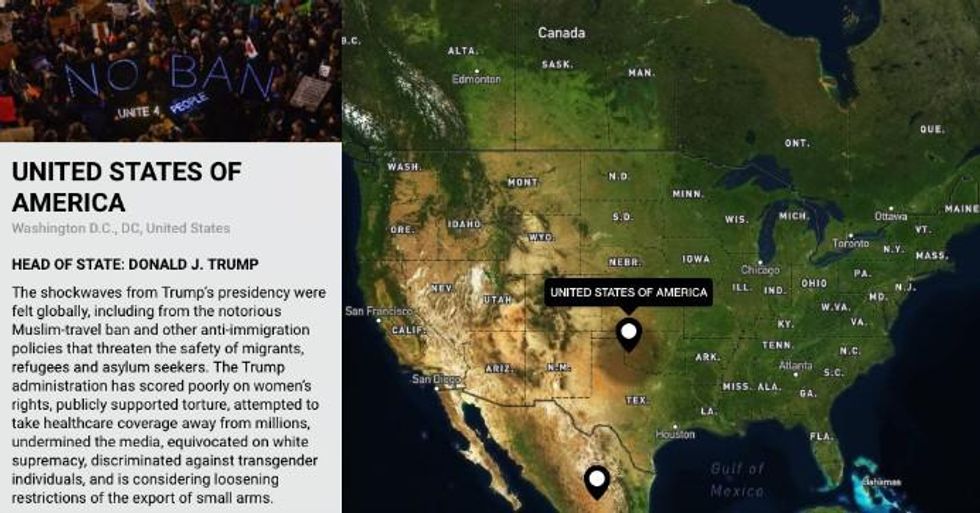
In an interactive map of "human rights hot spots" around the world, which was published on the group's website with the report, a descriptor attached to the U.S. pin notes how "the shockwaves from Trump's presidency were felt globally," and the numerous ways the Trump administration has failed to protect the rights of U.S. citizens and others.
While, in the report's forward, Shetty denounces leaders of wealthy countries who have "continued to approach the global refugee crisis with a blend of evasion and outright callousness," he highlights the approach of U.S. President Donald Trump, whose efforts "to ban entry to all citizens of several Muslim-majority countries based on their nationality was a transparently hateful move."
The U.S. section of the report addresses not only refugees' and migrants' rights, which focuses on Trump's executive orders and actions by the Department of Homeland Security, but also:
In its new annual report, Amnesty International documents "the struggle of many people to claim their rights, and the failures of governments to respect, protect, and fulfill human rights," in 159 countries and territories over the past year.
"As we enter 2018, the year in which the Universal Declaration of Human Rights turns 70, it is abundantly clear that none of us can take any of our human rights for granted."
--Salil Shetty, Amnesty International
"As we enter 2018, the year in which the Universal Declaration of Human Rights turns 70, it is abundantly clear that none of us can take any of our human rights for granted," Amnesty International secretary general Salil Shetty writes in the foreward of the report, which details how, "faced with unprecedented challenges across the world, people have shown repeatedly that their thirst for justice, dignity, and equality will not be extinguished."
Shetty outlines human rights abuses around the globe, while also noting that 2017 "demonstrated the enduring willingness of people to stand up for their rights and for the values they want to see in the world." He urges advocates to continue their fights.
"We certainly cannot take for granted that we will be free to gather together in protest or to criticize our governments. Neither can we take for granted that social security will be available when we are old or incapacitated; that our babies can grow up in cities with clean, breathable air; or that as young people we will leave school to find jobs that enable us to buy a home," he concludes. "The coming year provides a vital opportunity for a renewed commitment to the transformative idea of human rights, as we ask what kind of societies we want to live in. We must not squander it."
The report includes five regional overviews--one each for Africa, the Americas, Asia-Pacific, Europe and Central Asia, and the Middle East and North Africa--in addition to detailed reports from various nations and territories. It also features a "Spotlight on Austerity," which describes the impacts of cuts to government spending and tax increases through which officials aim to reduce public debt.
"Since the financial crisis of 2008, austerity has become a familiar term and experience for millions of people," the report notes. "Austerity is a human rights issue. It affects people's access to education, health, housing, social security, and other economic and social rights. It also leads to abuses of civil and political rights, as governments respond to protests and other dissent in draconian ways or cut services that affect access to justice, such as legal aid."
In an interactive map of "human rights hot spots" around the world, which was published on the group's website with the report, a descriptor attached to the U.S. pin notes how "the shockwaves from Trump's presidency were felt globally," and the numerous ways the Trump administration has failed to protect the rights of U.S. citizens and others.
While, in the report's forward, Shetty denounces leaders of wealthy countries who have "continued to approach the global refugee crisis with a blend of evasion and outright callousness," he highlights the approach of U.S. President Donald Trump, whose efforts "to ban entry to all citizens of several Muslim-majority countries based on their nationality was a transparently hateful move."
The U.S. section of the report addresses not only refugees' and migrants' rights, which focuses on Trump's executive orders and actions by the Department of Homeland Security, but also:
In its new annual report, Amnesty International documents "the struggle of many people to claim their rights, and the failures of governments to respect, protect, and fulfill human rights," in 159 countries and territories over the past year.
"As we enter 2018, the year in which the Universal Declaration of Human Rights turns 70, it is abundantly clear that none of us can take any of our human rights for granted."
--Salil Shetty, Amnesty International
"As we enter 2018, the year in which the Universal Declaration of Human Rights turns 70, it is abundantly clear that none of us can take any of our human rights for granted," Amnesty International secretary general Salil Shetty writes in the foreward of the report, which details how, "faced with unprecedented challenges across the world, people have shown repeatedly that their thirst for justice, dignity, and equality will not be extinguished."
Shetty outlines human rights abuses around the globe, while also noting that 2017 "demonstrated the enduring willingness of people to stand up for their rights and for the values they want to see in the world." He urges advocates to continue their fights.
"We certainly cannot take for granted that we will be free to gather together in protest or to criticize our governments. Neither can we take for granted that social security will be available when we are old or incapacitated; that our babies can grow up in cities with clean, breathable air; or that as young people we will leave school to find jobs that enable us to buy a home," he concludes. "The coming year provides a vital opportunity for a renewed commitment to the transformative idea of human rights, as we ask what kind of societies we want to live in. We must not squander it."
The report includes five regional overviews--one each for Africa, the Americas, Asia-Pacific, Europe and Central Asia, and the Middle East and North Africa--in addition to detailed reports from various nations and territories. It also features a "Spotlight on Austerity," which describes the impacts of cuts to government spending and tax increases through which officials aim to reduce public debt.
"Since the financial crisis of 2008, austerity has become a familiar term and experience for millions of people," the report notes. "Austerity is a human rights issue. It affects people's access to education, health, housing, social security, and other economic and social rights. It also leads to abuses of civil and political rights, as governments respond to protests and other dissent in draconian ways or cut services that affect access to justice, such as legal aid."
In an interactive map of "human rights hot spots" around the world, which was published on the group's website with the report, a descriptor attached to the U.S. pin notes how "the shockwaves from Trump's presidency were felt globally," and the numerous ways the Trump administration has failed to protect the rights of U.S. citizens and others.
While, in the report's forward, Shetty denounces leaders of wealthy countries who have "continued to approach the global refugee crisis with a blend of evasion and outright callousness," he highlights the approach of U.S. President Donald Trump, whose efforts "to ban entry to all citizens of several Muslim-majority countries based on their nationality was a transparently hateful move."
The U.S. section of the report addresses not only refugees' and migrants' rights, which focuses on Trump's executive orders and actions by the Department of Homeland Security, but also:

