SUBSCRIBE TO OUR FREE NEWSLETTER
Daily news & progressive opinion—funded by the people, not the corporations—delivered straight to your inbox.
5
#000000
#FFFFFF
To donate by check, phone, or other method, see our More Ways to Give page.
Daily news & progressive opinion—funded by the people, not the corporations—delivered straight to your inbox.
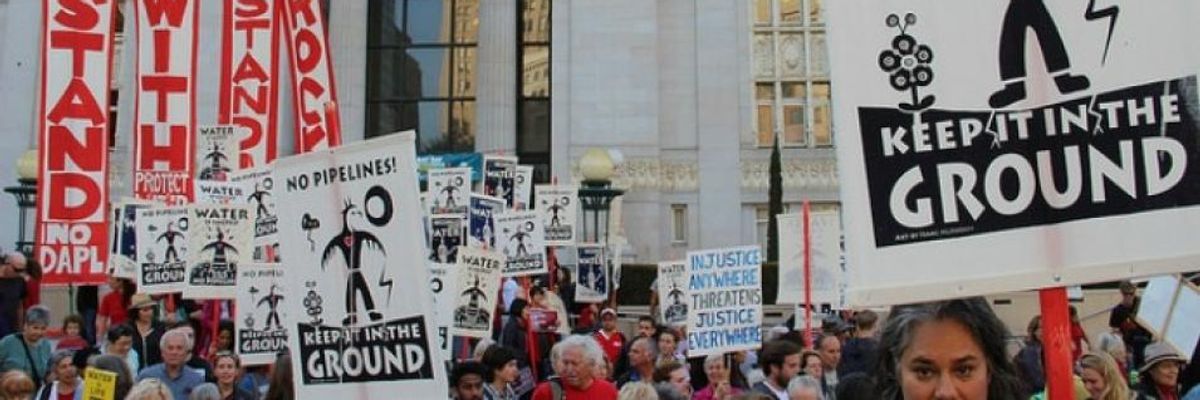
Environmentalists have protested and launched multiple legal challenges against the Dakota Access Pipeline. (Photo: Peg Hunter/flickr/cc)
As green groups continue to denounce the Trump administration's recently unveiled infrastructure plan as a "scam" that's designed to keep the nation trapped in its "dirty and destructive past," analysts are also warning the proposal will "make it harder for the next big anti-pipeline movement" to launch successful legal challenges to new fossil fuel projects.
"This proposal would trample over Indigenous rights to pave the way for a fossil fuel frenzy, and would even let Big Oil build pipelines through national parks."
-- 350.org
The plan aims to not only fast-track the construction of more pipelines across the U.S., but also to limit "the legal options available to lawyers at environmental groups opposed to new fossil fuel infrastructure" in part by changing "the standard under which a pipeline project could be temporarily halted by a judge," as Dino Gradoni explains in a Washington Post piece published Friday.
Trump also wants Congress to rewrite long-standing environmental laws that allow for lawsuits challenging permits. Gradoni notes that although the administration's desire for that specific revision by lawmakers may be a bit of a "pipe dream," enacting barriers to launching legal challenges against pipeline projects "could be a significant blow to the slew of protesters who spent years agitating against the Keystone XL pipeline and more recently the Dakota Access one."
Additionally, as just the latest development in the Trump administration's long-term pursuit of "American energy dominance" through the exploitation of "vast amounts" of energy reserves on public lands, the infrastructure plan proposes allowing Interior Department Secretary Ryan Zinke to approve the construction of pipelines through national parks. Currently, only acts of Congress can do that.
The environmental group 350.org has launched a campaign to pressure members of Congress to oppose Trump's plan, which they describe as a "climate-wrecking pipeline bonanza." In a drafted letter to senators, the group declares, "This proposal would trample over Indigenous rights to pave the way for a fossil fuel frenzy, and would even let Big Oil build pipelines through national parks."
"And Trump wants to pay for this pipeline bonanza with deep cuts to essential programs like food assistance and Medicaid--a cruel attack on America's most vulnerable communities--and by forcing taxpayers in cash-strapped cities and states to pick up most of the tab. That's unacceptable," the letter continues, calling on Congress to advocate for an infrastructure deal "that creates millions of jobs and helps build the 100 percent renewable energy-powered world we need."
This country and this world are at a monumental crossroads. US voters have an opportunity to beat back the forces of fascism and confront the billionaires who are rigging the economy, our media system, and our democracy, making it increasingly impossible for ordinary people to get by. We’re not just talking about the election. We’re talking about what must be done once these fascist elements are vanquished from power. We need a bolder set of solutions than what either major party has so far been willing to offer and a working-class movement ready to fight like hell for it. Trump didn't emerge from nowhere. The conditions that fueled MAGA authoritarianism were created by decades of radical neoliberal economic policies and a corrupt political system dominated by corporate interests. They slashed taxes on the super-rich, promising that the benefits would trickle down. They said giveaways to the corporate titans would make life more affordable for the rest of us. It was all bullshit. And when a bitter, betrayed populace searches for someone to blame, right-wing demagogues have little trouble finding scapegoats. People know when they're being lied to, but you won't hear any of this from the corporate media. Only independent journalism—powered and funded by people who believe in building a better world—can deliver truly trustworthy daily news. If you share our vision, please contribute whatever you can to sustain our work. |
As green groups continue to denounce the Trump administration's recently unveiled infrastructure plan as a "scam" that's designed to keep the nation trapped in its "dirty and destructive past," analysts are also warning the proposal will "make it harder for the next big anti-pipeline movement" to launch successful legal challenges to new fossil fuel projects.
"This proposal would trample over Indigenous rights to pave the way for a fossil fuel frenzy, and would even let Big Oil build pipelines through national parks."
-- 350.org
The plan aims to not only fast-track the construction of more pipelines across the U.S., but also to limit "the legal options available to lawyers at environmental groups opposed to new fossil fuel infrastructure" in part by changing "the standard under which a pipeline project could be temporarily halted by a judge," as Dino Gradoni explains in a Washington Post piece published Friday.
Trump also wants Congress to rewrite long-standing environmental laws that allow for lawsuits challenging permits. Gradoni notes that although the administration's desire for that specific revision by lawmakers may be a bit of a "pipe dream," enacting barriers to launching legal challenges against pipeline projects "could be a significant blow to the slew of protesters who spent years agitating against the Keystone XL pipeline and more recently the Dakota Access one."
Additionally, as just the latest development in the Trump administration's long-term pursuit of "American energy dominance" through the exploitation of "vast amounts" of energy reserves on public lands, the infrastructure plan proposes allowing Interior Department Secretary Ryan Zinke to approve the construction of pipelines through national parks. Currently, only acts of Congress can do that.
The environmental group 350.org has launched a campaign to pressure members of Congress to oppose Trump's plan, which they describe as a "climate-wrecking pipeline bonanza." In a drafted letter to senators, the group declares, "This proposal would trample over Indigenous rights to pave the way for a fossil fuel frenzy, and would even let Big Oil build pipelines through national parks."
"And Trump wants to pay for this pipeline bonanza with deep cuts to essential programs like food assistance and Medicaid--a cruel attack on America's most vulnerable communities--and by forcing taxpayers in cash-strapped cities and states to pick up most of the tab. That's unacceptable," the letter continues, calling on Congress to advocate for an infrastructure deal "that creates millions of jobs and helps build the 100 percent renewable energy-powered world we need."