SUBSCRIBE TO OUR FREE NEWSLETTER
Daily news & progressive opinion—funded by the people, not the corporations—delivered straight to your inbox.
5
#000000
#FFFFFF
To donate by check, phone, or other method, see our More Ways to Give page.
Daily news & progressive opinion—funded by the people, not the corporations—delivered straight to your inbox.
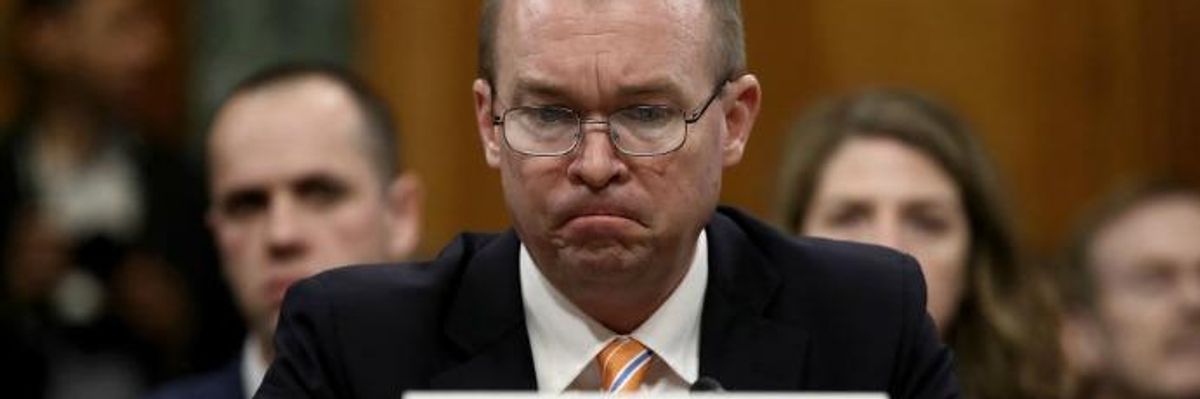
Office of Management and Budget Director Mick Mulvaney testifies before the Senate Budget Committee May 25, 2017 in Washington, D.C.
In yet another indication that the Consumer Financial Protection Bureau (CFPB) under the leadership of Trump budget chief Mick Mulvaney is no longer devoted to protecting the public from corporate wrongdoing, the agency has reportedly placed its investigation of Equifax "on ice"--a move that says "you're out of luck" to the more than 143 million Americans whose personal information was compromised in a massive security breach last year.
"Equifax's tissue-thin security allowed hackers to steal personal data from more than 140 million Americans, yet Mulvaney appears intent on protecting the company instead of consumers."
--Public Citizen
"This is an absolute outrage," the consumer advocacy group Public Citizen wrote in Twitter in response to the news. "Equifax's tissue-thin security allowed hackers to steal personal data from more than 140 million Americans, yet Mulvaney appears intent on protecting the company instead of consumers."
Highlighting the fact that Mulvaney has received thousands of dollars in campaign contributions from Equifax, corporate watchdog Allied Progress decried the CFPB's move as "deeply disturbing."
"This has become par for the course at Mulvaney's CFPB. If you've given him massive campaign contributions, you should expect special treatment," said Allied Progress executive director Karl Frisch in a statement.
First reported by Reuters' Patrick Rucker, the CFPB's decision to pull back from its probe into how the credit reporting giant Equifax failed to protect the data of nearly half of the U.S. population--and then took six weeks to notify the public of the breach--was driven by Mulvaney himself, who President Donald Trump placed in charge of the consumer bureau after former director Richard Cordray resigned in November.
Mulvaney, Rucker notes, "has not ordered subpoenas against Equifax or sought sworn testimony from executives, routine steps when launching a full-scale probe. Meanwhile the CFPB has shelved plans for on-the-ground tests of how Equifax protects data, an idea backed by Cordray."
"The CFPB also recently rebuffed bank regulators at the Federal Reserve, Federal Deposit Insurance Corp and Office of the Comptroller of the Currency when they offered to help with on-site exams of credit bureaus, said two sources familiar with the matter," Rucker adds.
Mulvaney's move comes as Equifax is facing a flurry of class action lawsuits--more than 240, by its own estimation--as well as investigations from state attorneys general.
Equifax has also faced heat from members of Congress--particularly Sen. Elizabeth Warren (D-Mass.), who last September introduced legislation aimed at giving control of credit information back to consumers.
Dear Common Dreams reader, It’s been nearly 30 years since I co-founded Common Dreams with my late wife, Lina Newhouser. We had the radical notion that journalism should serve the public good, not corporate profits. It was clear to us from the outset what it would take to build such a project. No paid advertisements. No corporate sponsors. No millionaire publisher telling us what to think or do. Many people said we wouldn't last a year, but we proved those doubters wrong. Together with a tremendous team of journalists and dedicated staff, we built an independent media outlet free from the constraints of profits and corporate control. Our mission has always been simple: To inform. To inspire. To ignite change for the common good. Building Common Dreams was not easy. Our survival was never guaranteed. When you take on the most powerful forces—Wall Street greed, fossil fuel industry destruction, Big Tech lobbyists, and uber-rich oligarchs who have spent billions upon billions rigging the economy and democracy in their favor—the only bulwark you have is supporters who believe in your work. But here’s the urgent message from me today. It's never been this bad out there. And it's never been this hard to keep us going. At the very moment Common Dreams is most needed, the threats we face are intensifying. We need your support now more than ever. We don't accept corporate advertising and never will. We don't have a paywall because we don't think people should be blocked from critical news based on their ability to pay. Everything we do is funded by the donations of readers like you. When everyone does the little they can afford, we are strong. But if that support retreats or dries up, so do we. Will you donate now to make sure Common Dreams not only survives but thrives? —Craig Brown, Co-founder |
In yet another indication that the Consumer Financial Protection Bureau (CFPB) under the leadership of Trump budget chief Mick Mulvaney is no longer devoted to protecting the public from corporate wrongdoing, the agency has reportedly placed its investigation of Equifax "on ice"--a move that says "you're out of luck" to the more than 143 million Americans whose personal information was compromised in a massive security breach last year.
"Equifax's tissue-thin security allowed hackers to steal personal data from more than 140 million Americans, yet Mulvaney appears intent on protecting the company instead of consumers."
--Public Citizen
"This is an absolute outrage," the consumer advocacy group Public Citizen wrote in Twitter in response to the news. "Equifax's tissue-thin security allowed hackers to steal personal data from more than 140 million Americans, yet Mulvaney appears intent on protecting the company instead of consumers."
Highlighting the fact that Mulvaney has received thousands of dollars in campaign contributions from Equifax, corporate watchdog Allied Progress decried the CFPB's move as "deeply disturbing."
"This has become par for the course at Mulvaney's CFPB. If you've given him massive campaign contributions, you should expect special treatment," said Allied Progress executive director Karl Frisch in a statement.
First reported by Reuters' Patrick Rucker, the CFPB's decision to pull back from its probe into how the credit reporting giant Equifax failed to protect the data of nearly half of the U.S. population--and then took six weeks to notify the public of the breach--was driven by Mulvaney himself, who President Donald Trump placed in charge of the consumer bureau after former director Richard Cordray resigned in November.
Mulvaney, Rucker notes, "has not ordered subpoenas against Equifax or sought sworn testimony from executives, routine steps when launching a full-scale probe. Meanwhile the CFPB has shelved plans for on-the-ground tests of how Equifax protects data, an idea backed by Cordray."
"The CFPB also recently rebuffed bank regulators at the Federal Reserve, Federal Deposit Insurance Corp and Office of the Comptroller of the Currency when they offered to help with on-site exams of credit bureaus, said two sources familiar with the matter," Rucker adds.
Mulvaney's move comes as Equifax is facing a flurry of class action lawsuits--more than 240, by its own estimation--as well as investigations from state attorneys general.
Equifax has also faced heat from members of Congress--particularly Sen. Elizabeth Warren (D-Mass.), who last September introduced legislation aimed at giving control of credit information back to consumers.
In yet another indication that the Consumer Financial Protection Bureau (CFPB) under the leadership of Trump budget chief Mick Mulvaney is no longer devoted to protecting the public from corporate wrongdoing, the agency has reportedly placed its investigation of Equifax "on ice"--a move that says "you're out of luck" to the more than 143 million Americans whose personal information was compromised in a massive security breach last year.
"Equifax's tissue-thin security allowed hackers to steal personal data from more than 140 million Americans, yet Mulvaney appears intent on protecting the company instead of consumers."
--Public Citizen
"This is an absolute outrage," the consumer advocacy group Public Citizen wrote in Twitter in response to the news. "Equifax's tissue-thin security allowed hackers to steal personal data from more than 140 million Americans, yet Mulvaney appears intent on protecting the company instead of consumers."
Highlighting the fact that Mulvaney has received thousands of dollars in campaign contributions from Equifax, corporate watchdog Allied Progress decried the CFPB's move as "deeply disturbing."
"This has become par for the course at Mulvaney's CFPB. If you've given him massive campaign contributions, you should expect special treatment," said Allied Progress executive director Karl Frisch in a statement.
First reported by Reuters' Patrick Rucker, the CFPB's decision to pull back from its probe into how the credit reporting giant Equifax failed to protect the data of nearly half of the U.S. population--and then took six weeks to notify the public of the breach--was driven by Mulvaney himself, who President Donald Trump placed in charge of the consumer bureau after former director Richard Cordray resigned in November.
Mulvaney, Rucker notes, "has not ordered subpoenas against Equifax or sought sworn testimony from executives, routine steps when launching a full-scale probe. Meanwhile the CFPB has shelved plans for on-the-ground tests of how Equifax protects data, an idea backed by Cordray."
"The CFPB also recently rebuffed bank regulators at the Federal Reserve, Federal Deposit Insurance Corp and Office of the Comptroller of the Currency when they offered to help with on-site exams of credit bureaus, said two sources familiar with the matter," Rucker adds.
Mulvaney's move comes as Equifax is facing a flurry of class action lawsuits--more than 240, by its own estimation--as well as investigations from state attorneys general.
Equifax has also faced heat from members of Congress--particularly Sen. Elizabeth Warren (D-Mass.), who last September introduced legislation aimed at giving control of credit information back to consumers.