SUBSCRIBE TO OUR FREE NEWSLETTER
Daily news & progressive opinion—funded by the people, not the corporations—delivered straight to your inbox.
5
#000000
#FFFFFF
To donate by check, phone, or other method, see our More Ways to Give page.
Daily news & progressive opinion—funded by the people, not the corporations—delivered straight to your inbox.
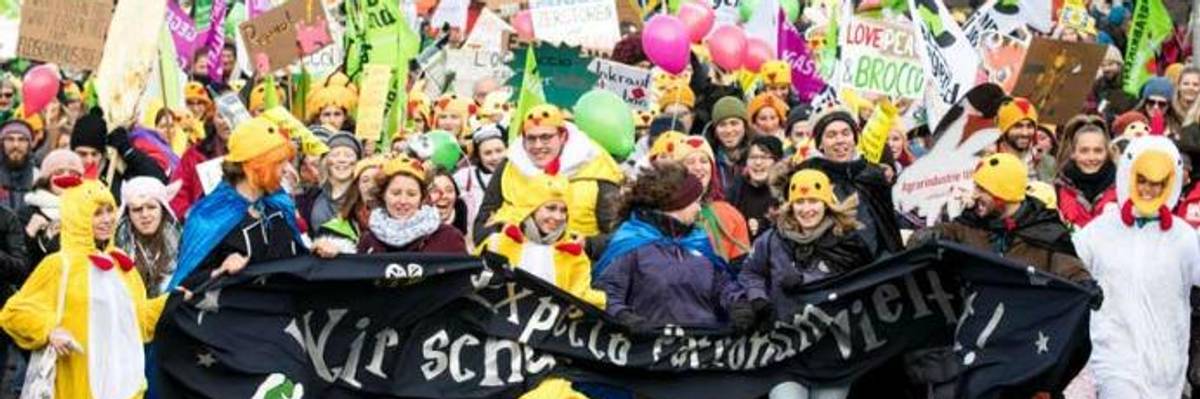
Demonstrators march in Berlin on Saturday calling for an end to industrial agriculture. (Photo: BUND/Friends of the Earth Germany)
Tens of thousands of people--and more than 100 tractors--swarmed the streets of Berlin this weekend to demand a food system transformation nourished by political policies that foster ecological farming.
"Farmers and consumers from all over Europe have made it clear that they are fed up with current policies that benefit huge food and agriculture corporations, at the expense of the environment, peasant farming, and public safety," said Adrian Bebb, food and farming campaigner at Friends of the Earth Europe, and among the estimated 33,000 that took part in the Saturday march.
"Policymakers at the European and national level need to listen, and use the upcoming reform of the EU's common agricultural policy to build a better food system for the future," he added.
According to the more than 100 groups that organized the march, policies must shift so that industrial agriculture is dumped in favor climate- and farmer-friendly practices.
A good place to start they say, is by banning the controversial weedkiller Roundup.
"Food is political--more and more people realize this. But politicians nurture an agricultural sector that detrimentally affects the environment and animals in the name of productivity," said Jochen Fritz, a spokesperson for the organizers.
The demonstration took place as International Green Week, an major agricultural exposition, kicked off in the German capital.
Friends of the Earth Europe and BUND/Friends of the Earth Germany tweeted images and videos from the march:
Dear Common Dreams reader, It’s been nearly 30 years since I co-founded Common Dreams with my late wife, Lina Newhouser. We had the radical notion that journalism should serve the public good, not corporate profits. It was clear to us from the outset what it would take to build such a project. No paid advertisements. No corporate sponsors. No millionaire publisher telling us what to think or do. Many people said we wouldn't last a year, but we proved those doubters wrong. Together with a tremendous team of journalists and dedicated staff, we built an independent media outlet free from the constraints of profits and corporate control. Our mission has always been simple: To inform. To inspire. To ignite change for the common good. Building Common Dreams was not easy. Our survival was never guaranteed. When you take on the most powerful forces—Wall Street greed, fossil fuel industry destruction, Big Tech lobbyists, and uber-rich oligarchs who have spent billions upon billions rigging the economy and democracy in their favor—the only bulwark you have is supporters who believe in your work. But here’s the urgent message from me today. It's never been this bad out there. And it's never been this hard to keep us going. At the very moment Common Dreams is most needed, the threats we face are intensifying. We need your support now more than ever. We don't accept corporate advertising and never will. We don't have a paywall because we don't think people should be blocked from critical news based on their ability to pay. Everything we do is funded by the donations of readers like you. When everyone does the little they can afford, we are strong. But if that support retreats or dries up, so do we. Will you donate now to make sure Common Dreams not only survives but thrives? —Craig Brown, Co-founder |
Tens of thousands of people--and more than 100 tractors--swarmed the streets of Berlin this weekend to demand a food system transformation nourished by political policies that foster ecological farming.
"Farmers and consumers from all over Europe have made it clear that they are fed up with current policies that benefit huge food and agriculture corporations, at the expense of the environment, peasant farming, and public safety," said Adrian Bebb, food and farming campaigner at Friends of the Earth Europe, and among the estimated 33,000 that took part in the Saturday march.
"Policymakers at the European and national level need to listen, and use the upcoming reform of the EU's common agricultural policy to build a better food system for the future," he added.
According to the more than 100 groups that organized the march, policies must shift so that industrial agriculture is dumped in favor climate- and farmer-friendly practices.
A good place to start they say, is by banning the controversial weedkiller Roundup.
"Food is political--more and more people realize this. But politicians nurture an agricultural sector that detrimentally affects the environment and animals in the name of productivity," said Jochen Fritz, a spokesperson for the organizers.
The demonstration took place as International Green Week, an major agricultural exposition, kicked off in the German capital.
Friends of the Earth Europe and BUND/Friends of the Earth Germany tweeted images and videos from the march:
Tens of thousands of people--and more than 100 tractors--swarmed the streets of Berlin this weekend to demand a food system transformation nourished by political policies that foster ecological farming.
"Farmers and consumers from all over Europe have made it clear that they are fed up with current policies that benefit huge food and agriculture corporations, at the expense of the environment, peasant farming, and public safety," said Adrian Bebb, food and farming campaigner at Friends of the Earth Europe, and among the estimated 33,000 that took part in the Saturday march.
"Policymakers at the European and national level need to listen, and use the upcoming reform of the EU's common agricultural policy to build a better food system for the future," he added.
According to the more than 100 groups that organized the march, policies must shift so that industrial agriculture is dumped in favor climate- and farmer-friendly practices.
A good place to start they say, is by banning the controversial weedkiller Roundup.
"Food is political--more and more people realize this. But politicians nurture an agricultural sector that detrimentally affects the environment and animals in the name of productivity," said Jochen Fritz, a spokesperson for the organizers.
The demonstration took place as International Green Week, an major agricultural exposition, kicked off in the German capital.
Friends of the Earth Europe and BUND/Friends of the Earth Germany tweeted images and videos from the march: