

SUBSCRIBE TO OUR FREE NEWSLETTER
Daily news & progressive opinion—funded by the people, not the corporations—delivered straight to your inbox.
5
#000000
#FFFFFF
To donate by check, phone, or other method, see our More Ways to Give page.
Daily news & progressive opinion—funded by the people, not the corporations—delivered straight to your inbox.
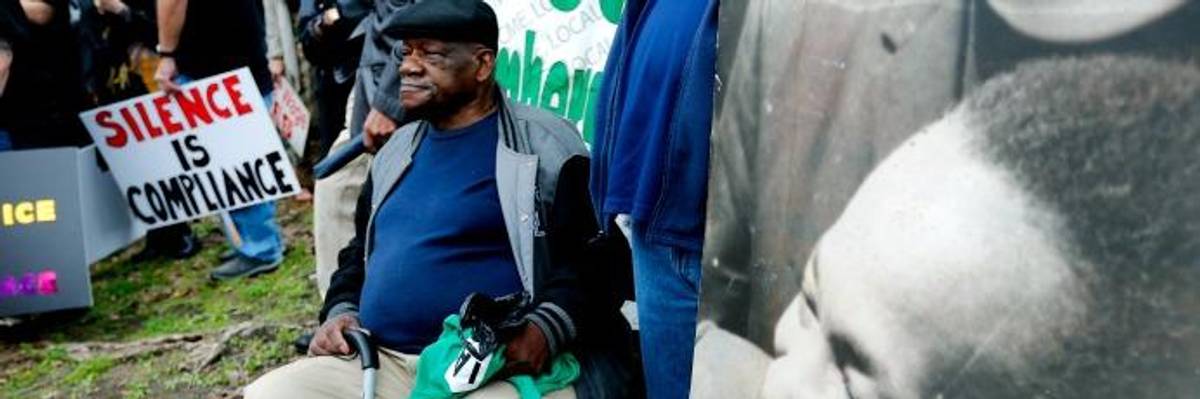
Alvin Turner, who was a sanitation worker in Memphis for 34 years and marched alongside Martin Luther King Jr. during the strike in 1968, listens to speeches before the annual march on Jan. 16, 2017 in Memphis, Tennessee.
As U.S. politicians across the political spectrum turn to social media to commemorate Rev. Dr. Martin Luther King Jr. on the national holiday celebrating his life, students of history, citing the civil rights leader's complex legacy, have issued a warning: "Don't fall for their scams."
"Modern day Republicans and Democrats often speak as if they love King, even as they excoriate the real heirs to his legacy: the Black Lives Matter activists and other social justice warriors who fight for racial and economic liberation."
--Steven Thrasher,
The Guardian
"As you listen to American politicians from both parties invoke MLK," writes Steven Thrasher in the Guardian, "think about if their actions live up to King's vision of justice--and push them as hard as he would have when they fall short."
"Modern day Republicans and Democrats often speak as if they love King, even as they excoriate the real heirs to his legacy: the Black Lives Matter activists and other social justice warriors who fight for racial and economic liberation," Thrasher notes. "But the truth is, many of these American politicians would have hated King when he was alive as much as they hypocritically dishonor his radical legacy today."
Thrasher outlines how King's critiques of American exceptionalism, imperialism, and capitalism flagrantly contrast with the actions of so many politicans who have spent the weekend blasting out tweets in his honor, and how America's embrace of King has changed since he was assassinated nearly 50 years ago:
As often as American politicians are always saying they wish Ferguson or NFL protesters did things "more like King," white Americans have never really liked any kind of racial protest, and didn't especially like King when he was alive. They didn't like him marching at Selma or helping run a bus boycott in Montgomery. The didn't like him organizing a Poor People's Campaign to try to bring together economically exploited people of all races. And they certainly didn't like him showing up in Memphis to help sanitation workers strike for better working conditions after two of their own, Echol Cole and Robert Walker, were killed on the job.
Writing for The Intercept on Monday, Zaid Jilani points to a notable shift in public opinion polling before and decades after King's death; in 1966, 63 percent of Americans held a negative view of him, but by 1999, King was ranked second, behind Mother Theresa, on a list of the most admired figures of the 20th century. King had been more widely accepted in the early 1960s, but his popularity declined with his decisions to publicly denounce the Vietnam War and launch more provocative anti-poverty initaitves.
"He labeled the war an 'enemy of the poor,' saying that its budget was draining anti-poverty programs; he also pointed out that it was hypocritical for him to preach nonviolence to activists at home, while watching his government reject that principle abroad," Jilani writes. "The backlash from a liberal establishment that had once praised King for his civil rights campaign came as hard and fast," as did that of the African-American establishment and 168 newspaper editorial boards nationwide.
However, after King was killed in April of 1968, "the mood shifted quickly," Jilani notes. Former President Lyndon B. Johnson, "who had once terminated all communication with King and privately cursed his name, issued a statement saying the 'heart of America is heavy, the spirit of America weeps'" while "Bobby Kennedy, who once authorized the wiretaps of King's phones, attended the funeral."
Several people turned to Twitter on Monday to decry the "whitewashing" of King's legacy, with journalist Glenn Greenwald observing that 50 years after his life was cut short because of his political activism, today King is "celebrated only by ignoring and deleting his core beliefs."
King's daughter Bernice posted a series of tweets urging the public to also honor her mother, Coretta Scott King, "the architect of the King Legacy," and calling on the global community to "truly hear" her father's voice, "follow his teachings, and demonstrate his love for humanity."
Dear Common Dreams reader, It’s been nearly 30 years since I co-founded Common Dreams with my late wife, Lina Newhouser. We had the radical notion that journalism should serve the public good, not corporate profits. It was clear to us from the outset what it would take to build such a project. No paid advertisements. No corporate sponsors. No millionaire publisher telling us what to think or do. Many people said we wouldn't last a year, but we proved those doubters wrong. Together with a tremendous team of journalists and dedicated staff, we built an independent media outlet free from the constraints of profits and corporate control. Our mission has always been simple: To inform. To inspire. To ignite change for the common good. Building Common Dreams was not easy. Our survival was never guaranteed. When you take on the most powerful forces—Wall Street greed, fossil fuel industry destruction, Big Tech lobbyists, and uber-rich oligarchs who have spent billions upon billions rigging the economy and democracy in their favor—the only bulwark you have is supporters who believe in your work. But here’s the urgent message from me today. It's never been this bad out there. And it's never been this hard to keep us going. At the very moment Common Dreams is most needed, the threats we face are intensifying. We need your support now more than ever. We don't accept corporate advertising and never will. We don't have a paywall because we don't think people should be blocked from critical news based on their ability to pay. Everything we do is funded by the donations of readers like you. When everyone does the little they can afford, we are strong. But if that support retreats or dries up, so do we. Will you donate now to make sure Common Dreams not only survives but thrives? —Craig Brown, Co-founder |
As U.S. politicians across the political spectrum turn to social media to commemorate Rev. Dr. Martin Luther King Jr. on the national holiday celebrating his life, students of history, citing the civil rights leader's complex legacy, have issued a warning: "Don't fall for their scams."
"Modern day Republicans and Democrats often speak as if they love King, even as they excoriate the real heirs to his legacy: the Black Lives Matter activists and other social justice warriors who fight for racial and economic liberation."
--Steven Thrasher,
The Guardian
"As you listen to American politicians from both parties invoke MLK," writes Steven Thrasher in the Guardian, "think about if their actions live up to King's vision of justice--and push them as hard as he would have when they fall short."
"Modern day Republicans and Democrats often speak as if they love King, even as they excoriate the real heirs to his legacy: the Black Lives Matter activists and other social justice warriors who fight for racial and economic liberation," Thrasher notes. "But the truth is, many of these American politicians would have hated King when he was alive as much as they hypocritically dishonor his radical legacy today."
Thrasher outlines how King's critiques of American exceptionalism, imperialism, and capitalism flagrantly contrast with the actions of so many politicans who have spent the weekend blasting out tweets in his honor, and how America's embrace of King has changed since he was assassinated nearly 50 years ago:
As often as American politicians are always saying they wish Ferguson or NFL protesters did things "more like King," white Americans have never really liked any kind of racial protest, and didn't especially like King when he was alive. They didn't like him marching at Selma or helping run a bus boycott in Montgomery. The didn't like him organizing a Poor People's Campaign to try to bring together economically exploited people of all races. And they certainly didn't like him showing up in Memphis to help sanitation workers strike for better working conditions after two of their own, Echol Cole and Robert Walker, were killed on the job.
Writing for The Intercept on Monday, Zaid Jilani points to a notable shift in public opinion polling before and decades after King's death; in 1966, 63 percent of Americans held a negative view of him, but by 1999, King was ranked second, behind Mother Theresa, on a list of the most admired figures of the 20th century. King had been more widely accepted in the early 1960s, but his popularity declined with his decisions to publicly denounce the Vietnam War and launch more provocative anti-poverty initaitves.
"He labeled the war an 'enemy of the poor,' saying that its budget was draining anti-poverty programs; he also pointed out that it was hypocritical for him to preach nonviolence to activists at home, while watching his government reject that principle abroad," Jilani writes. "The backlash from a liberal establishment that had once praised King for his civil rights campaign came as hard and fast," as did that of the African-American establishment and 168 newspaper editorial boards nationwide.
However, after King was killed in April of 1968, "the mood shifted quickly," Jilani notes. Former President Lyndon B. Johnson, "who had once terminated all communication with King and privately cursed his name, issued a statement saying the 'heart of America is heavy, the spirit of America weeps'" while "Bobby Kennedy, who once authorized the wiretaps of King's phones, attended the funeral."
Several people turned to Twitter on Monday to decry the "whitewashing" of King's legacy, with journalist Glenn Greenwald observing that 50 years after his life was cut short because of his political activism, today King is "celebrated only by ignoring and deleting his core beliefs."
King's daughter Bernice posted a series of tweets urging the public to also honor her mother, Coretta Scott King, "the architect of the King Legacy," and calling on the global community to "truly hear" her father's voice, "follow his teachings, and demonstrate his love for humanity."
As U.S. politicians across the political spectrum turn to social media to commemorate Rev. Dr. Martin Luther King Jr. on the national holiday celebrating his life, students of history, citing the civil rights leader's complex legacy, have issued a warning: "Don't fall for their scams."
"Modern day Republicans and Democrats often speak as if they love King, even as they excoriate the real heirs to his legacy: the Black Lives Matter activists and other social justice warriors who fight for racial and economic liberation."
--Steven Thrasher,
The Guardian
"As you listen to American politicians from both parties invoke MLK," writes Steven Thrasher in the Guardian, "think about if their actions live up to King's vision of justice--and push them as hard as he would have when they fall short."
"Modern day Republicans and Democrats often speak as if they love King, even as they excoriate the real heirs to his legacy: the Black Lives Matter activists and other social justice warriors who fight for racial and economic liberation," Thrasher notes. "But the truth is, many of these American politicians would have hated King when he was alive as much as they hypocritically dishonor his radical legacy today."
Thrasher outlines how King's critiques of American exceptionalism, imperialism, and capitalism flagrantly contrast with the actions of so many politicans who have spent the weekend blasting out tweets in his honor, and how America's embrace of King has changed since he was assassinated nearly 50 years ago:
As often as American politicians are always saying they wish Ferguson or NFL protesters did things "more like King," white Americans have never really liked any kind of racial protest, and didn't especially like King when he was alive. They didn't like him marching at Selma or helping run a bus boycott in Montgomery. The didn't like him organizing a Poor People's Campaign to try to bring together economically exploited people of all races. And they certainly didn't like him showing up in Memphis to help sanitation workers strike for better working conditions after two of their own, Echol Cole and Robert Walker, were killed on the job.
Writing for The Intercept on Monday, Zaid Jilani points to a notable shift in public opinion polling before and decades after King's death; in 1966, 63 percent of Americans held a negative view of him, but by 1999, King was ranked second, behind Mother Theresa, on a list of the most admired figures of the 20th century. King had been more widely accepted in the early 1960s, but his popularity declined with his decisions to publicly denounce the Vietnam War and launch more provocative anti-poverty initaitves.
"He labeled the war an 'enemy of the poor,' saying that its budget was draining anti-poverty programs; he also pointed out that it was hypocritical for him to preach nonviolence to activists at home, while watching his government reject that principle abroad," Jilani writes. "The backlash from a liberal establishment that had once praised King for his civil rights campaign came as hard and fast," as did that of the African-American establishment and 168 newspaper editorial boards nationwide.
However, after King was killed in April of 1968, "the mood shifted quickly," Jilani notes. Former President Lyndon B. Johnson, "who had once terminated all communication with King and privately cursed his name, issued a statement saying the 'heart of America is heavy, the spirit of America weeps'" while "Bobby Kennedy, who once authorized the wiretaps of King's phones, attended the funeral."
Several people turned to Twitter on Monday to decry the "whitewashing" of King's legacy, with journalist Glenn Greenwald observing that 50 years after his life was cut short because of his political activism, today King is "celebrated only by ignoring and deleting his core beliefs."
King's daughter Bernice posted a series of tweets urging the public to also honor her mother, Coretta Scott King, "the architect of the King Legacy," and calling on the global community to "truly hear" her father's voice, "follow his teachings, and demonstrate his love for humanity."

