SUBSCRIBE TO OUR FREE NEWSLETTER
Daily news & progressive opinion—funded by the people, not the corporations—delivered straight to your inbox.
5
#000000
#FFFFFF
To donate by check, phone, or other method, see our More Ways to Give page.
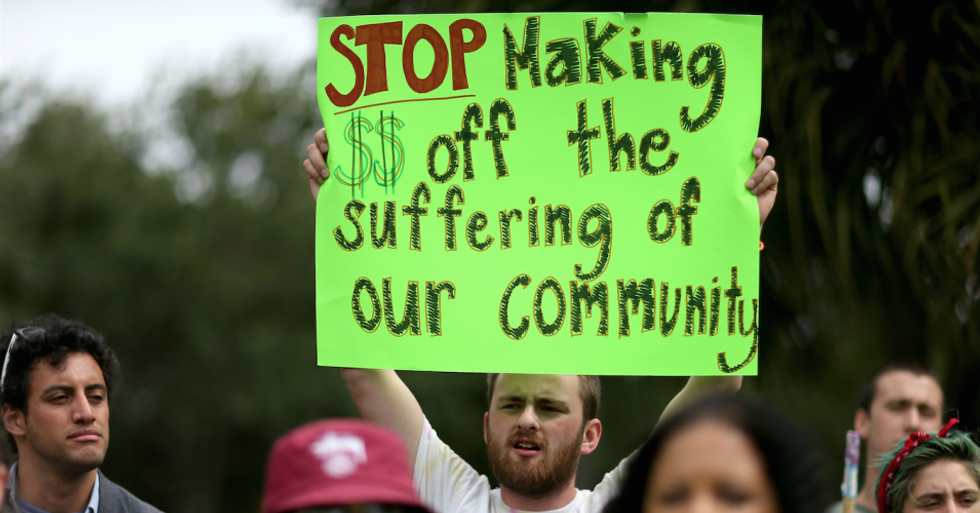
Investors in the private prison industry in the U.S. will see major tax cuts under the new Republican tax law, making the unpopular law beneficial for those who count on the country's mass incarceration crisis for financial gain.
Investments in for-profit prisons will go from 39.6 to 29.6 percent, thanks to the industry's classification within the tax code.
In a move critics including Sen. Ron Wyden (D-Ore.) have called "unjust" and "unfair," private prison corporations including CoreCivic (formerly the Corrections Corporation of America, or CCA) and the Geo Group have been structured as "real estate investment trusts" since 2013. The companies have argued that by housing inmates for the government, they operate in the same way as any company that charges a tenant rent. The restructuring has allowed the companies to pay far less than the corporate tax rate they paid prior to 2013, and now those who own private prison shares will benefit as well.
"It's going to be great for the investors, banks and hedge funds that...are dependent on increased incarceration and criminalization," Jamie Trinkle of the racial and economic justice coalition Enlace, told the Guardian.
Investors in the $4 billion industry can expect to see an additional $50 million in earnings from dividends in 2018, according to the Guardian.
Private prisons have found an ally in President Donald Trump and his administration, following efforts by President Barack Obama to phase out the use of for-profit detention facilities. The Geo Group hosted its annual leadership conference at one of the president's golf clubs shortly before being awarded a government contract to run an immigration detention center.
Attorney General Jeff Sessions also quickly reversed Obama's directive to move away from the use of for-profit prisons, arguing that doing so would impair the government's "ability to meet the future needs of the federal correctional system." Critics have pointed to reports like one released in 2016 by the Justice Department's own Office of the Inspector General, which found that private prisons are far less safe than those run by the government.
They've also urged companies to divest from the for-profit incarceration industry as a way of limiting private prisons' power. Enlace has targeted investors in CoreCivic and Geo Group, successfully pressuring cities, universities, and financial institutions to end their investment in the businesses and their major lenders.
On social media, critics denounced reports of even more profits for those who have a stake in mass incarceration.
Investors in the private prison industry in the U.S. will see major tax cuts under the new Republican tax law, making the unpopular law beneficial for those who count on the country's mass incarceration crisis for financial gain.
Investments in for-profit prisons will go from 39.6 to 29.6 percent, thanks to the industry's classification within the tax code.
In a move critics including Sen. Ron Wyden (D-Ore.) have called "unjust" and "unfair," private prison corporations including CoreCivic (formerly the Corrections Corporation of America, or CCA) and the Geo Group have been structured as "real estate investment trusts" since 2013. The companies have argued that by housing inmates for the government, they operate in the same way as any company that charges a tenant rent. The restructuring has allowed the companies to pay far less than the corporate tax rate they paid prior to 2013, and now those who own private prison shares will benefit as well.
"It's going to be great for the investors, banks and hedge funds that...are dependent on increased incarceration and criminalization," Jamie Trinkle of the racial and economic justice coalition Enlace, told the Guardian.
Investors in the $4 billion industry can expect to see an additional $50 million in earnings from dividends in 2018, according to the Guardian.
Private prisons have found an ally in President Donald Trump and his administration, following efforts by President Barack Obama to phase out the use of for-profit detention facilities. The Geo Group hosted its annual leadership conference at one of the president's golf clubs shortly before being awarded a government contract to run an immigration detention center.
Attorney General Jeff Sessions also quickly reversed Obama's directive to move away from the use of for-profit prisons, arguing that doing so would impair the government's "ability to meet the future needs of the federal correctional system." Critics have pointed to reports like one released in 2016 by the Justice Department's own Office of the Inspector General, which found that private prisons are far less safe than those run by the government.
They've also urged companies to divest from the for-profit incarceration industry as a way of limiting private prisons' power. Enlace has targeted investors in CoreCivic and Geo Group, successfully pressuring cities, universities, and financial institutions to end their investment in the businesses and their major lenders.
On social media, critics denounced reports of even more profits for those who have a stake in mass incarceration.
Investors in the private prison industry in the U.S. will see major tax cuts under the new Republican tax law, making the unpopular law beneficial for those who count on the country's mass incarceration crisis for financial gain.
Investments in for-profit prisons will go from 39.6 to 29.6 percent, thanks to the industry's classification within the tax code.
In a move critics including Sen. Ron Wyden (D-Ore.) have called "unjust" and "unfair," private prison corporations including CoreCivic (formerly the Corrections Corporation of America, or CCA) and the Geo Group have been structured as "real estate investment trusts" since 2013. The companies have argued that by housing inmates for the government, they operate in the same way as any company that charges a tenant rent. The restructuring has allowed the companies to pay far less than the corporate tax rate they paid prior to 2013, and now those who own private prison shares will benefit as well.
"It's going to be great for the investors, banks and hedge funds that...are dependent on increased incarceration and criminalization," Jamie Trinkle of the racial and economic justice coalition Enlace, told the Guardian.
Investors in the $4 billion industry can expect to see an additional $50 million in earnings from dividends in 2018, according to the Guardian.
Private prisons have found an ally in President Donald Trump and his administration, following efforts by President Barack Obama to phase out the use of for-profit detention facilities. The Geo Group hosted its annual leadership conference at one of the president's golf clubs shortly before being awarded a government contract to run an immigration detention center.
Attorney General Jeff Sessions also quickly reversed Obama's directive to move away from the use of for-profit prisons, arguing that doing so would impair the government's "ability to meet the future needs of the federal correctional system." Critics have pointed to reports like one released in 2016 by the Justice Department's own Office of the Inspector General, which found that private prisons are far less safe than those run by the government.
They've also urged companies to divest from the for-profit incarceration industry as a way of limiting private prisons' power. Enlace has targeted investors in CoreCivic and Geo Group, successfully pressuring cities, universities, and financial institutions to end their investment in the businesses and their major lenders.
On social media, critics denounced reports of even more profits for those who have a stake in mass incarceration.