SUBSCRIBE TO OUR FREE NEWSLETTER
Daily news & progressive opinion—funded by the people, not the corporations—delivered straight to your inbox.
5
#000000
#FFFFFF
To donate by check, phone, or other method, see our More Ways to Give page.
Daily news & progressive opinion—funded by the people, not the corporations—delivered straight to your inbox.
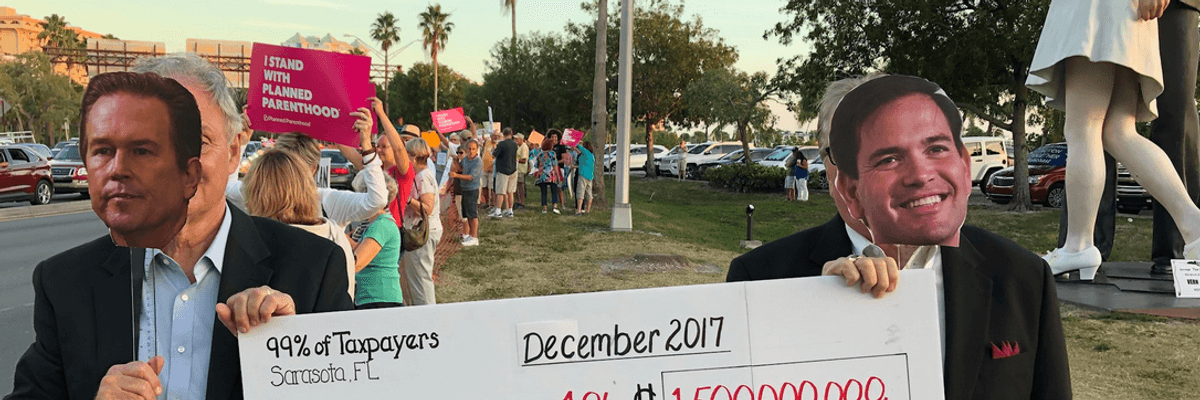
Protesters took to the streets ahead of Congress's passage of the Republican tax plan, demanding their representatives vote against the legislation, which was expected to benefit rich Americans including President Trump. A new analysis by the Center for American Progress shows the critics were correct. (Photo: @zacjanderson/Twitter)
After weeks of touting his tax plan's benefits for the middle class and denying it would enrich him personally, President Trump and several members of his administration are expected to save millions per year on their taxes thanks to the unpopular legislation, according to analysis by the Center for American Progress (CAP)w.
The president can expect to save between $11 million and $15 million per year due to sweeping cuts to pass-through business income. According to what little is known of Trump's finances, due to his refusal to release his tax returns to the public, he has an estimated annual income of approximately $150 million.
"There is no doubt that Trump is getting major new tax cuts from this bill--at the same time as it preserves special loopholes, like the deductions Trump reportedly takes on his golf courses," Seth Hanlon, a senior fellow at CAP, told the Guardian. "These are just one illustration of the venality and corruption behind this bill."
Trump's son-in-law and advisor, Jared Kushner, is expected to save up to $12 million, while his billionaire Secretary of Education, Betsy DeVos, will receive a tax cut of $2.7 million.
"I think that the American people, whether they receive a tax increase or tax cut from this bill, are outraged that President Trump, his cabinet, and members of Congress stand to receive big payouts from this tax bill," said Hanlon.
The analysis was released shortly after President Donald Trump blurted out an admission that reducing the corporate tax rate was "probably the biggest factor" in the Republicans' tax plan, despite repeated claims by the White House and Republican leaders that the legislation was drafted with the middle class in mind.
While Trump and Republican congressional leaders have been especially focused on convincing Americans that farmers and small business owners will reap rewards from their changes to the estate tax, the president and his cabinet members are among the very small group of richest families who will see any benefit from the changes. Trump's heirs stand to save $4.5 million, as do the families of Commerce Secretary Wilbur Ross, Treasury Secretary Steve Mnuchin, and Secretary of State Rex Tillerson.
As Common Dreams reported while the GOP was promoting its plan, the estate tax only impacts families who transfer or inherit fortunes greater than $5.5 million--about 5,000 American households.
Even before CAP released its report, the public largely perceived the Republican tax plan as mainly benefiting the wealthiest Americans.
On social media, a number of critics condemned the president and his top officials for their celebration of a bill clearly meant to enrich them while middle-class families receive relatively meager and short-term benefits.
This country and this world are at a monumental crossroads. US voters have an opportunity to beat back the forces of fascism and confront the billionaires who are rigging the economy, our media system, and our democracy, making it increasingly impossible for ordinary people to get by. We’re not just talking about the election. We’re talking about what must be done once these fascist elements are vanquished from power. We need a bolder set of solutions than what either major party has so far been willing to offer and a working-class movement ready to fight like hell for it. Trump didn't emerge from nowhere. The conditions that fueled MAGA authoritarianism were created by decades of radical neoliberal economic policies and a corrupt political system dominated by corporate interests. They slashed taxes on the super-rich, promising that the benefits would trickle down. They said giveaways to the corporate titans would make life more affordable for the rest of us. It was all bullshit. And when a bitter, betrayed populace searches for someone to blame, right-wing demagogues have little trouble finding scapegoats. People know when they're being lied to, but you won't hear any of this from the corporate media. Only independent journalism—powered and funded by people who believe in building a better world—can deliver truly trustworthy daily news. If you share our vision, please contribute whatever you can to sustain our work. |
After weeks of touting his tax plan's benefits for the middle class and denying it would enrich him personally, President Trump and several members of his administration are expected to save millions per year on their taxes thanks to the unpopular legislation, according to analysis by the Center for American Progress (CAP)w.
The president can expect to save between $11 million and $15 million per year due to sweeping cuts to pass-through business income. According to what little is known of Trump's finances, due to his refusal to release his tax returns to the public, he has an estimated annual income of approximately $150 million.
"There is no doubt that Trump is getting major new tax cuts from this bill--at the same time as it preserves special loopholes, like the deductions Trump reportedly takes on his golf courses," Seth Hanlon, a senior fellow at CAP, told the Guardian. "These are just one illustration of the venality and corruption behind this bill."
Trump's son-in-law and advisor, Jared Kushner, is expected to save up to $12 million, while his billionaire Secretary of Education, Betsy DeVos, will receive a tax cut of $2.7 million.
"I think that the American people, whether they receive a tax increase or tax cut from this bill, are outraged that President Trump, his cabinet, and members of Congress stand to receive big payouts from this tax bill," said Hanlon.
The analysis was released shortly after President Donald Trump blurted out an admission that reducing the corporate tax rate was "probably the biggest factor" in the Republicans' tax plan, despite repeated claims by the White House and Republican leaders that the legislation was drafted with the middle class in mind.
While Trump and Republican congressional leaders have been especially focused on convincing Americans that farmers and small business owners will reap rewards from their changes to the estate tax, the president and his cabinet members are among the very small group of richest families who will see any benefit from the changes. Trump's heirs stand to save $4.5 million, as do the families of Commerce Secretary Wilbur Ross, Treasury Secretary Steve Mnuchin, and Secretary of State Rex Tillerson.
As Common Dreams reported while the GOP was promoting its plan, the estate tax only impacts families who transfer or inherit fortunes greater than $5.5 million--about 5,000 American households.
Even before CAP released its report, the public largely perceived the Republican tax plan as mainly benefiting the wealthiest Americans.
On social media, a number of critics condemned the president and his top officials for their celebration of a bill clearly meant to enrich them while middle-class families receive relatively meager and short-term benefits.