SUBSCRIBE TO OUR FREE NEWSLETTER
Daily news & progressive opinion—funded by the people, not the corporations—delivered straight to your inbox.
5
#000000
#FFFFFF
To donate by check, phone, or other method, see our More Ways to Give page.
Daily news & progressive opinion—funded by the people, not the corporations—delivered straight to your inbox.
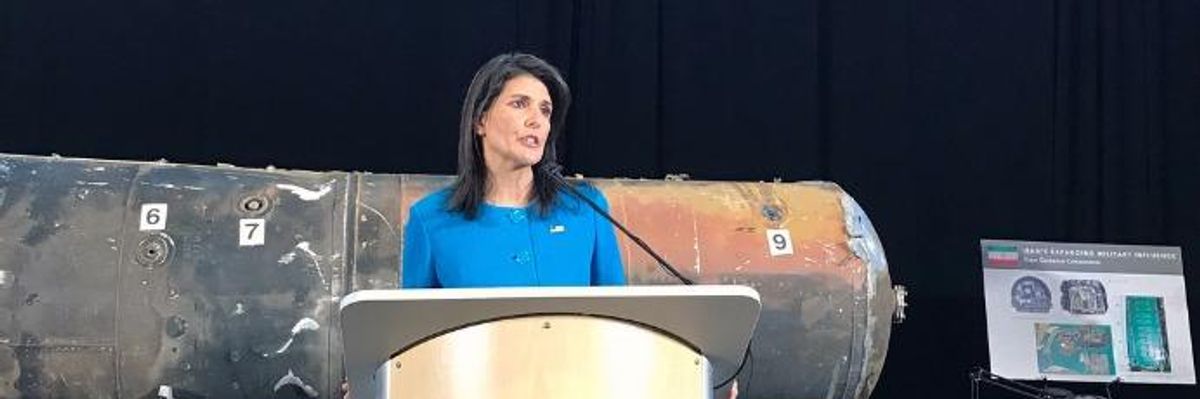
"The U.S. goverment has an agenda and is constantly at work to deceive the public into believing the cases they put together to advance it," Iran said in a statement. (Photo: Josh Lederman/Twitter)
In a presentation critics characterized as remarkably similar to former Secretary of State Colin Powell's case for the Iraq War, U.S. ambassador to the United Nations Nikki Haley stood before a missile fragment that she claimed bears Iran's "fingerprints" and asserted that the Iranian regime poses "a threat to the peace and security of the entire world."
"Make no mistake: What Nikki Haley is doing right now is laying the groundwork for a U.S.-Iran war on behalf of Saudi Arabia."
--Trita Parsi, National Iranian American Council
"It's hard to find a conflict or a terrorist group in the Middle East that does not have Iran's fingerprints all over it," Haley said in a speech delivered at Joint Base Anacostia-Bolling, located just outside the nation's capital. Haley went on to suggest that the fragment theatrically positioned behind her on wooden pallets was part of a missile Houthi rebels fired into Saudi Arabia from Yemen last month.
Citing a report by U.N. Secretary General Antonio Guterres, Haley insisted that the evidence showing Iran provided the Houthis with the missile--and thus violated U.N. resolutions--is "irrefutable" and "undeniable."
In a statement, Iran fiercely denied Haley's allegations, saying they were "fabricated" with the goal of "cover[ing] up for the Saudi war crimes in Yemen," which have been carried out with "U.S. complicity."
In response to Haley's remarks, American analysts also called attention to the direct and protracted role the U.S. government has played, and continues to play, in the ongoing war and Yemen's humanitarian crisis. Spencer Ackerman, national security reporter for the Daily Beast, wrote: "Wonder when Iran holds its press conference to highlight all the American and British munitions the Saudis have used on hospitals, the Sanaa airport, etc."
Experts and some members of the international community also expressed doubts that Haley's "evidence" for Iran's connection to Houthi rebels in Yemen was as strong as she claimed. "Info I have is less clear," Olof Skoog, Sweden's ambassador to the U.N., said when asked about Haley's assertions.
Reza Marashi, research director for the National Iranian American Council (NIAC), pointed out that the U.N. report Haley cited as "devastating" proof against Iran has not even been completed, and thus cannot possibly amount to "irrefutable" evidence.
"As is the case with so many claims from the Trump administration, it appears that the facts are being chosen to fit a predetermined narrative or policy goal," Marashi concluded.
It was also "a hell of a day" for the U.S. to accuse Iran of arming Houthi rebels, some commentators observed, given new reports that American arms sent to Syrian opposition groups "frequently ended up in the hands" of ISIS fighters.
While Haley was vague about the ultimate implications of her case against Iran, many commentators argued that the dramatic presentation--which comes just a month before President Donald Trump is required to certify whether Iran is complying with the nuclear deal--indicates that the U.S. is slowly building up a rationale for war.
"Make no mistake: What Nikki Haley is doing right now is laying the groundwork for a U.S.-Iran war on behalf of Saudi Arabia," concluded Trita Parsi, president of the National Iranian American Council.
Dear Common Dreams reader, It’s been nearly 30 years since I co-founded Common Dreams with my late wife, Lina Newhouser. We had the radical notion that journalism should serve the public good, not corporate profits. It was clear to us from the outset what it would take to build such a project. No paid advertisements. No corporate sponsors. No millionaire publisher telling us what to think or do. Many people said we wouldn't last a year, but we proved those doubters wrong. Together with a tremendous team of journalists and dedicated staff, we built an independent media outlet free from the constraints of profits and corporate control. Our mission has always been simple: To inform. To inspire. To ignite change for the common good. Building Common Dreams was not easy. Our survival was never guaranteed. When you take on the most powerful forces—Wall Street greed, fossil fuel industry destruction, Big Tech lobbyists, and uber-rich oligarchs who have spent billions upon billions rigging the economy and democracy in their favor—the only bulwark you have is supporters who believe in your work. But here’s the urgent message from me today. It's never been this bad out there. And it's never been this hard to keep us going. At the very moment Common Dreams is most needed, the threats we face are intensifying. We need your support now more than ever. We don't accept corporate advertising and never will. We don't have a paywall because we don't think people should be blocked from critical news based on their ability to pay. Everything we do is funded by the donations of readers like you. When everyone does the little they can afford, we are strong. But if that support retreats or dries up, so do we. Will you donate now to make sure Common Dreams not only survives but thrives? —Craig Brown, Co-founder |
In a presentation critics characterized as remarkably similar to former Secretary of State Colin Powell's case for the Iraq War, U.S. ambassador to the United Nations Nikki Haley stood before a missile fragment that she claimed bears Iran's "fingerprints" and asserted that the Iranian regime poses "a threat to the peace and security of the entire world."
"Make no mistake: What Nikki Haley is doing right now is laying the groundwork for a U.S.-Iran war on behalf of Saudi Arabia."
--Trita Parsi, National Iranian American Council
"It's hard to find a conflict or a terrorist group in the Middle East that does not have Iran's fingerprints all over it," Haley said in a speech delivered at Joint Base Anacostia-Bolling, located just outside the nation's capital. Haley went on to suggest that the fragment theatrically positioned behind her on wooden pallets was part of a missile Houthi rebels fired into Saudi Arabia from Yemen last month.
Citing a report by U.N. Secretary General Antonio Guterres, Haley insisted that the evidence showing Iran provided the Houthis with the missile--and thus violated U.N. resolutions--is "irrefutable" and "undeniable."
In a statement, Iran fiercely denied Haley's allegations, saying they were "fabricated" with the goal of "cover[ing] up for the Saudi war crimes in Yemen," which have been carried out with "U.S. complicity."
In response to Haley's remarks, American analysts also called attention to the direct and protracted role the U.S. government has played, and continues to play, in the ongoing war and Yemen's humanitarian crisis. Spencer Ackerman, national security reporter for the Daily Beast, wrote: "Wonder when Iran holds its press conference to highlight all the American and British munitions the Saudis have used on hospitals, the Sanaa airport, etc."
Experts and some members of the international community also expressed doubts that Haley's "evidence" for Iran's connection to Houthi rebels in Yemen was as strong as she claimed. "Info I have is less clear," Olof Skoog, Sweden's ambassador to the U.N., said when asked about Haley's assertions.
Reza Marashi, research director for the National Iranian American Council (NIAC), pointed out that the U.N. report Haley cited as "devastating" proof against Iran has not even been completed, and thus cannot possibly amount to "irrefutable" evidence.
"As is the case with so many claims from the Trump administration, it appears that the facts are being chosen to fit a predetermined narrative or policy goal," Marashi concluded.
It was also "a hell of a day" for the U.S. to accuse Iran of arming Houthi rebels, some commentators observed, given new reports that American arms sent to Syrian opposition groups "frequently ended up in the hands" of ISIS fighters.
While Haley was vague about the ultimate implications of her case against Iran, many commentators argued that the dramatic presentation--which comes just a month before President Donald Trump is required to certify whether Iran is complying with the nuclear deal--indicates that the U.S. is slowly building up a rationale for war.
"Make no mistake: What Nikki Haley is doing right now is laying the groundwork for a U.S.-Iran war on behalf of Saudi Arabia," concluded Trita Parsi, president of the National Iranian American Council.
In a presentation critics characterized as remarkably similar to former Secretary of State Colin Powell's case for the Iraq War, U.S. ambassador to the United Nations Nikki Haley stood before a missile fragment that she claimed bears Iran's "fingerprints" and asserted that the Iranian regime poses "a threat to the peace and security of the entire world."
"Make no mistake: What Nikki Haley is doing right now is laying the groundwork for a U.S.-Iran war on behalf of Saudi Arabia."
--Trita Parsi, National Iranian American Council
"It's hard to find a conflict or a terrorist group in the Middle East that does not have Iran's fingerprints all over it," Haley said in a speech delivered at Joint Base Anacostia-Bolling, located just outside the nation's capital. Haley went on to suggest that the fragment theatrically positioned behind her on wooden pallets was part of a missile Houthi rebels fired into Saudi Arabia from Yemen last month.
Citing a report by U.N. Secretary General Antonio Guterres, Haley insisted that the evidence showing Iran provided the Houthis with the missile--and thus violated U.N. resolutions--is "irrefutable" and "undeniable."
In a statement, Iran fiercely denied Haley's allegations, saying they were "fabricated" with the goal of "cover[ing] up for the Saudi war crimes in Yemen," which have been carried out with "U.S. complicity."
In response to Haley's remarks, American analysts also called attention to the direct and protracted role the U.S. government has played, and continues to play, in the ongoing war and Yemen's humanitarian crisis. Spencer Ackerman, national security reporter for the Daily Beast, wrote: "Wonder when Iran holds its press conference to highlight all the American and British munitions the Saudis have used on hospitals, the Sanaa airport, etc."
Experts and some members of the international community also expressed doubts that Haley's "evidence" for Iran's connection to Houthi rebels in Yemen was as strong as she claimed. "Info I have is less clear," Olof Skoog, Sweden's ambassador to the U.N., said when asked about Haley's assertions.
Reza Marashi, research director for the National Iranian American Council (NIAC), pointed out that the U.N. report Haley cited as "devastating" proof against Iran has not even been completed, and thus cannot possibly amount to "irrefutable" evidence.
"As is the case with so many claims from the Trump administration, it appears that the facts are being chosen to fit a predetermined narrative or policy goal," Marashi concluded.
It was also "a hell of a day" for the U.S. to accuse Iran of arming Houthi rebels, some commentators observed, given new reports that American arms sent to Syrian opposition groups "frequently ended up in the hands" of ISIS fighters.
While Haley was vague about the ultimate implications of her case against Iran, many commentators argued that the dramatic presentation--which comes just a month before President Donald Trump is required to certify whether Iran is complying with the nuclear deal--indicates that the U.S. is slowly building up a rationale for war.
"Make no mistake: What Nikki Haley is doing right now is laying the groundwork for a U.S.-Iran war on behalf of Saudi Arabia," concluded Trita Parsi, president of the National Iranian American Council.