SUBSCRIBE TO OUR FREE NEWSLETTER
Daily news & progressive opinion—funded by the people, not the corporations—delivered straight to your inbox.
5
#000000
#FFFFFF
To donate by check, phone, or other method, see our More Ways to Give page.
Daily news & progressive opinion—funded by the people, not the corporations—delivered straight to your inbox.
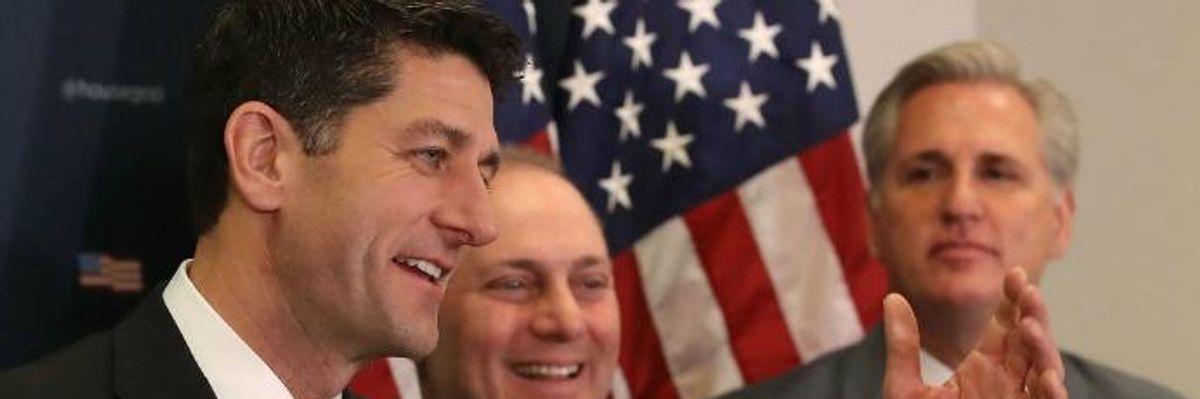
House Speaker Paul Ryan (R-Wis.) speaks while flanked by House Majority Whip Steve Scalise (R-La.) and House Majority Leader Kevin McCarthy (R-Calif.) during a news conference on Capitol Hill December 5, 2017 in Washington, D.C. (Photo: Mark Wilson/Getty Images)
While tax experts continue to exclaim with horror as they sift through the "legislative monstrosity" Republicans rammed through the Senate last week, Sens. Elizabeth Warren (D-Mass.) and Bernie Sanders (I-Vt.) on Wednesday hosted a Facebook live event aimed at detailing the next steps in the fight against both the GOP's tax plan and the party's broader economic agenda.
"They want to run up the deficit and then say a high debt is the reason they've gotta cut all the things for working people."
--Sen. Elizabeth Warren (D-Mass.)One of the most significant battles ahead, Sanders and Warren note, will be over Republican efforts to pivot from "tax reform" to the pursuit of devastating cuts to safety net programs that low-income and middle class families rely upon to put food on the table and afford life-saving medical care.
"Literally minutes after they passed this disastrous [tax] bill in the Senate, the discussion escalates. Of course they're going to cut Social Security, Medicare, and Medicaid," Sanders said. "And you know why? This is shocking: the deficit is too big."
"That's right," Warren added, calling the Republican tax plan a "pay off" to right-wing billionaire donors. "They want to run up the deficit and then say a high debt is the reason they've gotta cut all the things for working people."
Watch:
This GOP plot to use the deficit created by their own legislation to justify deep cuts to social programs is hardly a secret. As the Washington Post's Jeff Stein reported on Wednesday, Republicans are discussing their plans openly and proudly.
"President Trump and top Republican officials have signaled prioritizing welfare cuts, including new restrictions on who can receive benefits like food stamps, housing assistance, and direct cash welfare for the poor," Stein notes, quoting several Republican lawmakers who seem giddy at the prospect of "welfare reform."
In an appearance on a right-wing radio show Wednesday morning, House Speaker Paul Ryan (R-Wis.) honed in on Medicare as "the biggest entitlement we've got to reform" and expressed confidence that Trump would approve of such a plan, despite his campaign promises.
Rep. Rod Blum (R-Iowa) added in an interview with the Post that "welfare reform" is necessary "to achieve three percent GDP growth over the next 10 years."
"Welfare reform isn't about fixing the debt, or growing the labor force. It's about flattering the ideological prejudices of Republican donors."
--Eric Levitz, New York Magazine
"In my district, a lot of employers can't find employees," Blum added. "Sometimes we need to force people to go to work."
As Stein notes, Blum--like other proponents of "welfare reform"--neglects to mention the fact that most recipients of food stamps and other major safety net programs already have jobs.
Sharon Parrott, a senior counselor the Center on Budget and Policy Priorities (CBPP), concluded that Republicans' "far-fetched" economic justifications for welfare reform obscure the fact that cuts to food stamps and other social programs would do little more "than take away food from people who need it."
"Welfare reform isn't about fixing the debt, or growing the labor force," adds Eric Levitz of New York Magazine. "It's about flattering the ideological prejudices of Republican donors--and reminding the party's voters which parasitic social class they're supposed to hate."
Nonetheless, many of the GOP's proposed "reforms" are already well underway. Politico reported on Tuesday that Trump's Agriculture Department is taking steps toward giving states "greater flexibility over how they administer food stamps"--which, in practical terms, means prohibitive work requirements, mandatory drug testing on all recipients, and other restrictions.
In response to these developments, progressive groups and activists who have worked for months to kill the GOP tax scam are increasingly raising alarm about the coming "onslaught" against social programs, which is coming before the Republican tax bill has even reached Trump's desk.
As part of the mass effort to call attention to and combat Republicans' efforts, Public Citizen, Indivisible, Planned Parenthood, and more than a dozen other organizations teamed up recently to launch Hands Off, a "campaign dedicated to stopping cuts to people's healthcare, disability benefits, nutrition assistance, and other basic living standards in the upcoming congressional budgets."
"President Donald Trump's and the congressional Republicans' budgets are cutting access to basic living standards--everything from jobs to education, housing, Meals on Wheels, food assistance, environmental protections, and disability programs--all to pay for tax cuts for millionaires and corporations," the groups said.
Dear Common Dreams reader, It’s been nearly 30 years since I co-founded Common Dreams with my late wife, Lina Newhouser. We had the radical notion that journalism should serve the public good, not corporate profits. It was clear to us from the outset what it would take to build such a project. No paid advertisements. No corporate sponsors. No millionaire publisher telling us what to think or do. Many people said we wouldn't last a year, but we proved those doubters wrong. Together with a tremendous team of journalists and dedicated staff, we built an independent media outlet free from the constraints of profits and corporate control. Our mission has always been simple: To inform. To inspire. To ignite change for the common good. Building Common Dreams was not easy. Our survival was never guaranteed. When you take on the most powerful forces—Wall Street greed, fossil fuel industry destruction, Big Tech lobbyists, and uber-rich oligarchs who have spent billions upon billions rigging the economy and democracy in their favor—the only bulwark you have is supporters who believe in your work. But here’s the urgent message from me today. It's never been this bad out there. And it's never been this hard to keep us going. At the very moment Common Dreams is most needed, the threats we face are intensifying. We need your support now more than ever. We don't accept corporate advertising and never will. We don't have a paywall because we don't think people should be blocked from critical news based on their ability to pay. Everything we do is funded by the donations of readers like you. When everyone does the little they can afford, we are strong. But if that support retreats or dries up, so do we. Will you donate now to make sure Common Dreams not only survives but thrives? —Craig Brown, Co-founder |
While tax experts continue to exclaim with horror as they sift through the "legislative monstrosity" Republicans rammed through the Senate last week, Sens. Elizabeth Warren (D-Mass.) and Bernie Sanders (I-Vt.) on Wednesday hosted a Facebook live event aimed at detailing the next steps in the fight against both the GOP's tax plan and the party's broader economic agenda.
"They want to run up the deficit and then say a high debt is the reason they've gotta cut all the things for working people."
--Sen. Elizabeth Warren (D-Mass.)One of the most significant battles ahead, Sanders and Warren note, will be over Republican efforts to pivot from "tax reform" to the pursuit of devastating cuts to safety net programs that low-income and middle class families rely upon to put food on the table and afford life-saving medical care.
"Literally minutes after they passed this disastrous [tax] bill in the Senate, the discussion escalates. Of course they're going to cut Social Security, Medicare, and Medicaid," Sanders said. "And you know why? This is shocking: the deficit is too big."
"That's right," Warren added, calling the Republican tax plan a "pay off" to right-wing billionaire donors. "They want to run up the deficit and then say a high debt is the reason they've gotta cut all the things for working people."
Watch:
This GOP plot to use the deficit created by their own legislation to justify deep cuts to social programs is hardly a secret. As the Washington Post's Jeff Stein reported on Wednesday, Republicans are discussing their plans openly and proudly.
"President Trump and top Republican officials have signaled prioritizing welfare cuts, including new restrictions on who can receive benefits like food stamps, housing assistance, and direct cash welfare for the poor," Stein notes, quoting several Republican lawmakers who seem giddy at the prospect of "welfare reform."
In an appearance on a right-wing radio show Wednesday morning, House Speaker Paul Ryan (R-Wis.) honed in on Medicare as "the biggest entitlement we've got to reform" and expressed confidence that Trump would approve of such a plan, despite his campaign promises.
Rep. Rod Blum (R-Iowa) added in an interview with the Post that "welfare reform" is necessary "to achieve three percent GDP growth over the next 10 years."
"Welfare reform isn't about fixing the debt, or growing the labor force. It's about flattering the ideological prejudices of Republican donors."
--Eric Levitz, New York Magazine
"In my district, a lot of employers can't find employees," Blum added. "Sometimes we need to force people to go to work."
As Stein notes, Blum--like other proponents of "welfare reform"--neglects to mention the fact that most recipients of food stamps and other major safety net programs already have jobs.
Sharon Parrott, a senior counselor the Center on Budget and Policy Priorities (CBPP), concluded that Republicans' "far-fetched" economic justifications for welfare reform obscure the fact that cuts to food stamps and other social programs would do little more "than take away food from people who need it."
"Welfare reform isn't about fixing the debt, or growing the labor force," adds Eric Levitz of New York Magazine. "It's about flattering the ideological prejudices of Republican donors--and reminding the party's voters which parasitic social class they're supposed to hate."
Nonetheless, many of the GOP's proposed "reforms" are already well underway. Politico reported on Tuesday that Trump's Agriculture Department is taking steps toward giving states "greater flexibility over how they administer food stamps"--which, in practical terms, means prohibitive work requirements, mandatory drug testing on all recipients, and other restrictions.
In response to these developments, progressive groups and activists who have worked for months to kill the GOP tax scam are increasingly raising alarm about the coming "onslaught" against social programs, which is coming before the Republican tax bill has even reached Trump's desk.
As part of the mass effort to call attention to and combat Republicans' efforts, Public Citizen, Indivisible, Planned Parenthood, and more than a dozen other organizations teamed up recently to launch Hands Off, a "campaign dedicated to stopping cuts to people's healthcare, disability benefits, nutrition assistance, and other basic living standards in the upcoming congressional budgets."
"President Donald Trump's and the congressional Republicans' budgets are cutting access to basic living standards--everything from jobs to education, housing, Meals on Wheels, food assistance, environmental protections, and disability programs--all to pay for tax cuts for millionaires and corporations," the groups said.
While tax experts continue to exclaim with horror as they sift through the "legislative monstrosity" Republicans rammed through the Senate last week, Sens. Elizabeth Warren (D-Mass.) and Bernie Sanders (I-Vt.) on Wednesday hosted a Facebook live event aimed at detailing the next steps in the fight against both the GOP's tax plan and the party's broader economic agenda.
"They want to run up the deficit and then say a high debt is the reason they've gotta cut all the things for working people."
--Sen. Elizabeth Warren (D-Mass.)One of the most significant battles ahead, Sanders and Warren note, will be over Republican efforts to pivot from "tax reform" to the pursuit of devastating cuts to safety net programs that low-income and middle class families rely upon to put food on the table and afford life-saving medical care.
"Literally minutes after they passed this disastrous [tax] bill in the Senate, the discussion escalates. Of course they're going to cut Social Security, Medicare, and Medicaid," Sanders said. "And you know why? This is shocking: the deficit is too big."
"That's right," Warren added, calling the Republican tax plan a "pay off" to right-wing billionaire donors. "They want to run up the deficit and then say a high debt is the reason they've gotta cut all the things for working people."
Watch:
This GOP plot to use the deficit created by their own legislation to justify deep cuts to social programs is hardly a secret. As the Washington Post's Jeff Stein reported on Wednesday, Republicans are discussing their plans openly and proudly.
"President Trump and top Republican officials have signaled prioritizing welfare cuts, including new restrictions on who can receive benefits like food stamps, housing assistance, and direct cash welfare for the poor," Stein notes, quoting several Republican lawmakers who seem giddy at the prospect of "welfare reform."
In an appearance on a right-wing radio show Wednesday morning, House Speaker Paul Ryan (R-Wis.) honed in on Medicare as "the biggest entitlement we've got to reform" and expressed confidence that Trump would approve of such a plan, despite his campaign promises.
Rep. Rod Blum (R-Iowa) added in an interview with the Post that "welfare reform" is necessary "to achieve three percent GDP growth over the next 10 years."
"Welfare reform isn't about fixing the debt, or growing the labor force. It's about flattering the ideological prejudices of Republican donors."
--Eric Levitz, New York Magazine
"In my district, a lot of employers can't find employees," Blum added. "Sometimes we need to force people to go to work."
As Stein notes, Blum--like other proponents of "welfare reform"--neglects to mention the fact that most recipients of food stamps and other major safety net programs already have jobs.
Sharon Parrott, a senior counselor the Center on Budget and Policy Priorities (CBPP), concluded that Republicans' "far-fetched" economic justifications for welfare reform obscure the fact that cuts to food stamps and other social programs would do little more "than take away food from people who need it."
"Welfare reform isn't about fixing the debt, or growing the labor force," adds Eric Levitz of New York Magazine. "It's about flattering the ideological prejudices of Republican donors--and reminding the party's voters which parasitic social class they're supposed to hate."
Nonetheless, many of the GOP's proposed "reforms" are already well underway. Politico reported on Tuesday that Trump's Agriculture Department is taking steps toward giving states "greater flexibility over how they administer food stamps"--which, in practical terms, means prohibitive work requirements, mandatory drug testing on all recipients, and other restrictions.
In response to these developments, progressive groups and activists who have worked for months to kill the GOP tax scam are increasingly raising alarm about the coming "onslaught" against social programs, which is coming before the Republican tax bill has even reached Trump's desk.
As part of the mass effort to call attention to and combat Republicans' efforts, Public Citizen, Indivisible, Planned Parenthood, and more than a dozen other organizations teamed up recently to launch Hands Off, a "campaign dedicated to stopping cuts to people's healthcare, disability benefits, nutrition assistance, and other basic living standards in the upcoming congressional budgets."
"President Donald Trump's and the congressional Republicans' budgets are cutting access to basic living standards--everything from jobs to education, housing, Meals on Wheels, food assistance, environmental protections, and disability programs--all to pay for tax cuts for millionaires and corporations," the groups said.