SUBSCRIBE TO OUR FREE NEWSLETTER
Daily news & progressive opinion—funded by the people, not the corporations—delivered straight to your inbox.
5
#000000
#FFFFFF
To donate by check, phone, or other method, see our More Ways to Give page.
Daily news & progressive opinion—funded by the people, not the corporations—delivered straight to your inbox.
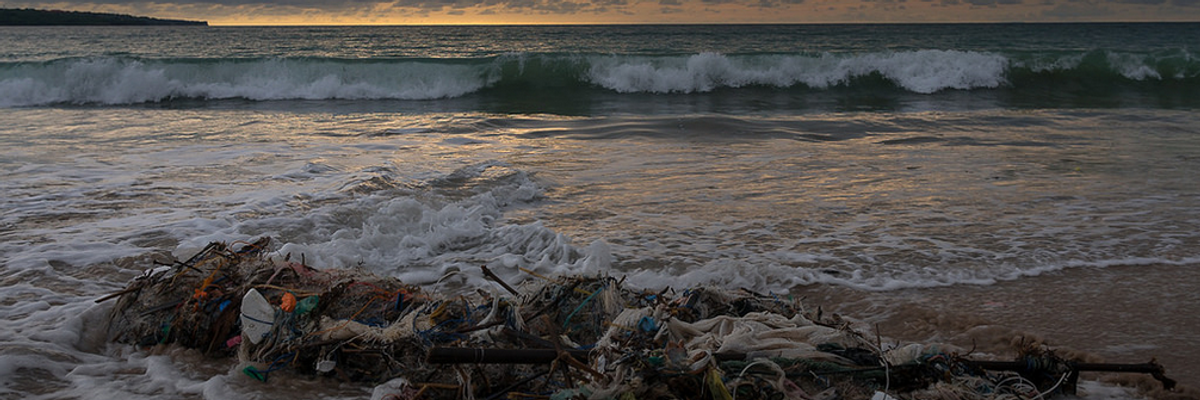
Plastic bags, bottles and other trash entangled in spent fishing nets litter Jimbaran beach on the island of Bali, Indonesia. (Photo: Onny Carr/Flickr/cc)
While renowned naturalist Sir David Attenborough warned the world's oceans are "under threat now as never before in human history," green groups on Tuesday said a United Nations resolution to end plastic pollution in the world's oceans does not go nearly far enough to combat the problem, and stressed that more urgent action is needed to eradicate the damage before it's too late.
Attenborough's new BBC documentary series finale airing this weekend will highlight the crisis, drawing attention to the huge amount of plastic that's dumped into oceans and seas every year, as well as the impact of climate change, overfishing, and noise pollution on underwater wildlife.
The final episode of Blue Planet 2 will focus entirely on the damage being done, arguing that humans' actions are the only thing capable of reversing the effects.
"For years we thought the oceans were so vast and the inhabitants so infinitely numerous that nothing we could do could have an effect upon them. But now we know that was wrong," said Attenborough, who narrates the show, in a preview of the episode in the Guardian. "It is now clear our actions are having a significant impact on the world's oceans...Many people believe the oceans have reached a crisis point."
"The future of humanity, and indeed all life on Earth, now depends on us," added Attenborough.
Sharing the broadcaster's sense of urgency, the World Wildlife Fund (WWF) expressed concern that resolutions like the one adopted by the UN don't go far enough in combating the disastrous impact of ocean pollution.
"At last we are seeing some action on this issue, but we still don't have the urgency we need," said Li Lin, director of global policy for WWF, speaking to the BBC about the UN's resolution. "The problem needs solving right now."
The resolution, reached at an environmental summit in Kenya, is not legally binding and includes no timetable. It calls for the creation of an international task force to combat plastic overuse and waste, fighting against decades of lobbying by the plastics industry.
"For years we thought the oceans were so vast and the inhabitants so infinitely numerous that nothing we could do could have an effect upon them. But now we know that was wrong."--Sir David Attenborough
Amid plastic bans and taxes in countries including Kenya, South Africa, and Bangladesh, the industry has pushed media outlets to cover potential job losses that could result from less plastic use, according to a BBC report.
In addition to the damage done by plastics, Blue Planet 2 will detail the bleaching of coral reefs, which have served as ecosystems for fish and other ocean life, brought on by the warming of oceans; the damage done to water when carbon dioxide dissolves in oceans; and the harm done by noise from shipping, tourism, and fossil fuel drilling.
"There is a whole language underwater that we are only just getting a handle on," Steve Simpson, a coral reef researcher at the University of Exeter in England, told the Guardian, explaining that high levels of noise prevent sea animals from communicating with one another.
Another researcher featured in the program concludes that it is "beyond question" that the damage to the oceans is manmade. "The shells and the reefs really, truly are dissolving. The reefs could be gone by the end of the century," said Professor Chris Langdon of the University of Miami.
Consumers buy about one million plastic bottles per minute, according to a Guardian report earlier this year, and Attenborough stressed that a reduction in plastic use is a step people around the world can take immediately to help combat plastic's impact on the oceans.
"What we're going to do about 1.5 degrees rise in the temperature of the ocean over the next 10 years, I don't know, but we could actually do something about plastic right now," he told the newspaper.
Dear Common Dreams reader, It’s been nearly 30 years since I co-founded Common Dreams with my late wife, Lina Newhouser. We had the radical notion that journalism should serve the public good, not corporate profits. It was clear to us from the outset what it would take to build such a project. No paid advertisements. No corporate sponsors. No millionaire publisher telling us what to think or do. Many people said we wouldn't last a year, but we proved those doubters wrong. Together with a tremendous team of journalists and dedicated staff, we built an independent media outlet free from the constraints of profits and corporate control. Our mission has always been simple: To inform. To inspire. To ignite change for the common good. Building Common Dreams was not easy. Our survival was never guaranteed. When you take on the most powerful forces—Wall Street greed, fossil fuel industry destruction, Big Tech lobbyists, and uber-rich oligarchs who have spent billions upon billions rigging the economy and democracy in their favor—the only bulwark you have is supporters who believe in your work. But here’s the urgent message from me today. It's never been this bad out there. And it's never been this hard to keep us going. At the very moment Common Dreams is most needed, the threats we face are intensifying. We need your support now more than ever. We don't accept corporate advertising and never will. We don't have a paywall because we don't think people should be blocked from critical news based on their ability to pay. Everything we do is funded by the donations of readers like you. When everyone does the little they can afford, we are strong. But if that support retreats or dries up, so do we. Will you donate now to make sure Common Dreams not only survives but thrives? —Craig Brown, Co-founder |
While renowned naturalist Sir David Attenborough warned the world's oceans are "under threat now as never before in human history," green groups on Tuesday said a United Nations resolution to end plastic pollution in the world's oceans does not go nearly far enough to combat the problem, and stressed that more urgent action is needed to eradicate the damage before it's too late.
Attenborough's new BBC documentary series finale airing this weekend will highlight the crisis, drawing attention to the huge amount of plastic that's dumped into oceans and seas every year, as well as the impact of climate change, overfishing, and noise pollution on underwater wildlife.
The final episode of Blue Planet 2 will focus entirely on the damage being done, arguing that humans' actions are the only thing capable of reversing the effects.
"For years we thought the oceans were so vast and the inhabitants so infinitely numerous that nothing we could do could have an effect upon them. But now we know that was wrong," said Attenborough, who narrates the show, in a preview of the episode in the Guardian. "It is now clear our actions are having a significant impact on the world's oceans...Many people believe the oceans have reached a crisis point."
"The future of humanity, and indeed all life on Earth, now depends on us," added Attenborough.
Sharing the broadcaster's sense of urgency, the World Wildlife Fund (WWF) expressed concern that resolutions like the one adopted by the UN don't go far enough in combating the disastrous impact of ocean pollution.
"At last we are seeing some action on this issue, but we still don't have the urgency we need," said Li Lin, director of global policy for WWF, speaking to the BBC about the UN's resolution. "The problem needs solving right now."
The resolution, reached at an environmental summit in Kenya, is not legally binding and includes no timetable. It calls for the creation of an international task force to combat plastic overuse and waste, fighting against decades of lobbying by the plastics industry.
"For years we thought the oceans were so vast and the inhabitants so infinitely numerous that nothing we could do could have an effect upon them. But now we know that was wrong."--Sir David Attenborough
Amid plastic bans and taxes in countries including Kenya, South Africa, and Bangladesh, the industry has pushed media outlets to cover potential job losses that could result from less plastic use, according to a BBC report.
In addition to the damage done by plastics, Blue Planet 2 will detail the bleaching of coral reefs, which have served as ecosystems for fish and other ocean life, brought on by the warming of oceans; the damage done to water when carbon dioxide dissolves in oceans; and the harm done by noise from shipping, tourism, and fossil fuel drilling.
"There is a whole language underwater that we are only just getting a handle on," Steve Simpson, a coral reef researcher at the University of Exeter in England, told the Guardian, explaining that high levels of noise prevent sea animals from communicating with one another.
Another researcher featured in the program concludes that it is "beyond question" that the damage to the oceans is manmade. "The shells and the reefs really, truly are dissolving. The reefs could be gone by the end of the century," said Professor Chris Langdon of the University of Miami.
Consumers buy about one million plastic bottles per minute, according to a Guardian report earlier this year, and Attenborough stressed that a reduction in plastic use is a step people around the world can take immediately to help combat plastic's impact on the oceans.
"What we're going to do about 1.5 degrees rise in the temperature of the ocean over the next 10 years, I don't know, but we could actually do something about plastic right now," he told the newspaper.
While renowned naturalist Sir David Attenborough warned the world's oceans are "under threat now as never before in human history," green groups on Tuesday said a United Nations resolution to end plastic pollution in the world's oceans does not go nearly far enough to combat the problem, and stressed that more urgent action is needed to eradicate the damage before it's too late.
Attenborough's new BBC documentary series finale airing this weekend will highlight the crisis, drawing attention to the huge amount of plastic that's dumped into oceans and seas every year, as well as the impact of climate change, overfishing, and noise pollution on underwater wildlife.
The final episode of Blue Planet 2 will focus entirely on the damage being done, arguing that humans' actions are the only thing capable of reversing the effects.
"For years we thought the oceans were so vast and the inhabitants so infinitely numerous that nothing we could do could have an effect upon them. But now we know that was wrong," said Attenborough, who narrates the show, in a preview of the episode in the Guardian. "It is now clear our actions are having a significant impact on the world's oceans...Many people believe the oceans have reached a crisis point."
"The future of humanity, and indeed all life on Earth, now depends on us," added Attenborough.
Sharing the broadcaster's sense of urgency, the World Wildlife Fund (WWF) expressed concern that resolutions like the one adopted by the UN don't go far enough in combating the disastrous impact of ocean pollution.
"At last we are seeing some action on this issue, but we still don't have the urgency we need," said Li Lin, director of global policy for WWF, speaking to the BBC about the UN's resolution. "The problem needs solving right now."
The resolution, reached at an environmental summit in Kenya, is not legally binding and includes no timetable. It calls for the creation of an international task force to combat plastic overuse and waste, fighting against decades of lobbying by the plastics industry.
"For years we thought the oceans were so vast and the inhabitants so infinitely numerous that nothing we could do could have an effect upon them. But now we know that was wrong."--Sir David Attenborough
Amid plastic bans and taxes in countries including Kenya, South Africa, and Bangladesh, the industry has pushed media outlets to cover potential job losses that could result from less plastic use, according to a BBC report.
In addition to the damage done by plastics, Blue Planet 2 will detail the bleaching of coral reefs, which have served as ecosystems for fish and other ocean life, brought on by the warming of oceans; the damage done to water when carbon dioxide dissolves in oceans; and the harm done by noise from shipping, tourism, and fossil fuel drilling.
"There is a whole language underwater that we are only just getting a handle on," Steve Simpson, a coral reef researcher at the University of Exeter in England, told the Guardian, explaining that high levels of noise prevent sea animals from communicating with one another.
Another researcher featured in the program concludes that it is "beyond question" that the damage to the oceans is manmade. "The shells and the reefs really, truly are dissolving. The reefs could be gone by the end of the century," said Professor Chris Langdon of the University of Miami.
Consumers buy about one million plastic bottles per minute, according to a Guardian report earlier this year, and Attenborough stressed that a reduction in plastic use is a step people around the world can take immediately to help combat plastic's impact on the oceans.
"What we're going to do about 1.5 degrees rise in the temperature of the ocean over the next 10 years, I don't know, but we could actually do something about plastic right now," he told the newspaper.