

SUBSCRIBE TO OUR FREE NEWSLETTER
Daily news & progressive opinion—funded by the people, not the corporations—delivered straight to your inbox.
5
#000000
#FFFFFF
To donate by check, phone, or other method, see our More Ways to Give page.
Daily news & progressive opinion—funded by the people, not the corporations—delivered straight to your inbox.
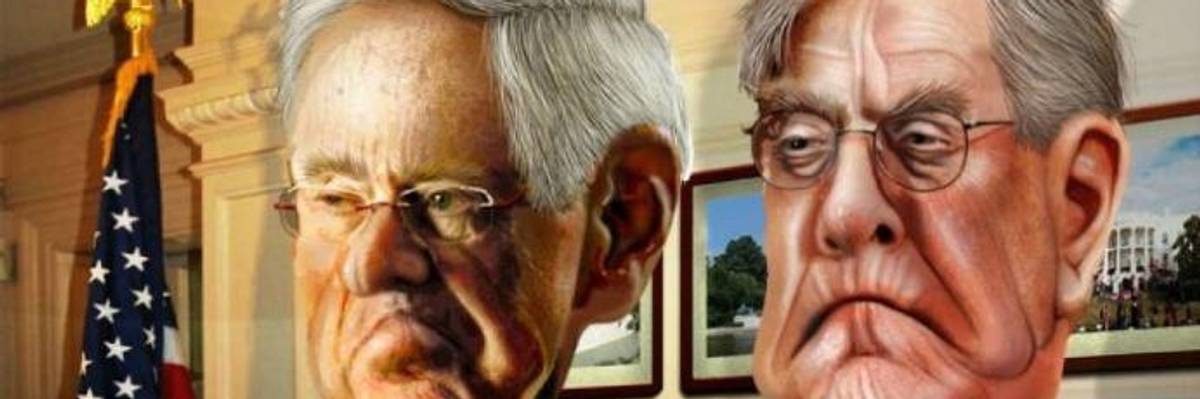
Conservative billionaire brothers David and Charles Koch are investing $650 million in a media company's acquisition of four national magazines. (Image: DonkeyHotey/cc/flickr)
Critics of media consolidation and the fossil fuel industry are decrying an announcement that the media company Meredith Corp., with a $650 million boost from conservative billionaires David and Charles Koch, will buy Time Inc.--which owns Time, Fortune, People, and Sports Illustrated magazines--for an estimated $2.8 billion.
"The only way they can convince the public not to worry their heads about climate change and to forget about regulating the fossil fuel industry is to create their own media megaphone."
--Mary Bottari, Center for Media and Democracy
In a statement announcing the all-cash deal, Meredith Corp. insisted that Koch Equity Development--a subsidiary of Koch Industries, the billionaire brothers' company that's largely been built through investments in oil, natural gas, and chemicals--"will not have a seat on the Meredith Board and will have no influence on Meredith's editorial or managerial operations."
"But not everyone believes the spin," as Andy Rowell writes for Oil Change International. The Kochs are "some of the biggest funders of groups promoting climate denial and libertarian causes for the last two decades," he notes. "Alarm bells should start ringing."
Denouncing Meredith's insistence that the Kochs won't influence editorial content as "rubbish," Robert Reich, a professor of public policy at UC Berkeley and former Secretary of Labor, speculated about the magazines' futures in a Facebook post published Sunday:
The Koch Brothers don't invest $650 million for nothing. My guess is they intend to use Time and its other publications--which reach millions of online and print readers--to promote their right-wing conservatism. The investment also gives them a way to combine their [cache] of voter information held by a data analytics company controlled by their network, i360, with the publishers' consumer data.
Mary Bottari, deputy director of the Center for Media and Democracy, told the Guardian she thinks it "a smart move" by the brothers. "The only way they can convince the public not to worry their heads about climate change and to forget about regulating the fossil fuel industry is to create their own media megaphone," she said.
Climate activist and 350.org co-founder Bill McKibben called the the investment "a cheap way to wield even more political influence" and expressed concerns that "the return on investment on their political work is off the charts."
The advocacy group Free Press, which works to raise awareness about media consolidation, reacted to the news on Twitter.
The outcry over the acquisition announcement on Sunday followed days of mounting speculation and concerns about Meredith's bid for the magazines. Charles Alexander, a former environmental editor for Time, wrote one such warning in The Nation last week. "The story is not just about the fate of Time," he wrote. "The story is about the fate of the world."
Alexander continued:
For decades, the Kochs' "dark money," as The New Yorker's Jane Mayer called it, has financed a campaign of disinformation designed to convince the public and politicians that climate change is nothing to worry about.... I confess I don't know what the solution is, but it is perverse and dangerous for two billionaires with no commitment to factual truth to be permitted to buy a magazine that has been a voice for reason and use it to further their narrow business interests.
After rehashing his efforts to cover global warming in great detail, Alexander confesses that since his time there, "Time's environmental coverage has gone from in-your-face to barely noticeable." However, he still laments that the magazine where he spent 13 years "may have fallen casualty to the forces of greed and deception," and worries about the futures of other publications that continue to cover climate change "if they too get bought by dark knights with fossil-fuel money."
Dear Common Dreams reader, It’s been nearly 30 years since I co-founded Common Dreams with my late wife, Lina Newhouser. We had the radical notion that journalism should serve the public good, not corporate profits. It was clear to us from the outset what it would take to build such a project. No paid advertisements. No corporate sponsors. No millionaire publisher telling us what to think or do. Many people said we wouldn't last a year, but we proved those doubters wrong. Together with a tremendous team of journalists and dedicated staff, we built an independent media outlet free from the constraints of profits and corporate control. Our mission has always been simple: To inform. To inspire. To ignite change for the common good. Building Common Dreams was not easy. Our survival was never guaranteed. When you take on the most powerful forces—Wall Street greed, fossil fuel industry destruction, Big Tech lobbyists, and uber-rich oligarchs who have spent billions upon billions rigging the economy and democracy in their favor—the only bulwark you have is supporters who believe in your work. But here’s the urgent message from me today. It's never been this bad out there. And it's never been this hard to keep us going. At the very moment Common Dreams is most needed, the threats we face are intensifying. We need your support now more than ever. We don't accept corporate advertising and never will. We don't have a paywall because we don't think people should be blocked from critical news based on their ability to pay. Everything we do is funded by the donations of readers like you. When everyone does the little they can afford, we are strong. But if that support retreats or dries up, so do we. Will you donate now to make sure Common Dreams not only survives but thrives? —Craig Brown, Co-founder |
Critics of media consolidation and the fossil fuel industry are decrying an announcement that the media company Meredith Corp., with a $650 million boost from conservative billionaires David and Charles Koch, will buy Time Inc.--which owns Time, Fortune, People, and Sports Illustrated magazines--for an estimated $2.8 billion.
"The only way they can convince the public not to worry their heads about climate change and to forget about regulating the fossil fuel industry is to create their own media megaphone."
--Mary Bottari, Center for Media and Democracy
In a statement announcing the all-cash deal, Meredith Corp. insisted that Koch Equity Development--a subsidiary of Koch Industries, the billionaire brothers' company that's largely been built through investments in oil, natural gas, and chemicals--"will not have a seat on the Meredith Board and will have no influence on Meredith's editorial or managerial operations."
"But not everyone believes the spin," as Andy Rowell writes for Oil Change International. The Kochs are "some of the biggest funders of groups promoting climate denial and libertarian causes for the last two decades," he notes. "Alarm bells should start ringing."
Denouncing Meredith's insistence that the Kochs won't influence editorial content as "rubbish," Robert Reich, a professor of public policy at UC Berkeley and former Secretary of Labor, speculated about the magazines' futures in a Facebook post published Sunday:
The Koch Brothers don't invest $650 million for nothing. My guess is they intend to use Time and its other publications--which reach millions of online and print readers--to promote their right-wing conservatism. The investment also gives them a way to combine their [cache] of voter information held by a data analytics company controlled by their network, i360, with the publishers' consumer data.
Mary Bottari, deputy director of the Center for Media and Democracy, told the Guardian she thinks it "a smart move" by the brothers. "The only way they can convince the public not to worry their heads about climate change and to forget about regulating the fossil fuel industry is to create their own media megaphone," she said.
Climate activist and 350.org co-founder Bill McKibben called the the investment "a cheap way to wield even more political influence" and expressed concerns that "the return on investment on their political work is off the charts."
The advocacy group Free Press, which works to raise awareness about media consolidation, reacted to the news on Twitter.
The outcry over the acquisition announcement on Sunday followed days of mounting speculation and concerns about Meredith's bid for the magazines. Charles Alexander, a former environmental editor for Time, wrote one such warning in The Nation last week. "The story is not just about the fate of Time," he wrote. "The story is about the fate of the world."
Alexander continued:
For decades, the Kochs' "dark money," as The New Yorker's Jane Mayer called it, has financed a campaign of disinformation designed to convince the public and politicians that climate change is nothing to worry about.... I confess I don't know what the solution is, but it is perverse and dangerous for two billionaires with no commitment to factual truth to be permitted to buy a magazine that has been a voice for reason and use it to further their narrow business interests.
After rehashing his efforts to cover global warming in great detail, Alexander confesses that since his time there, "Time's environmental coverage has gone from in-your-face to barely noticeable." However, he still laments that the magazine where he spent 13 years "may have fallen casualty to the forces of greed and deception," and worries about the futures of other publications that continue to cover climate change "if they too get bought by dark knights with fossil-fuel money."
Critics of media consolidation and the fossil fuel industry are decrying an announcement that the media company Meredith Corp., with a $650 million boost from conservative billionaires David and Charles Koch, will buy Time Inc.--which owns Time, Fortune, People, and Sports Illustrated magazines--for an estimated $2.8 billion.
"The only way they can convince the public not to worry their heads about climate change and to forget about regulating the fossil fuel industry is to create their own media megaphone."
--Mary Bottari, Center for Media and Democracy
In a statement announcing the all-cash deal, Meredith Corp. insisted that Koch Equity Development--a subsidiary of Koch Industries, the billionaire brothers' company that's largely been built through investments in oil, natural gas, and chemicals--"will not have a seat on the Meredith Board and will have no influence on Meredith's editorial or managerial operations."
"But not everyone believes the spin," as Andy Rowell writes for Oil Change International. The Kochs are "some of the biggest funders of groups promoting climate denial and libertarian causes for the last two decades," he notes. "Alarm bells should start ringing."
Denouncing Meredith's insistence that the Kochs won't influence editorial content as "rubbish," Robert Reich, a professor of public policy at UC Berkeley and former Secretary of Labor, speculated about the magazines' futures in a Facebook post published Sunday:
The Koch Brothers don't invest $650 million for nothing. My guess is they intend to use Time and its other publications--which reach millions of online and print readers--to promote their right-wing conservatism. The investment also gives them a way to combine their [cache] of voter information held by a data analytics company controlled by their network, i360, with the publishers' consumer data.
Mary Bottari, deputy director of the Center for Media and Democracy, told the Guardian she thinks it "a smart move" by the brothers. "The only way they can convince the public not to worry their heads about climate change and to forget about regulating the fossil fuel industry is to create their own media megaphone," she said.
Climate activist and 350.org co-founder Bill McKibben called the the investment "a cheap way to wield even more political influence" and expressed concerns that "the return on investment on their political work is off the charts."
The advocacy group Free Press, which works to raise awareness about media consolidation, reacted to the news on Twitter.
The outcry over the acquisition announcement on Sunday followed days of mounting speculation and concerns about Meredith's bid for the magazines. Charles Alexander, a former environmental editor for Time, wrote one such warning in The Nation last week. "The story is not just about the fate of Time," he wrote. "The story is about the fate of the world."
Alexander continued:
For decades, the Kochs' "dark money," as The New Yorker's Jane Mayer called it, has financed a campaign of disinformation designed to convince the public and politicians that climate change is nothing to worry about.... I confess I don't know what the solution is, but it is perverse and dangerous for two billionaires with no commitment to factual truth to be permitted to buy a magazine that has been a voice for reason and use it to further their narrow business interests.
After rehashing his efforts to cover global warming in great detail, Alexander confesses that since his time there, "Time's environmental coverage has gone from in-your-face to barely noticeable." However, he still laments that the magazine where he spent 13 years "may have fallen casualty to the forces of greed and deception," and worries about the futures of other publications that continue to cover climate change "if they too get bought by dark knights with fossil-fuel money."

