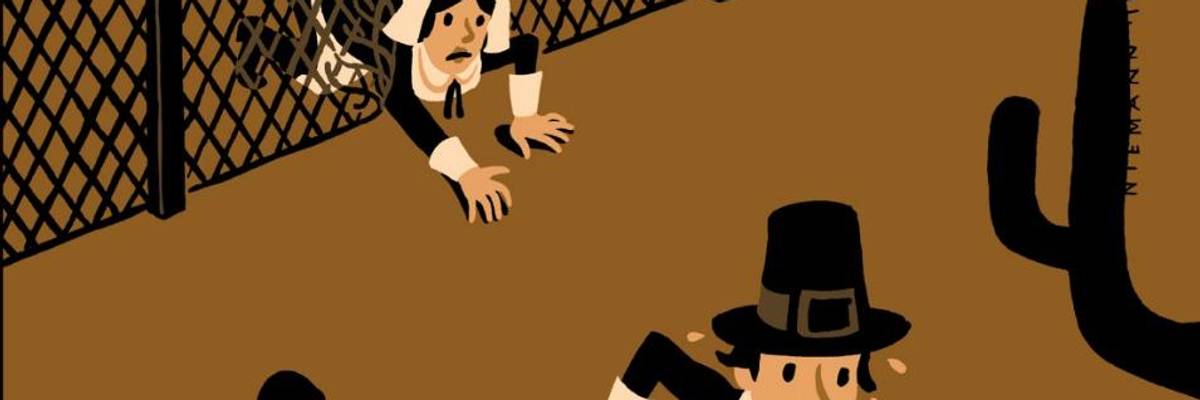
Many people might find it jarring on Thursday morning by how President Donald Trump offered the nation a Happy Thanksgiving in the form of a tweet in which he vowed to "build the WALL" designed to keep future refugees and immigrants out of the country. (Cover detail: New Yorker/Christoph Niemann)
On Thanksgiving, Day to Celebrate Coming Together, Trump Vows to Build Wall
"Trump using Thanksgiving to call for his 'WALL,' apparently without irony. Missed the part of the Pilgrims' story where they scale one."
There are many versions of the historic event, endless ways--both personal and political--to interpret its meaning, and books filled with various perspectives and reasons about why and how people should (or should not) celebrate the U.S. holiday known as Thanksgiving.
However, one of the most widely recognized interpretations of the U.S. holiday, is based on the narrative of how early European settlers--many of them fleeing their home countries following religious persecution or otherwise looking for a new and better life--were nurtured from the struggles of living in a harsh new land by the Indigenous people already living on the continent when they arrived.
It is that notion of the holiday, perhaps, why many people might find it jarring on Thursday morning by how President Donald Trump offered the nation a Happy Thanksgiving in the form of a tweet in which he vowed to "build the WALL" designed to keep future refugees and immigrants out of the country.
While many pointed out that his predecessor, Barack Obama, should be the one credited for most of the nation's economic benchmarks in the current moment, others were quick to point out the ugly irony of his mention of the wall:
An Urgent Message From Our Co-Founder
Dear Common Dreams reader, It’s been nearly 30 years since I co-founded Common Dreams with my late wife, Lina Newhouser. We had the radical notion that journalism should serve the public good, not corporate profits. It was clear to us from the outset what it would take to build such a project. No paid advertisements. No corporate sponsors. No millionaire publisher telling us what to think or do. Many people said we wouldn't last a year, but we proved those doubters wrong. Together with a tremendous team of journalists and dedicated staff, we built an independent media outlet free from the constraints of profits and corporate control. Our mission has always been simple: To inform. To inspire. To ignite change for the common good. Building Common Dreams was not easy. Our survival was never guaranteed. When you take on the most powerful forces—Wall Street greed, fossil fuel industry destruction, Big Tech lobbyists, and uber-rich oligarchs who have spent billions upon billions rigging the economy and democracy in their favor—the only bulwark you have is supporters who believe in your work. But here’s the urgent message from me today. It's never been this bad out there. And it's never been this hard to keep us going. At the very moment Common Dreams is most needed, the threats we face are intensifying. We need your support now more than ever. We don't accept corporate advertising and never will. We don't have a paywall because we don't think people should be blocked from critical news based on their ability to pay. Everything we do is funded by the donations of readers like you. When everyone does the little they can afford, we are strong. But if that support retreats or dries up, so do we. Will you donate now to make sure Common Dreams not only survives but thrives? —Craig Brown, Co-founder |
There are many versions of the historic event, endless ways--both personal and political--to interpret its meaning, and books filled with various perspectives and reasons about why and how people should (or should not) celebrate the U.S. holiday known as Thanksgiving.
However, one of the most widely recognized interpretations of the U.S. holiday, is based on the narrative of how early European settlers--many of them fleeing their home countries following religious persecution or otherwise looking for a new and better life--were nurtured from the struggles of living in a harsh new land by the Indigenous people already living on the continent when they arrived.
It is that notion of the holiday, perhaps, why many people might find it jarring on Thursday morning by how President Donald Trump offered the nation a Happy Thanksgiving in the form of a tweet in which he vowed to "build the WALL" designed to keep future refugees and immigrants out of the country.
While many pointed out that his predecessor, Barack Obama, should be the one credited for most of the nation's economic benchmarks in the current moment, others were quick to point out the ugly irony of his mention of the wall:
There are many versions of the historic event, endless ways--both personal and political--to interpret its meaning, and books filled with various perspectives and reasons about why and how people should (or should not) celebrate the U.S. holiday known as Thanksgiving.
However, one of the most widely recognized interpretations of the U.S. holiday, is based on the narrative of how early European settlers--many of them fleeing their home countries following religious persecution or otherwise looking for a new and better life--were nurtured from the struggles of living in a harsh new land by the Indigenous people already living on the continent when they arrived.
It is that notion of the holiday, perhaps, why many people might find it jarring on Thursday morning by how President Donald Trump offered the nation a Happy Thanksgiving in the form of a tweet in which he vowed to "build the WALL" designed to keep future refugees and immigrants out of the country.
While many pointed out that his predecessor, Barack Obama, should be the one credited for most of the nation's economic benchmarks in the current moment, others were quick to point out the ugly irony of his mention of the wall: