

SUBSCRIBE TO OUR FREE NEWSLETTER
Daily news & progressive opinion—funded by the people, not the corporations—delivered straight to your inbox.
5
#000000
#FFFFFF
To donate by check, phone, or other method, see our More Ways to Give page.
Daily news & progressive opinion—funded by the people, not the corporations—delivered straight to your inbox.
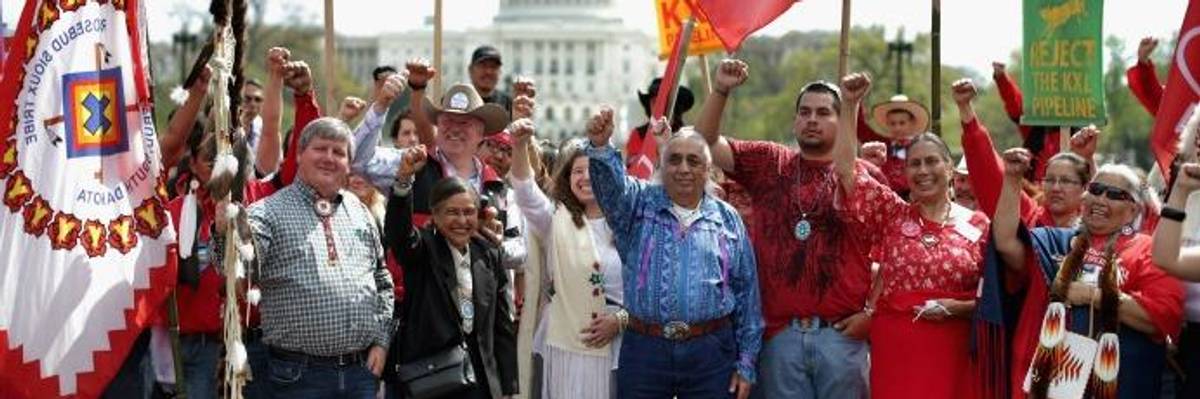
Members of the Cowboy and Indian Alliance, including Native Americans, farmers, and ranchers from across the United States, begin a demonstration against the proposed Keystone XL pipeline in front of the U.S. Capitol April 22, 2014 in Washington, D.C. (Photo: Chip Somodevilla/Getty Images)
Shortly following the Nebraska Public Service Commission's "shortsighted and dangerous" vote to green-light TransCanada's Keystone XL (KXL) pipeline, a coalition comprised of Indigenous peoples, farmers, and ranchers living along the oil project's proposed route published a letter on Monday urging the public to join them in protecting sacred land from corporate exploitation.
"Together we've stopped them for many years, and we are going to keep stopping them."
--Promise to Protect
Endorsed by Native tribes, green groups, and high-profile environmentalists, the "Promise to Protect" call to action argues that making "a concerted stand" against TransCanada's $8 billion dirty energy project "will make other fossil fuel companies think that much harder about their own expansion plans."
"Together we've stopped them for many years, and we are going to keep stopping them," the letter reads. "But we need everyone's help. We need you to take a stand no matter what land you live or work on. The struggle to save Mother Earth begins with you."
"For many years the tribes, indigenous leaders, farmers, ranchers, and allies everywhere have kept this pipeline at bay," the coalition notes. "That has been a great achievement. We honestly don't know if we can hold the line against Keystone XL forever--but we know that we have a chance."
The letter goes on to make several requests of those who wish to participate in the "creative resistance" against KXL that is expected to take shape in the coming months, including:
The fossil fuel industry "believes that with the inauguration of Mr. Trump, the obstacles in their path had disappeared," the letter concludes. "They are unaware of the rising tide of indigenous unity and the strong alliances with ranchers, farmers and the climate justice movement which grew stronger at Standing Rock. When the president approved the federal permits for KXL last winter, he asked TransCanada executives when construction would start: Our job is to make sure the answer is, no time soon."
"The climate can't handle another tar sands pipeline."
--Annie Leonard, Greenpeace
As Common Dreams reported, Nebraska's Public Service Commission voted 3-2 on Monday to grant TransCanada the final permit to begin construction along an alternative route to the one the company initially proposed. If built, the pipeline would carry an estimated 800,000 gallons of tar sands oil per day from Alberta, Canada through several states en route to Texas oil refineries.
In addition to the mass action that is expected to accompany any advances in construction of the pipeline, a flood of appeals and lawsuits are expected to challenge Nebraska's decision to approve the project in the coming weeks.
"The climate can't handle another tar sands pipeline," Annie Leonard, executive director of Greenpeace USA, declared in a statement. "We won't stand idly by while new fossil fuel infrastructure projects, like the Keystone XL pipeline, threaten communities and put drinking water at risk. TransCanada and the other companies trying to build new tar sands pipelines will continue to face a wall of resistance until each and every one of these projects is cancelled."
Dear Common Dreams reader, It’s been nearly 30 years since I co-founded Common Dreams with my late wife, Lina Newhouser. We had the radical notion that journalism should serve the public good, not corporate profits. It was clear to us from the outset what it would take to build such a project. No paid advertisements. No corporate sponsors. No millionaire publisher telling us what to think or do. Many people said we wouldn't last a year, but we proved those doubters wrong. Together with a tremendous team of journalists and dedicated staff, we built an independent media outlet free from the constraints of profits and corporate control. Our mission has always been simple: To inform. To inspire. To ignite change for the common good. Building Common Dreams was not easy. Our survival was never guaranteed. When you take on the most powerful forces—Wall Street greed, fossil fuel industry destruction, Big Tech lobbyists, and uber-rich oligarchs who have spent billions upon billions rigging the economy and democracy in their favor—the only bulwark you have is supporters who believe in your work. But here’s the urgent message from me today. It's never been this bad out there. And it's never been this hard to keep us going. At the very moment Common Dreams is most needed, the threats we face are intensifying. We need your support now more than ever. We don't accept corporate advertising and never will. We don't have a paywall because we don't think people should be blocked from critical news based on their ability to pay. Everything we do is funded by the donations of readers like you. When everyone does the little they can afford, we are strong. But if that support retreats or dries up, so do we. Will you donate now to make sure Common Dreams not only survives but thrives? —Craig Brown, Co-founder |
Shortly following the Nebraska Public Service Commission's "shortsighted and dangerous" vote to green-light TransCanada's Keystone XL (KXL) pipeline, a coalition comprised of Indigenous peoples, farmers, and ranchers living along the oil project's proposed route published a letter on Monday urging the public to join them in protecting sacred land from corporate exploitation.
"Together we've stopped them for many years, and we are going to keep stopping them."
--Promise to Protect
Endorsed by Native tribes, green groups, and high-profile environmentalists, the "Promise to Protect" call to action argues that making "a concerted stand" against TransCanada's $8 billion dirty energy project "will make other fossil fuel companies think that much harder about their own expansion plans."
"Together we've stopped them for many years, and we are going to keep stopping them," the letter reads. "But we need everyone's help. We need you to take a stand no matter what land you live or work on. The struggle to save Mother Earth begins with you."
"For many years the tribes, indigenous leaders, farmers, ranchers, and allies everywhere have kept this pipeline at bay," the coalition notes. "That has been a great achievement. We honestly don't know if we can hold the line against Keystone XL forever--but we know that we have a chance."
The letter goes on to make several requests of those who wish to participate in the "creative resistance" against KXL that is expected to take shape in the coming months, including:
The fossil fuel industry "believes that with the inauguration of Mr. Trump, the obstacles in their path had disappeared," the letter concludes. "They are unaware of the rising tide of indigenous unity and the strong alliances with ranchers, farmers and the climate justice movement which grew stronger at Standing Rock. When the president approved the federal permits for KXL last winter, he asked TransCanada executives when construction would start: Our job is to make sure the answer is, no time soon."
"The climate can't handle another tar sands pipeline."
--Annie Leonard, Greenpeace
As Common Dreams reported, Nebraska's Public Service Commission voted 3-2 on Monday to grant TransCanada the final permit to begin construction along an alternative route to the one the company initially proposed. If built, the pipeline would carry an estimated 800,000 gallons of tar sands oil per day from Alberta, Canada through several states en route to Texas oil refineries.
In addition to the mass action that is expected to accompany any advances in construction of the pipeline, a flood of appeals and lawsuits are expected to challenge Nebraska's decision to approve the project in the coming weeks.
"The climate can't handle another tar sands pipeline," Annie Leonard, executive director of Greenpeace USA, declared in a statement. "We won't stand idly by while new fossil fuel infrastructure projects, like the Keystone XL pipeline, threaten communities and put drinking water at risk. TransCanada and the other companies trying to build new tar sands pipelines will continue to face a wall of resistance until each and every one of these projects is cancelled."
Shortly following the Nebraska Public Service Commission's "shortsighted and dangerous" vote to green-light TransCanada's Keystone XL (KXL) pipeline, a coalition comprised of Indigenous peoples, farmers, and ranchers living along the oil project's proposed route published a letter on Monday urging the public to join them in protecting sacred land from corporate exploitation.
"Together we've stopped them for many years, and we are going to keep stopping them."
--Promise to Protect
Endorsed by Native tribes, green groups, and high-profile environmentalists, the "Promise to Protect" call to action argues that making "a concerted stand" against TransCanada's $8 billion dirty energy project "will make other fossil fuel companies think that much harder about their own expansion plans."
"Together we've stopped them for many years, and we are going to keep stopping them," the letter reads. "But we need everyone's help. We need you to take a stand no matter what land you live or work on. The struggle to save Mother Earth begins with you."
"For many years the tribes, indigenous leaders, farmers, ranchers, and allies everywhere have kept this pipeline at bay," the coalition notes. "That has been a great achievement. We honestly don't know if we can hold the line against Keystone XL forever--but we know that we have a chance."
The letter goes on to make several requests of those who wish to participate in the "creative resistance" against KXL that is expected to take shape in the coming months, including:
The fossil fuel industry "believes that with the inauguration of Mr. Trump, the obstacles in their path had disappeared," the letter concludes. "They are unaware of the rising tide of indigenous unity and the strong alliances with ranchers, farmers and the climate justice movement which grew stronger at Standing Rock. When the president approved the federal permits for KXL last winter, he asked TransCanada executives when construction would start: Our job is to make sure the answer is, no time soon."
"The climate can't handle another tar sands pipeline."
--Annie Leonard, Greenpeace
As Common Dreams reported, Nebraska's Public Service Commission voted 3-2 on Monday to grant TransCanada the final permit to begin construction along an alternative route to the one the company initially proposed. If built, the pipeline would carry an estimated 800,000 gallons of tar sands oil per day from Alberta, Canada through several states en route to Texas oil refineries.
In addition to the mass action that is expected to accompany any advances in construction of the pipeline, a flood of appeals and lawsuits are expected to challenge Nebraska's decision to approve the project in the coming weeks.
"The climate can't handle another tar sands pipeline," Annie Leonard, executive director of Greenpeace USA, declared in a statement. "We won't stand idly by while new fossil fuel infrastructure projects, like the Keystone XL pipeline, threaten communities and put drinking water at risk. TransCanada and the other companies trying to build new tar sands pipelines will continue to face a wall of resistance until each and every one of these projects is cancelled."

