

SUBSCRIBE TO OUR FREE NEWSLETTER
Daily news & progressive opinion—funded by the people, not the corporations—delivered straight to your inbox.
5
#000000
#FFFFFF
To donate by check, phone, or other method, see our More Ways to Give page.
Daily news & progressive opinion—funded by the people, not the corporations—delivered straight to your inbox.
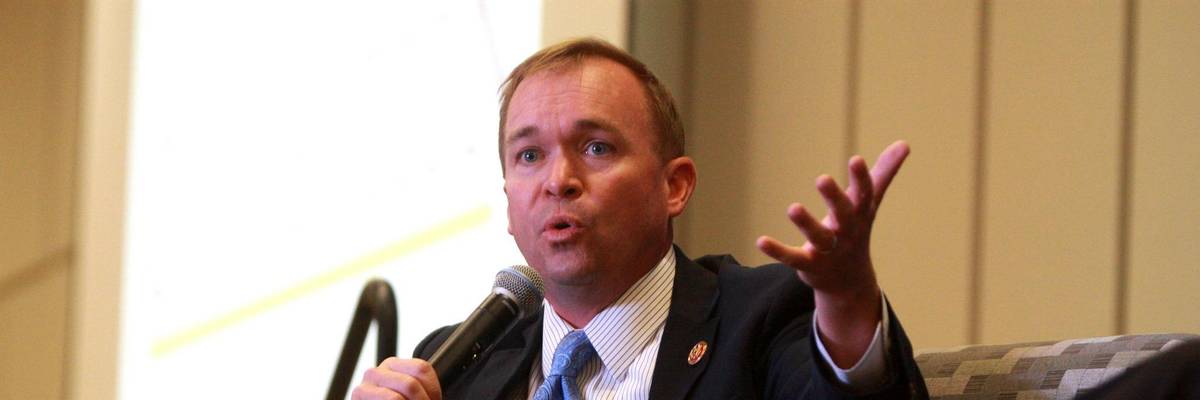
Mick Mulvaney is expected to be named the interim director of the Consumer Financial Protection Bureau, after saying numerous times that the agency should not exist. (Photo: Gage Skidmore/Flickr/cc)
Progressive leaders on Friday decried the Trump administration's reported plan to install Mick Mulvaney, an outspoken critic of the Consumer Financial Protection Bureau (CFPB), as interim director of the agency that was formed after the 2008 financial crisis to shield citizens from abusive practices by banks and other corporations.
While consumer advocates and progressives like Sen. Elizabeth Warren (D-Mass.), who was a chief architect of the bureau, have heralded the agency as a much-needed watchdog for Wall Street, payday loan companies, and other predatory lenders, Mulvaney has referred to the CFPB as a "sad joke" and has called for it to be disbanded.
"The new director of the CFPB must be someone with a track record of protecting consumers and holding financial firms responsible when they cheat people," Warren said in a statement after the current CFPB head, Richard Cordray, announced he would step down by the end of the month. "This is no place for another Trump-appointed industry hack."
Mulvaney currently directs the Office of Management and Budget, where he has shown little concern for the U.S. families and consumers the CFPB is meant to protect. In the budget proposal he unveiled earlier this year, he urged cuts to food stamps and Medicaid and the elimination of student loan subsidies.
"Could not imagine a more outrageously terrible selection to run CFPB--a man who *hates* its mission."--Richard Yeselson, Dissent Magazine
He also argued against Meals on Wheels, declaring that the government shouldn't spend money to feed elderly people because it was "just not showing any results," and said that after-school programs that offer meals to low-income children were unnecessary because there was "no demonstrable evidence" that the programs improve school performance--evidently the only potential benefit to such an effort that Mulvaney considered.
Under Cordray, the CFPB ordered Wells Fargo to pay $185 million in fines for opening fraudulent accounts in customers' names. It also introduced a rule allowing consumers to file class-action lawsuits against banks and credit-card companies--but that law was killed by the Republican-led Congress.
Critics on social media expressed fears that Mulvaney will further de-fang the agency or destroy in completely.
Dear Common Dreams reader, It’s been nearly 30 years since I co-founded Common Dreams with my late wife, Lina Newhouser. We had the radical notion that journalism should serve the public good, not corporate profits. It was clear to us from the outset what it would take to build such a project. No paid advertisements. No corporate sponsors. No millionaire publisher telling us what to think or do. Many people said we wouldn't last a year, but we proved those doubters wrong. Together with a tremendous team of journalists and dedicated staff, we built an independent media outlet free from the constraints of profits and corporate control. Our mission has always been simple: To inform. To inspire. To ignite change for the common good. Building Common Dreams was not easy. Our survival was never guaranteed. When you take on the most powerful forces—Wall Street greed, fossil fuel industry destruction, Big Tech lobbyists, and uber-rich oligarchs who have spent billions upon billions rigging the economy and democracy in their favor—the only bulwark you have is supporters who believe in your work. But here’s the urgent message from me today. It's never been this bad out there. And it's never been this hard to keep us going. At the very moment Common Dreams is most needed, the threats we face are intensifying. We need your support now more than ever. We don't accept corporate advertising and never will. We don't have a paywall because we don't think people should be blocked from critical news based on their ability to pay. Everything we do is funded by the donations of readers like you. When everyone does the little they can afford, we are strong. But if that support retreats or dries up, so do we. Will you donate now to make sure Common Dreams not only survives but thrives? —Craig Brown, Co-founder |
Progressive leaders on Friday decried the Trump administration's reported plan to install Mick Mulvaney, an outspoken critic of the Consumer Financial Protection Bureau (CFPB), as interim director of the agency that was formed after the 2008 financial crisis to shield citizens from abusive practices by banks and other corporations.
While consumer advocates and progressives like Sen. Elizabeth Warren (D-Mass.), who was a chief architect of the bureau, have heralded the agency as a much-needed watchdog for Wall Street, payday loan companies, and other predatory lenders, Mulvaney has referred to the CFPB as a "sad joke" and has called for it to be disbanded.
"The new director of the CFPB must be someone with a track record of protecting consumers and holding financial firms responsible when they cheat people," Warren said in a statement after the current CFPB head, Richard Cordray, announced he would step down by the end of the month. "This is no place for another Trump-appointed industry hack."
Mulvaney currently directs the Office of Management and Budget, where he has shown little concern for the U.S. families and consumers the CFPB is meant to protect. In the budget proposal he unveiled earlier this year, he urged cuts to food stamps and Medicaid and the elimination of student loan subsidies.
"Could not imagine a more outrageously terrible selection to run CFPB--a man who *hates* its mission."--Richard Yeselson, Dissent Magazine
He also argued against Meals on Wheels, declaring that the government shouldn't spend money to feed elderly people because it was "just not showing any results," and said that after-school programs that offer meals to low-income children were unnecessary because there was "no demonstrable evidence" that the programs improve school performance--evidently the only potential benefit to such an effort that Mulvaney considered.
Under Cordray, the CFPB ordered Wells Fargo to pay $185 million in fines for opening fraudulent accounts in customers' names. It also introduced a rule allowing consumers to file class-action lawsuits against banks and credit-card companies--but that law was killed by the Republican-led Congress.
Critics on social media expressed fears that Mulvaney will further de-fang the agency or destroy in completely.
Progressive leaders on Friday decried the Trump administration's reported plan to install Mick Mulvaney, an outspoken critic of the Consumer Financial Protection Bureau (CFPB), as interim director of the agency that was formed after the 2008 financial crisis to shield citizens from abusive practices by banks and other corporations.
While consumer advocates and progressives like Sen. Elizabeth Warren (D-Mass.), who was a chief architect of the bureau, have heralded the agency as a much-needed watchdog for Wall Street, payday loan companies, and other predatory lenders, Mulvaney has referred to the CFPB as a "sad joke" and has called for it to be disbanded.
"The new director of the CFPB must be someone with a track record of protecting consumers and holding financial firms responsible when they cheat people," Warren said in a statement after the current CFPB head, Richard Cordray, announced he would step down by the end of the month. "This is no place for another Trump-appointed industry hack."
Mulvaney currently directs the Office of Management and Budget, where he has shown little concern for the U.S. families and consumers the CFPB is meant to protect. In the budget proposal he unveiled earlier this year, he urged cuts to food stamps and Medicaid and the elimination of student loan subsidies.
"Could not imagine a more outrageously terrible selection to run CFPB--a man who *hates* its mission."--Richard Yeselson, Dissent Magazine
He also argued against Meals on Wheels, declaring that the government shouldn't spend money to feed elderly people because it was "just not showing any results," and said that after-school programs that offer meals to low-income children were unnecessary because there was "no demonstrable evidence" that the programs improve school performance--evidently the only potential benefit to such an effort that Mulvaney considered.
Under Cordray, the CFPB ordered Wells Fargo to pay $185 million in fines for opening fraudulent accounts in customers' names. It also introduced a rule allowing consumers to file class-action lawsuits against banks and credit-card companies--but that law was killed by the Republican-led Congress.
Critics on social media expressed fears that Mulvaney will further de-fang the agency or destroy in completely.

