SUBSCRIBE TO OUR FREE NEWSLETTER
Daily news & progressive opinion—funded by the people, not the corporations—delivered straight to your inbox.
5
#000000
#FFFFFF
To donate by check, phone, or other method, see our More Ways to Give page.
Daily news & progressive opinion—funded by the people, not the corporations—delivered straight to your inbox.
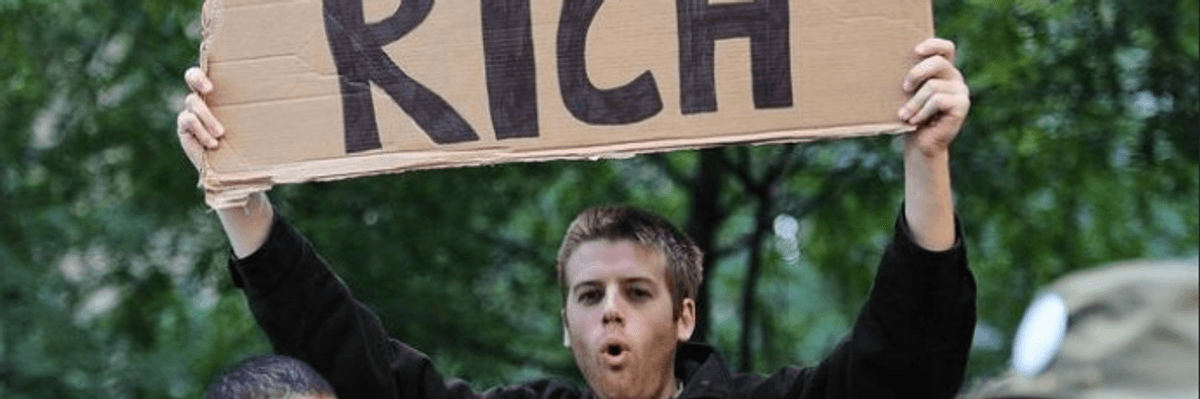
Ahead of President Trump's speech on his tax reform plan in Harrisburg, Pennsylvania, A Reuters/Ipsos poll showed that 75 percent of Americans think the rich should face higher taxes. (Photo: AFP/Getty)
In stark contrast to President Donald Trump's tax proposal, most Americans think that wealthy Americans should pay more, not less, in taxes.
In a new Reuters/Ipsos poll released Wednesday, about 75 percent of Americans answered that they at least "somewhat agree" that the wealthy should pay more in taxes. Fifty-three percent "strongly" agreed with the statement.
Contrary to President Donald Trump's insistence that his tax plan will benefit middle-class Americans, analysis from the Urban Institute and the Brookings Institution's Tax Policy Center has shown that the richest one percent of Americans--those making over $730,000 per year--would benefit the most from the proposal.
"The Republican plan is essentially the opposite of what the vast majority of Americans want to see in tax policy."--John Atcheson
The poll came out as Trump prepared to speak in Harrisburg, Pennsylvania, pitching his tax reform plan to an audience of truck drivers and other workers. According to his prepared remarks, Trump was expected to tell the workers that they would likely get a $4,000 raise via tax breaks if his plan passes in Congress.
But the Tax Policy Center's analysis paints a different picture. The bottom 95 percent of earners "would see average after-tax incomes increase between 0.5 and 1.2 percent. Taxpayers in the top one percent would receive about 50 percent of the total tax benefit; their after-tax income would increase an average of 8.5 percent."
Trump also wants to lower the corporate tax rate from 35 to 20 percent; a poll taken by Politico/Morning Consult last month found that this was an unpopular plan as well, with 60 percent of respondents saying corporations already pay too little in taxes.
As columnist John Atcheson wrote for Common Dreams on Wednesday, "The Republican plan is essentially the opposite of what the vast majority of Americans want to see in tax policy."
In Harrisburg on Wednesday, protesters with the Not One Penny campaign as well as the SEIU were there to greet Trump, ready to debunk his claims that most Americans will benefit from his tax proposal.
Dear Common Dreams reader, It’s been nearly 30 years since I co-founded Common Dreams with my late wife, Lina Newhouser. We had the radical notion that journalism should serve the public good, not corporate profits. It was clear to us from the outset what it would take to build such a project. No paid advertisements. No corporate sponsors. No millionaire publisher telling us what to think or do. Many people said we wouldn't last a year, but we proved those doubters wrong. Together with a tremendous team of journalists and dedicated staff, we built an independent media outlet free from the constraints of profits and corporate control. Our mission has always been simple: To inform. To inspire. To ignite change for the common good. Building Common Dreams was not easy. Our survival was never guaranteed. When you take on the most powerful forces—Wall Street greed, fossil fuel industry destruction, Big Tech lobbyists, and uber-rich oligarchs who have spent billions upon billions rigging the economy and democracy in their favor—the only bulwark you have is supporters who believe in your work. But here’s the urgent message from me today. It's never been this bad out there. And it's never been this hard to keep us going. At the very moment Common Dreams is most needed, the threats we face are intensifying. We need your support now more than ever. We don't accept corporate advertising and never will. We don't have a paywall because we don't think people should be blocked from critical news based on their ability to pay. Everything we do is funded by the donations of readers like you. When everyone does the little they can afford, we are strong. But if that support retreats or dries up, so do we. Will you donate now to make sure Common Dreams not only survives but thrives? —Craig Brown, Co-founder |
In stark contrast to President Donald Trump's tax proposal, most Americans think that wealthy Americans should pay more, not less, in taxes.
In a new Reuters/Ipsos poll released Wednesday, about 75 percent of Americans answered that they at least "somewhat agree" that the wealthy should pay more in taxes. Fifty-three percent "strongly" agreed with the statement.
Contrary to President Donald Trump's insistence that his tax plan will benefit middle-class Americans, analysis from the Urban Institute and the Brookings Institution's Tax Policy Center has shown that the richest one percent of Americans--those making over $730,000 per year--would benefit the most from the proposal.
"The Republican plan is essentially the opposite of what the vast majority of Americans want to see in tax policy."--John Atcheson
The poll came out as Trump prepared to speak in Harrisburg, Pennsylvania, pitching his tax reform plan to an audience of truck drivers and other workers. According to his prepared remarks, Trump was expected to tell the workers that they would likely get a $4,000 raise via tax breaks if his plan passes in Congress.
But the Tax Policy Center's analysis paints a different picture. The bottom 95 percent of earners "would see average after-tax incomes increase between 0.5 and 1.2 percent. Taxpayers in the top one percent would receive about 50 percent of the total tax benefit; their after-tax income would increase an average of 8.5 percent."
Trump also wants to lower the corporate tax rate from 35 to 20 percent; a poll taken by Politico/Morning Consult last month found that this was an unpopular plan as well, with 60 percent of respondents saying corporations already pay too little in taxes.
As columnist John Atcheson wrote for Common Dreams on Wednesday, "The Republican plan is essentially the opposite of what the vast majority of Americans want to see in tax policy."
In Harrisburg on Wednesday, protesters with the Not One Penny campaign as well as the SEIU were there to greet Trump, ready to debunk his claims that most Americans will benefit from his tax proposal.
In stark contrast to President Donald Trump's tax proposal, most Americans think that wealthy Americans should pay more, not less, in taxes.
In a new Reuters/Ipsos poll released Wednesday, about 75 percent of Americans answered that they at least "somewhat agree" that the wealthy should pay more in taxes. Fifty-three percent "strongly" agreed with the statement.
Contrary to President Donald Trump's insistence that his tax plan will benefit middle-class Americans, analysis from the Urban Institute and the Brookings Institution's Tax Policy Center has shown that the richest one percent of Americans--those making over $730,000 per year--would benefit the most from the proposal.
"The Republican plan is essentially the opposite of what the vast majority of Americans want to see in tax policy."--John Atcheson
The poll came out as Trump prepared to speak in Harrisburg, Pennsylvania, pitching his tax reform plan to an audience of truck drivers and other workers. According to his prepared remarks, Trump was expected to tell the workers that they would likely get a $4,000 raise via tax breaks if his plan passes in Congress.
But the Tax Policy Center's analysis paints a different picture. The bottom 95 percent of earners "would see average after-tax incomes increase between 0.5 and 1.2 percent. Taxpayers in the top one percent would receive about 50 percent of the total tax benefit; their after-tax income would increase an average of 8.5 percent."
Trump also wants to lower the corporate tax rate from 35 to 20 percent; a poll taken by Politico/Morning Consult last month found that this was an unpopular plan as well, with 60 percent of respondents saying corporations already pay too little in taxes.
As columnist John Atcheson wrote for Common Dreams on Wednesday, "The Republican plan is essentially the opposite of what the vast majority of Americans want to see in tax policy."
In Harrisburg on Wednesday, protesters with the Not One Penny campaign as well as the SEIU were there to greet Trump, ready to debunk his claims that most Americans will benefit from his tax proposal.