SUBSCRIBE TO OUR FREE NEWSLETTER
Daily news & progressive opinion—funded by the people, not the corporations—delivered straight to your inbox.
5
#000000
#FFFFFF
To donate by check, phone, or other method, see our More Ways to Give page.
Daily news & progressive opinion—funded by the people, not the corporations—delivered straight to your inbox.
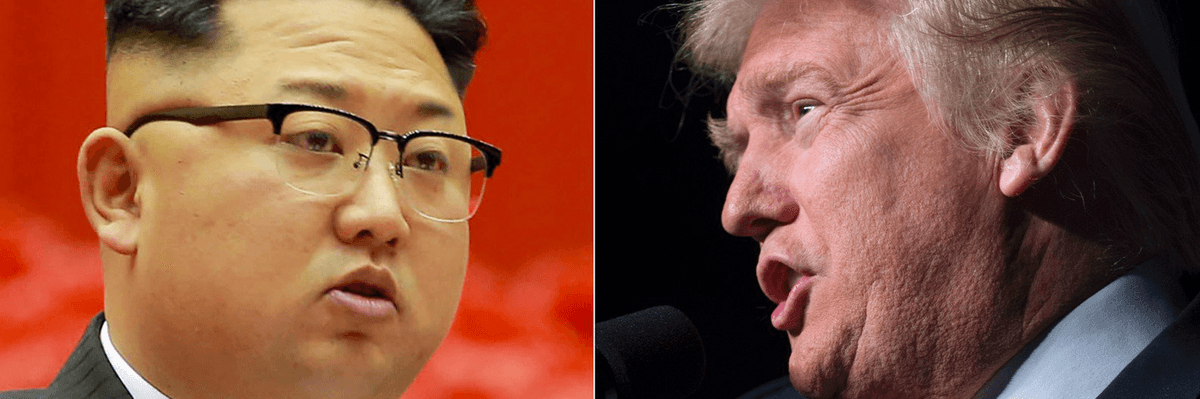
While the majority of Americans disapprove of Trump's handling of current tensions between the U.S. and North Korea, the president has so far refused to engage in diplomacy with Kim Jong-un. (Photo: @CNNi@Twitter)
President Donald Trump and North Korean leader Kim Jong-un traded insults early on Friday, continuing a war of words that's gone on for months, causing widespread anxiety over the possibility of a nuclear attack as North Korea conducts missile tests and Trump administration officials attempt to do damage control regarding the president's threats of retaliation.
The two leaders' statements have grown increasingly antagonistic, with Trump giving Kim the nickname "Rocket Man" last week and Kim introducing the arcane term "dotard" into the discourse Friday morning.
Three days after Trump's speech at the United Nations General Assembly in which he threatened to "totally destroy North Korea" if the Kim regime continues to test its nuclear capability, as it's done five times since July, Kim issued a lengthy statement comparing the president's threats to the barks of "a frightened dog."
Kim added that Trump "surely is a rogue and a gangster fond of playing with fire, rather than a politician," and called him a "mentally deranged U.S. dotard," using a relatively obscure word that Merriam-Webster defines as "a state or period of senile decay marked by decline of mental poise and alertness."
Trump responded on Twitter with his own shot at Kim's mental state.
The U.S. announced its latest round of sanctions on North Korea Thursday, penalizing foreign companies from doing business with the country and likely adding to the impact of its food shortage.
Meanwhile, a number of diplomatic officials and prominent activists have called for peaceful negotiations between the U.S. and North Korea. Defense Secretary James Mattis has warned against military action on North Korea, and on Friday, nearly 300 female leaders from 45 countries called on the U.N. secretary-general to appoint a special envoy to de-escalate the brewing tension. In a poll conducted by NPR/Ipsos just before Trump's speech at the U.N., 51 percent of Americans said they didn't approve of how the president has been handling North Korea's nuclear threats.
Dear Common Dreams reader, It’s been nearly 30 years since I co-founded Common Dreams with my late wife, Lina Newhouser. We had the radical notion that journalism should serve the public good, not corporate profits. It was clear to us from the outset what it would take to build such a project. No paid advertisements. No corporate sponsors. No millionaire publisher telling us what to think or do. Many people said we wouldn't last a year, but we proved those doubters wrong. Together with a tremendous team of journalists and dedicated staff, we built an independent media outlet free from the constraints of profits and corporate control. Our mission has always been simple: To inform. To inspire. To ignite change for the common good. Building Common Dreams was not easy. Our survival was never guaranteed. When you take on the most powerful forces—Wall Street greed, fossil fuel industry destruction, Big Tech lobbyists, and uber-rich oligarchs who have spent billions upon billions rigging the economy and democracy in their favor—the only bulwark you have is supporters who believe in your work. But here’s the urgent message from me today. It's never been this bad out there. And it's never been this hard to keep us going. At the very moment Common Dreams is most needed, the threats we face are intensifying. We need your support now more than ever. We don't accept corporate advertising and never will. We don't have a paywall because we don't think people should be blocked from critical news based on their ability to pay. Everything we do is funded by the donations of readers like you. When everyone does the little they can afford, we are strong. But if that support retreats or dries up, so do we. Will you donate now to make sure Common Dreams not only survives but thrives? —Craig Brown, Co-founder |
President Donald Trump and North Korean leader Kim Jong-un traded insults early on Friday, continuing a war of words that's gone on for months, causing widespread anxiety over the possibility of a nuclear attack as North Korea conducts missile tests and Trump administration officials attempt to do damage control regarding the president's threats of retaliation.
The two leaders' statements have grown increasingly antagonistic, with Trump giving Kim the nickname "Rocket Man" last week and Kim introducing the arcane term "dotard" into the discourse Friday morning.
Three days after Trump's speech at the United Nations General Assembly in which he threatened to "totally destroy North Korea" if the Kim regime continues to test its nuclear capability, as it's done five times since July, Kim issued a lengthy statement comparing the president's threats to the barks of "a frightened dog."
Kim added that Trump "surely is a rogue and a gangster fond of playing with fire, rather than a politician," and called him a "mentally deranged U.S. dotard," using a relatively obscure word that Merriam-Webster defines as "a state or period of senile decay marked by decline of mental poise and alertness."
Trump responded on Twitter with his own shot at Kim's mental state.
The U.S. announced its latest round of sanctions on North Korea Thursday, penalizing foreign companies from doing business with the country and likely adding to the impact of its food shortage.
Meanwhile, a number of diplomatic officials and prominent activists have called for peaceful negotiations between the U.S. and North Korea. Defense Secretary James Mattis has warned against military action on North Korea, and on Friday, nearly 300 female leaders from 45 countries called on the U.N. secretary-general to appoint a special envoy to de-escalate the brewing tension. In a poll conducted by NPR/Ipsos just before Trump's speech at the U.N., 51 percent of Americans said they didn't approve of how the president has been handling North Korea's nuclear threats.
President Donald Trump and North Korean leader Kim Jong-un traded insults early on Friday, continuing a war of words that's gone on for months, causing widespread anxiety over the possibility of a nuclear attack as North Korea conducts missile tests and Trump administration officials attempt to do damage control regarding the president's threats of retaliation.
The two leaders' statements have grown increasingly antagonistic, with Trump giving Kim the nickname "Rocket Man" last week and Kim introducing the arcane term "dotard" into the discourse Friday morning.
Three days after Trump's speech at the United Nations General Assembly in which he threatened to "totally destroy North Korea" if the Kim regime continues to test its nuclear capability, as it's done five times since July, Kim issued a lengthy statement comparing the president's threats to the barks of "a frightened dog."
Kim added that Trump "surely is a rogue and a gangster fond of playing with fire, rather than a politician," and called him a "mentally deranged U.S. dotard," using a relatively obscure word that Merriam-Webster defines as "a state or period of senile decay marked by decline of mental poise and alertness."
Trump responded on Twitter with his own shot at Kim's mental state.
The U.S. announced its latest round of sanctions on North Korea Thursday, penalizing foreign companies from doing business with the country and likely adding to the impact of its food shortage.
Meanwhile, a number of diplomatic officials and prominent activists have called for peaceful negotiations between the U.S. and North Korea. Defense Secretary James Mattis has warned against military action on North Korea, and on Friday, nearly 300 female leaders from 45 countries called on the U.N. secretary-general to appoint a special envoy to de-escalate the brewing tension. In a poll conducted by NPR/Ipsos just before Trump's speech at the U.N., 51 percent of Americans said they didn't approve of how the president has been handling North Korea's nuclear threats.