

SUBSCRIBE TO OUR FREE NEWSLETTER
Daily news & progressive opinion—funded by the people, not the corporations—delivered straight to your inbox.
5
#000000
#FFFFFF
To donate by check, phone, or other method, see our More Ways to Give page.
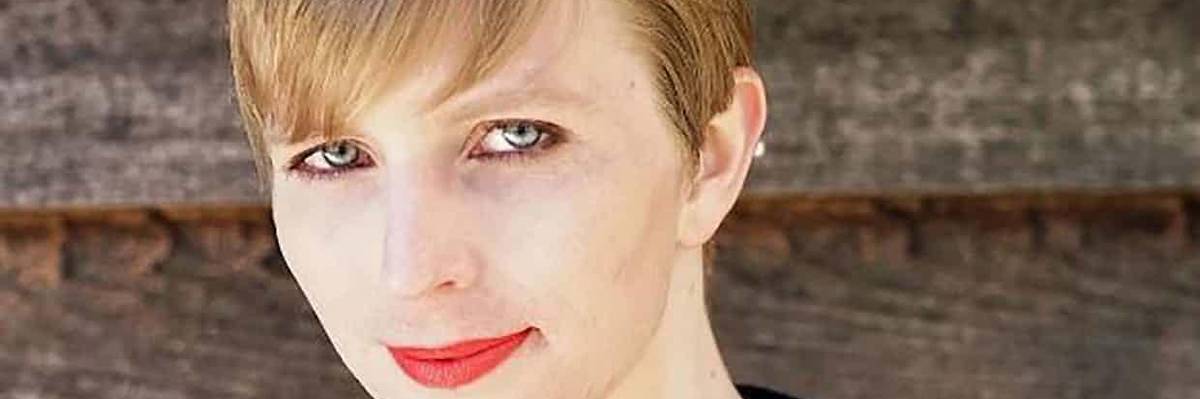
In a move called "moral cowardice" and in the wake of objections from the current and a former head of the CIA--an agency that has tried to and successfully assassinated people, helped overthrow democratic governments, and sowed chaos throughout the world as the U.S. government's clandestine enforcer--Harvard University overnight rescinded a fellowship invitation to Chelsea Manning, an Army whistleblower who exposed U.S. war crimes in Iraq and spent more than seven years in prison for her decision to release classified military and State Department documents to the press.
"How cowardly to be bullied by the CIA like this," declared Trevor Timm, executive director of the Freedom of the Press Foundation, in response to Harvard's decision.
And Manning herself was quick to speak out:
ACLU staff attorney, who has represented Manning for years, expressed disgust in a statement posted online:
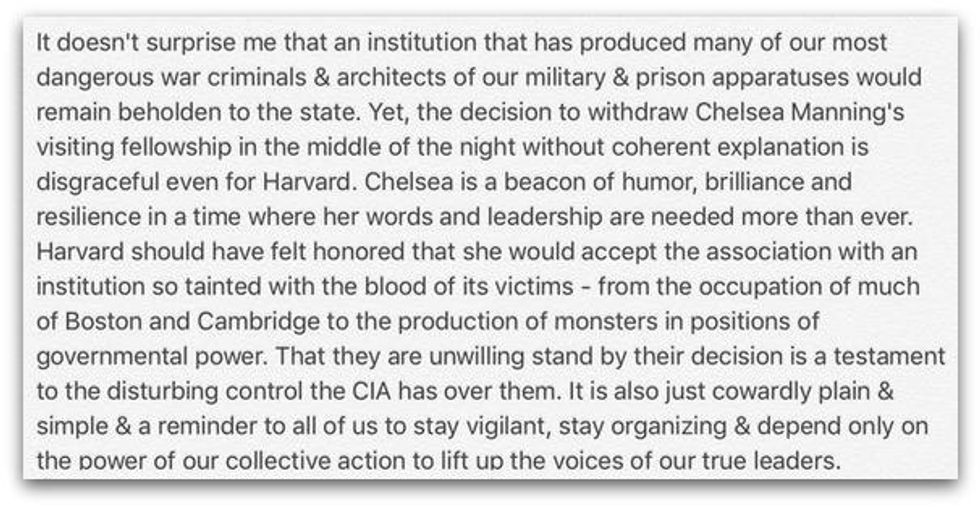
In his resignation letter, Morrell, said it was his "right, indeed my duty, to argue that the School's invitation [to Manning] is wholly inappropriate."
In a statement posted to Harvard's website early Friday morning, Harvard Kennedy School Dean Douglas Elmendorf officially rescinded Manning's fellowship invitation, calling the earlier honor a "mistake."
Elmedorf wrote that "I still think that having her speak in the Forum and talk with students is consistent with our longstanding approach, which puts great emphasis on the value of hearing from a diverse collection of people. But I see more clearly now that many people view a Visiting Fellow title as an honorific, so we should weigh that consideration when offering invitations." He continued:
I see more clearly now that many people view a Visiting Fellow title as an honorific, so we should weigh that consideration when offering invitations. In particular, I think we should weigh, for each potential visitor, what members of the Kennedy School community could learn from that person's visit against the extent to which that person's conduct fulfills the values of public service to which we aspire. This balance is not always easy to determine, and reasonable people can disagree about where to strike the balance for specific people. Any determination should start with the presumption that more speech is better than less. In retrospect, though, I think my assessment of that balance for Chelsea Manning was wrong. Therefore, we are withdrawing the invitation to her to serve as a Visiting Fellow--and the perceived honor that it implies to some people--while maintaining the invitation for her to spend a day at the Kennedy School and speak in the Forum.
Jesselyn Radack, director of the Whistleblower & Source Protection Program (WHISPeR) at the watchdog group ExposeFacts, called it "ironic that Michael Morell, a former CIA leader involved in torture and drone killings, had a crisis of 'conscience' that prompted Harvard's Kennedy School to withdraw its invitation to humanitarian Chelsea Manning."
The university, Radack continued, "obviously offered Chelsea Manning a visiting fellowship because of the valuable contribution she could make, and revoked it under pressure from the CIA. So much for academic freedom."
On social media, other critics blasted the university's decision to side with the CIA, with many pointing out that Harvard University has given out plenty of fellowships over the years to people who have committed what should be considered "horrific" offenses in their careers.
In a move called "moral cowardice" and in the wake of objections from the current and a former head of the CIA--an agency that has tried to and successfully assassinated people, helped overthrow democratic governments, and sowed chaos throughout the world as the U.S. government's clandestine enforcer--Harvard University overnight rescinded a fellowship invitation to Chelsea Manning, an Army whistleblower who exposed U.S. war crimes in Iraq and spent more than seven years in prison for her decision to release classified military and State Department documents to the press.
"How cowardly to be bullied by the CIA like this," declared Trevor Timm, executive director of the Freedom of the Press Foundation, in response to Harvard's decision.
And Manning herself was quick to speak out:
ACLU staff attorney, who has represented Manning for years, expressed disgust in a statement posted online:
In his resignation letter, Morrell, said it was his "right, indeed my duty, to argue that the School's invitation [to Manning] is wholly inappropriate."
In a statement posted to Harvard's website early Friday morning, Harvard Kennedy School Dean Douglas Elmendorf officially rescinded Manning's fellowship invitation, calling the earlier honor a "mistake."
Elmedorf wrote that "I still think that having her speak in the Forum and talk with students is consistent with our longstanding approach, which puts great emphasis on the value of hearing from a diverse collection of people. But I see more clearly now that many people view a Visiting Fellow title as an honorific, so we should weigh that consideration when offering invitations." He continued:
I see more clearly now that many people view a Visiting Fellow title as an honorific, so we should weigh that consideration when offering invitations. In particular, I think we should weigh, for each potential visitor, what members of the Kennedy School community could learn from that person's visit against the extent to which that person's conduct fulfills the values of public service to which we aspire. This balance is not always easy to determine, and reasonable people can disagree about where to strike the balance for specific people. Any determination should start with the presumption that more speech is better than less. In retrospect, though, I think my assessment of that balance for Chelsea Manning was wrong. Therefore, we are withdrawing the invitation to her to serve as a Visiting Fellow--and the perceived honor that it implies to some people--while maintaining the invitation for her to spend a day at the Kennedy School and speak in the Forum.
Jesselyn Radack, director of the Whistleblower & Source Protection Program (WHISPeR) at the watchdog group ExposeFacts, called it "ironic that Michael Morell, a former CIA leader involved in torture and drone killings, had a crisis of 'conscience' that prompted Harvard's Kennedy School to withdraw its invitation to humanitarian Chelsea Manning."
The university, Radack continued, "obviously offered Chelsea Manning a visiting fellowship because of the valuable contribution she could make, and revoked it under pressure from the CIA. So much for academic freedom."
On social media, other critics blasted the university's decision to side with the CIA, with many pointing out that Harvard University has given out plenty of fellowships over the years to people who have committed what should be considered "horrific" offenses in their careers.
In a move called "moral cowardice" and in the wake of objections from the current and a former head of the CIA--an agency that has tried to and successfully assassinated people, helped overthrow democratic governments, and sowed chaos throughout the world as the U.S. government's clandestine enforcer--Harvard University overnight rescinded a fellowship invitation to Chelsea Manning, an Army whistleblower who exposed U.S. war crimes in Iraq and spent more than seven years in prison for her decision to release classified military and State Department documents to the press.
"How cowardly to be bullied by the CIA like this," declared Trevor Timm, executive director of the Freedom of the Press Foundation, in response to Harvard's decision.
And Manning herself was quick to speak out:
ACLU staff attorney, who has represented Manning for years, expressed disgust in a statement posted online:
In his resignation letter, Morrell, said it was his "right, indeed my duty, to argue that the School's invitation [to Manning] is wholly inappropriate."
In a statement posted to Harvard's website early Friday morning, Harvard Kennedy School Dean Douglas Elmendorf officially rescinded Manning's fellowship invitation, calling the earlier honor a "mistake."
Elmedorf wrote that "I still think that having her speak in the Forum and talk with students is consistent with our longstanding approach, which puts great emphasis on the value of hearing from a diverse collection of people. But I see more clearly now that many people view a Visiting Fellow title as an honorific, so we should weigh that consideration when offering invitations." He continued:
I see more clearly now that many people view a Visiting Fellow title as an honorific, so we should weigh that consideration when offering invitations. In particular, I think we should weigh, for each potential visitor, what members of the Kennedy School community could learn from that person's visit against the extent to which that person's conduct fulfills the values of public service to which we aspire. This balance is not always easy to determine, and reasonable people can disagree about where to strike the balance for specific people. Any determination should start with the presumption that more speech is better than less. In retrospect, though, I think my assessment of that balance for Chelsea Manning was wrong. Therefore, we are withdrawing the invitation to her to serve as a Visiting Fellow--and the perceived honor that it implies to some people--while maintaining the invitation for her to spend a day at the Kennedy School and speak in the Forum.
Jesselyn Radack, director of the Whistleblower & Source Protection Program (WHISPeR) at the watchdog group ExposeFacts, called it "ironic that Michael Morell, a former CIA leader involved in torture and drone killings, had a crisis of 'conscience' that prompted Harvard's Kennedy School to withdraw its invitation to humanitarian Chelsea Manning."
The university, Radack continued, "obviously offered Chelsea Manning a visiting fellowship because of the valuable contribution she could make, and revoked it under pressure from the CIA. So much for academic freedom."
On social media, other critics blasted the university's decision to side with the CIA, with many pointing out that Harvard University has given out plenty of fellowships over the years to people who have committed what should be considered "horrific" offenses in their careers.

