SUBSCRIBE TO OUR FREE NEWSLETTER
Daily news & progressive opinion—funded by the people, not the corporations—delivered straight to your inbox.
5
#000000
#FFFFFF
To donate by check, phone, or other method, see our More Ways to Give page.
Daily news & progressive opinion—funded by the people, not the corporations—delivered straight to your inbox.
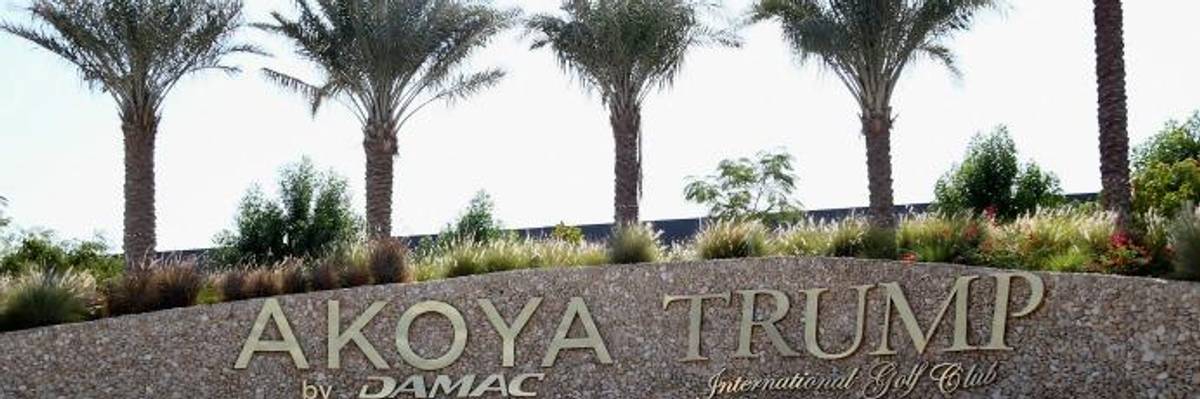
A general view of the entrance to the Akoya by DAMAC Trump International Golf Club on December 12, 2015 in Dubai, United Arab Emirates. (Photo: Francois Nel/Getty Images)
Raising further questions about the president's vast web of potential conflicts of interests, McClatchy reports that the Trump family business hired a Chinese state-owned construction company to do work on one of its golf club projects in Dubai.
Trump Organization partner DAMAC Properties awarded the contract to the Middle East subsidiary of the behemoth China State Construction Engineering Corporation (CSCEC) "in the first two months of 2017," McClatchy's Anita Kumar reports.
In January, just days before his inauguration, Donald Trump promised that his company would make no new foreign deals during his presidency.
CSCEC, Kumar reports, "was one of several accused by the World Bank of corruption for its role in the bidding process for a roads project in the Philippines and banned in 2009 from World Bank-financed contracts for several years."
The new $32-million contract is to make a road on part of the luxury, Tiger Woods-designed Trump World Golf Club Dubai. It is set to open in 2018 and will be the second Trump golf course in Dubai.
The new reporting sparked tweets from several ethics experts who suggested the development was more evidence of Trump running afoul of the Constitution's foreign emoluments clause:
According to McClatchy:
Hussain Sajwani, DAMAC's wealthy chairman, who has family members listed in the Panama papers, offered the Trump Organization $2 billion in deals following Trump's election, according to both sides. Trump said he rejected the offers to avoid conflicts of interest.
In February, the president's sons (and heads of the Trump organization) Eric and Donald Trump Jr. were in Dubai to open the Trump International Golf Club.
"It's rare in the world where you can be such great friends with a partner and that's what we have right here," Eric Trump said, according to the Associated Press. "Hussain," he added, referring to the billionaire head of DAMAC, "is an amazing person and DAMAC is an amazing company."
Sajwani, for his part, said at the time that "working with the Trump family and the Trump Organization was and continues to be a pleasure."
"One of the Trump Organization's subsidiaries received from $1 million to $5 million from DAMAC for running the golf club, according to a U.S. Federal Election Committee report submitted in May," AP added.
In January, AP wrote of the Trump International Golf Club that it "encapsulates the host of worries of possible conflicts of interest circulating around a president who is very different from America's past leaders."
All services to the property--electricity, water, roads--come at the discretion of the government. The club's bar will need government approvals to serve alcohol, not to mention other regulatory issues.
That could raise concerns about the so-called "emoluments clause" of the U.S. constitution, which bars public officials from accepting gifts or payments from foreign governments and companies controlled by them without the consent of Congress.
Any negotiations involving the Trump brand at the least could create the appearance of impropriety, legal experts warn.
"He has so many properties that his business interests become an obvious target for both bribes and threats," AP reported Robert W. Gordon, a legal historian and ethics expert who teaches at Stanford University, as saying. "The dangers really come in two directions: One is that foreign powers will try to use Trump's interests as a way of bribing him into public policies in a way that are friendly to them or use them put pressure on him."
Dear Common Dreams reader, It’s been nearly 30 years since I co-founded Common Dreams with my late wife, Lina Newhouser. We had the radical notion that journalism should serve the public good, not corporate profits. It was clear to us from the outset what it would take to build such a project. No paid advertisements. No corporate sponsors. No millionaire publisher telling us what to think or do. Many people said we wouldn't last a year, but we proved those doubters wrong. Together with a tremendous team of journalists and dedicated staff, we built an independent media outlet free from the constraints of profits and corporate control. Our mission has always been simple: To inform. To inspire. To ignite change for the common good. Building Common Dreams was not easy. Our survival was never guaranteed. When you take on the most powerful forces—Wall Street greed, fossil fuel industry destruction, Big Tech lobbyists, and uber-rich oligarchs who have spent billions upon billions rigging the economy and democracy in their favor—the only bulwark you have is supporters who believe in your work. But here’s the urgent message from me today. It's never been this bad out there. And it's never been this hard to keep us going. At the very moment Common Dreams is most needed, the threats we face are intensifying. We need your support now more than ever. We don't accept corporate advertising and never will. We don't have a paywall because we don't think people should be blocked from critical news based on their ability to pay. Everything we do is funded by the donations of readers like you. When everyone does the little they can afford, we are strong. But if that support retreats or dries up, so do we. Will you donate now to make sure Common Dreams not only survives but thrives? —Craig Brown, Co-founder |
Raising further questions about the president's vast web of potential conflicts of interests, McClatchy reports that the Trump family business hired a Chinese state-owned construction company to do work on one of its golf club projects in Dubai.
Trump Organization partner DAMAC Properties awarded the contract to the Middle East subsidiary of the behemoth China State Construction Engineering Corporation (CSCEC) "in the first two months of 2017," McClatchy's Anita Kumar reports.
In January, just days before his inauguration, Donald Trump promised that his company would make no new foreign deals during his presidency.
CSCEC, Kumar reports, "was one of several accused by the World Bank of corruption for its role in the bidding process for a roads project in the Philippines and banned in 2009 from World Bank-financed contracts for several years."
The new $32-million contract is to make a road on part of the luxury, Tiger Woods-designed Trump World Golf Club Dubai. It is set to open in 2018 and will be the second Trump golf course in Dubai.
The new reporting sparked tweets from several ethics experts who suggested the development was more evidence of Trump running afoul of the Constitution's foreign emoluments clause:
According to McClatchy:
Hussain Sajwani, DAMAC's wealthy chairman, who has family members listed in the Panama papers, offered the Trump Organization $2 billion in deals following Trump's election, according to both sides. Trump said he rejected the offers to avoid conflicts of interest.
In February, the president's sons (and heads of the Trump organization) Eric and Donald Trump Jr. were in Dubai to open the Trump International Golf Club.
"It's rare in the world where you can be such great friends with a partner and that's what we have right here," Eric Trump said, according to the Associated Press. "Hussain," he added, referring to the billionaire head of DAMAC, "is an amazing person and DAMAC is an amazing company."
Sajwani, for his part, said at the time that "working with the Trump family and the Trump Organization was and continues to be a pleasure."
"One of the Trump Organization's subsidiaries received from $1 million to $5 million from DAMAC for running the golf club, according to a U.S. Federal Election Committee report submitted in May," AP added.
In January, AP wrote of the Trump International Golf Club that it "encapsulates the host of worries of possible conflicts of interest circulating around a president who is very different from America's past leaders."
All services to the property--electricity, water, roads--come at the discretion of the government. The club's bar will need government approvals to serve alcohol, not to mention other regulatory issues.
That could raise concerns about the so-called "emoluments clause" of the U.S. constitution, which bars public officials from accepting gifts or payments from foreign governments and companies controlled by them without the consent of Congress.
Any negotiations involving the Trump brand at the least could create the appearance of impropriety, legal experts warn.
"He has so many properties that his business interests become an obvious target for both bribes and threats," AP reported Robert W. Gordon, a legal historian and ethics expert who teaches at Stanford University, as saying. "The dangers really come in two directions: One is that foreign powers will try to use Trump's interests as a way of bribing him into public policies in a way that are friendly to them or use them put pressure on him."
Raising further questions about the president's vast web of potential conflicts of interests, McClatchy reports that the Trump family business hired a Chinese state-owned construction company to do work on one of its golf club projects in Dubai.
Trump Organization partner DAMAC Properties awarded the contract to the Middle East subsidiary of the behemoth China State Construction Engineering Corporation (CSCEC) "in the first two months of 2017," McClatchy's Anita Kumar reports.
In January, just days before his inauguration, Donald Trump promised that his company would make no new foreign deals during his presidency.
CSCEC, Kumar reports, "was one of several accused by the World Bank of corruption for its role in the bidding process for a roads project in the Philippines and banned in 2009 from World Bank-financed contracts for several years."
The new $32-million contract is to make a road on part of the luxury, Tiger Woods-designed Trump World Golf Club Dubai. It is set to open in 2018 and will be the second Trump golf course in Dubai.
The new reporting sparked tweets from several ethics experts who suggested the development was more evidence of Trump running afoul of the Constitution's foreign emoluments clause:
According to McClatchy:
Hussain Sajwani, DAMAC's wealthy chairman, who has family members listed in the Panama papers, offered the Trump Organization $2 billion in deals following Trump's election, according to both sides. Trump said he rejected the offers to avoid conflicts of interest.
In February, the president's sons (and heads of the Trump organization) Eric and Donald Trump Jr. were in Dubai to open the Trump International Golf Club.
"It's rare in the world where you can be such great friends with a partner and that's what we have right here," Eric Trump said, according to the Associated Press. "Hussain," he added, referring to the billionaire head of DAMAC, "is an amazing person and DAMAC is an amazing company."
Sajwani, for his part, said at the time that "working with the Trump family and the Trump Organization was and continues to be a pleasure."
"One of the Trump Organization's subsidiaries received from $1 million to $5 million from DAMAC for running the golf club, according to a U.S. Federal Election Committee report submitted in May," AP added.
In January, AP wrote of the Trump International Golf Club that it "encapsulates the host of worries of possible conflicts of interest circulating around a president who is very different from America's past leaders."
All services to the property--electricity, water, roads--come at the discretion of the government. The club's bar will need government approvals to serve alcohol, not to mention other regulatory issues.
That could raise concerns about the so-called "emoluments clause" of the U.S. constitution, which bars public officials from accepting gifts or payments from foreign governments and companies controlled by them without the consent of Congress.
Any negotiations involving the Trump brand at the least could create the appearance of impropriety, legal experts warn.
"He has so many properties that his business interests become an obvious target for both bribes and threats," AP reported Robert W. Gordon, a legal historian and ethics expert who teaches at Stanford University, as saying. "The dangers really come in two directions: One is that foreign powers will try to use Trump's interests as a way of bribing him into public policies in a way that are friendly to them or use them put pressure on him."