SUBSCRIBE TO OUR FREE NEWSLETTER
Daily news & progressive opinion—funded by the people, not the corporations—delivered straight to your inbox.
5
#000000
#FFFFFF
To donate by check, phone, or other method, see our More Ways to Give page.
Daily news & progressive opinion—funded by the people, not the corporations—delivered straight to your inbox.
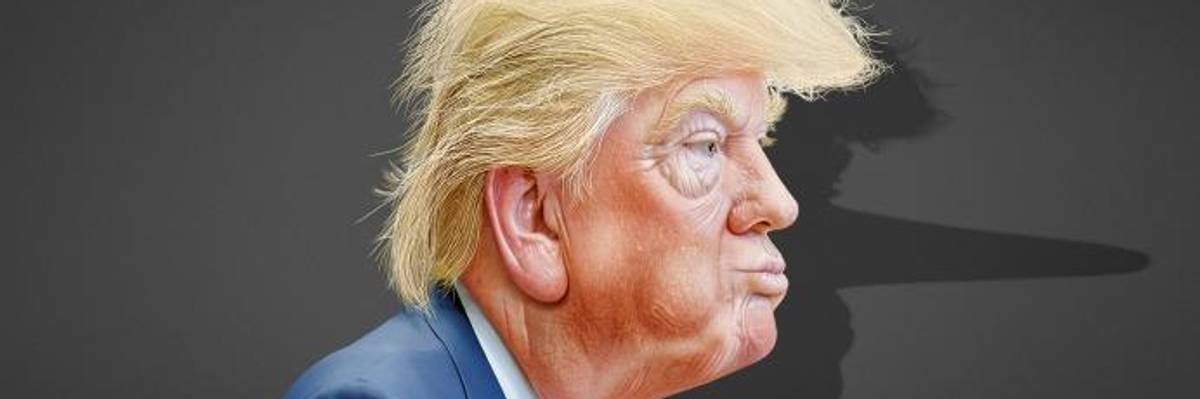
President Donald Trump had promised that if elected, "the American worker will finally have a president who will protect them and fight for them." Instead, his adminstration has waged a war on workers. (Image: DonkeyHotey/flickr/cc)
Continuing his war on workers, President Donald Trump on Thursday announced he was slashing the scheduled pay raises for federal workers.
The president, who declared during his bid for the White House, "the American worker will finally have a president who will protect them and fight for them," cited his authority to issue the "alternative plan for pay increases" during a "national emergency or serious economic conditions affecting the general welfare." His plan, he argued, is necessary to "to put our nation on a sustainable fiscal course."
He writes in his letter to Congress:
I have determined that for 2018, across-the-board pay increases will be 1.4 percent and locality pay increases will average 0.5 percent, resulting in an overall average increase of 1.9 percent for civilian federal employees.
That marks a slightly lower base pay increase and significantly lower supplemental locality pay increase, as Trump notes in his letter:
Under current law, in addition to a 1.9 percent across-the-board increase for the base General Schedule, locality pay increases averaging 26.16 percent and costing $26 billion would go into effect in January 2018.
Reacting to the announcement, the American Federation of Government Employees (AFGE) said the small increase is simply not enough; the workers deserve the same 2.1 percent increase military members are set to receive.
"Federal working people make 6.5 percent less today than they did in 2010, and that is unjust. They need and deserve more. And while the 1.9 percent increase does not make up for years of earning less, it will certainly help employees put food on the table, pay their bills, reduce their debts, and cover everyday costs facing working-class America," said J. David Cox Sr., national president of the union.
"At a time when federal workers are front and center in disaster relief in Texas, it's vital for the American public to recognize their dedication and work. And it's beyond time for them to be fairly compensated for the jobs they do," he said.
Josh Miller-Lewis, deputy communications director for Sen. Bernie Sanders, points out the the irony of the president claiming to base the decision on being fiscally responsible right after pushing a tax plan that amounts to massive tax cuts for those at the very top:
As a tally by the Center on Budget and Policy Priorities' Jared Bernstein and Ben Spielberg makes clear, "When it comes to supporting the jobs and living standards of many of the voters who helped elect him, Trump is not simply failing. He is actively working to make people's lives worse." And as Labor Day approaches, they write, it's important to "unpack the anti-worker campaign being carried out by the Trump administration."
Among the anti-worker actions they reference are his administration's efforts to make it harder for workers to get their overtime pay; blocking an Obama-era rule that ensures federal contractors adhere to labor laws; and his "budget and healthcare proposals [which] would whack many of the services that working people rely on, hacking away at worker training programs, transportation assistance, child care, and affordable housing."
On Labor Day, Bernstein and Spielberg continue, it's "essential to document the damage his administration is doing to the American workforce."
As to whether Trump's pay raise plan is final, the Washington Post explains: "There remains an outside chance that Congress will put a higher or lower figure in a spending bill, and if that is signed into law, that number will prevail."
Dear Common Dreams reader, It’s been nearly 30 years since I co-founded Common Dreams with my late wife, Lina Newhouser. We had the radical notion that journalism should serve the public good, not corporate profits. It was clear to us from the outset what it would take to build such a project. No paid advertisements. No corporate sponsors. No millionaire publisher telling us what to think or do. Many people said we wouldn't last a year, but we proved those doubters wrong. Together with a tremendous team of journalists and dedicated staff, we built an independent media outlet free from the constraints of profits and corporate control. Our mission has always been simple: To inform. To inspire. To ignite change for the common good. Building Common Dreams was not easy. Our survival was never guaranteed. When you take on the most powerful forces—Wall Street greed, fossil fuel industry destruction, Big Tech lobbyists, and uber-rich oligarchs who have spent billions upon billions rigging the economy and democracy in their favor—the only bulwark you have is supporters who believe in your work. But here’s the urgent message from me today. It's never been this bad out there. And it's never been this hard to keep us going. At the very moment Common Dreams is most needed, the threats we face are intensifying. We need your support now more than ever. We don't accept corporate advertising and never will. We don't have a paywall because we don't think people should be blocked from critical news based on their ability to pay. Everything we do is funded by the donations of readers like you. When everyone does the little they can afford, we are strong. But if that support retreats or dries up, so do we. Will you donate now to make sure Common Dreams not only survives but thrives? —Craig Brown, Co-founder |
Continuing his war on workers, President Donald Trump on Thursday announced he was slashing the scheduled pay raises for federal workers.
The president, who declared during his bid for the White House, "the American worker will finally have a president who will protect them and fight for them," cited his authority to issue the "alternative plan for pay increases" during a "national emergency or serious economic conditions affecting the general welfare." His plan, he argued, is necessary to "to put our nation on a sustainable fiscal course."
He writes in his letter to Congress:
I have determined that for 2018, across-the-board pay increases will be 1.4 percent and locality pay increases will average 0.5 percent, resulting in an overall average increase of 1.9 percent for civilian federal employees.
That marks a slightly lower base pay increase and significantly lower supplemental locality pay increase, as Trump notes in his letter:
Under current law, in addition to a 1.9 percent across-the-board increase for the base General Schedule, locality pay increases averaging 26.16 percent and costing $26 billion would go into effect in January 2018.
Reacting to the announcement, the American Federation of Government Employees (AFGE) said the small increase is simply not enough; the workers deserve the same 2.1 percent increase military members are set to receive.
"Federal working people make 6.5 percent less today than they did in 2010, and that is unjust. They need and deserve more. And while the 1.9 percent increase does not make up for years of earning less, it will certainly help employees put food on the table, pay their bills, reduce their debts, and cover everyday costs facing working-class America," said J. David Cox Sr., national president of the union.
"At a time when federal workers are front and center in disaster relief in Texas, it's vital for the American public to recognize their dedication and work. And it's beyond time for them to be fairly compensated for the jobs they do," he said.
Josh Miller-Lewis, deputy communications director for Sen. Bernie Sanders, points out the the irony of the president claiming to base the decision on being fiscally responsible right after pushing a tax plan that amounts to massive tax cuts for those at the very top:
As a tally by the Center on Budget and Policy Priorities' Jared Bernstein and Ben Spielberg makes clear, "When it comes to supporting the jobs and living standards of many of the voters who helped elect him, Trump is not simply failing. He is actively working to make people's lives worse." And as Labor Day approaches, they write, it's important to "unpack the anti-worker campaign being carried out by the Trump administration."
Among the anti-worker actions they reference are his administration's efforts to make it harder for workers to get their overtime pay; blocking an Obama-era rule that ensures federal contractors adhere to labor laws; and his "budget and healthcare proposals [which] would whack many of the services that working people rely on, hacking away at worker training programs, transportation assistance, child care, and affordable housing."
On Labor Day, Bernstein and Spielberg continue, it's "essential to document the damage his administration is doing to the American workforce."
As to whether Trump's pay raise plan is final, the Washington Post explains: "There remains an outside chance that Congress will put a higher or lower figure in a spending bill, and if that is signed into law, that number will prevail."
Continuing his war on workers, President Donald Trump on Thursday announced he was slashing the scheduled pay raises for federal workers.
The president, who declared during his bid for the White House, "the American worker will finally have a president who will protect them and fight for them," cited his authority to issue the "alternative plan for pay increases" during a "national emergency or serious economic conditions affecting the general welfare." His plan, he argued, is necessary to "to put our nation on a sustainable fiscal course."
He writes in his letter to Congress:
I have determined that for 2018, across-the-board pay increases will be 1.4 percent and locality pay increases will average 0.5 percent, resulting in an overall average increase of 1.9 percent for civilian federal employees.
That marks a slightly lower base pay increase and significantly lower supplemental locality pay increase, as Trump notes in his letter:
Under current law, in addition to a 1.9 percent across-the-board increase for the base General Schedule, locality pay increases averaging 26.16 percent and costing $26 billion would go into effect in January 2018.
Reacting to the announcement, the American Federation of Government Employees (AFGE) said the small increase is simply not enough; the workers deserve the same 2.1 percent increase military members are set to receive.
"Federal working people make 6.5 percent less today than they did in 2010, and that is unjust. They need and deserve more. And while the 1.9 percent increase does not make up for years of earning less, it will certainly help employees put food on the table, pay their bills, reduce their debts, and cover everyday costs facing working-class America," said J. David Cox Sr., national president of the union.
"At a time when federal workers are front and center in disaster relief in Texas, it's vital for the American public to recognize their dedication and work. And it's beyond time for them to be fairly compensated for the jobs they do," he said.
Josh Miller-Lewis, deputy communications director for Sen. Bernie Sanders, points out the the irony of the president claiming to base the decision on being fiscally responsible right after pushing a tax plan that amounts to massive tax cuts for those at the very top:
As a tally by the Center on Budget and Policy Priorities' Jared Bernstein and Ben Spielberg makes clear, "When it comes to supporting the jobs and living standards of many of the voters who helped elect him, Trump is not simply failing. He is actively working to make people's lives worse." And as Labor Day approaches, they write, it's important to "unpack the anti-worker campaign being carried out by the Trump administration."
Among the anti-worker actions they reference are his administration's efforts to make it harder for workers to get their overtime pay; blocking an Obama-era rule that ensures federal contractors adhere to labor laws; and his "budget and healthcare proposals [which] would whack many of the services that working people rely on, hacking away at worker training programs, transportation assistance, child care, and affordable housing."
On Labor Day, Bernstein and Spielberg continue, it's "essential to document the damage his administration is doing to the American workforce."
As to whether Trump's pay raise plan is final, the Washington Post explains: "There remains an outside chance that Congress will put a higher or lower figure in a spending bill, and if that is signed into law, that number will prevail."