
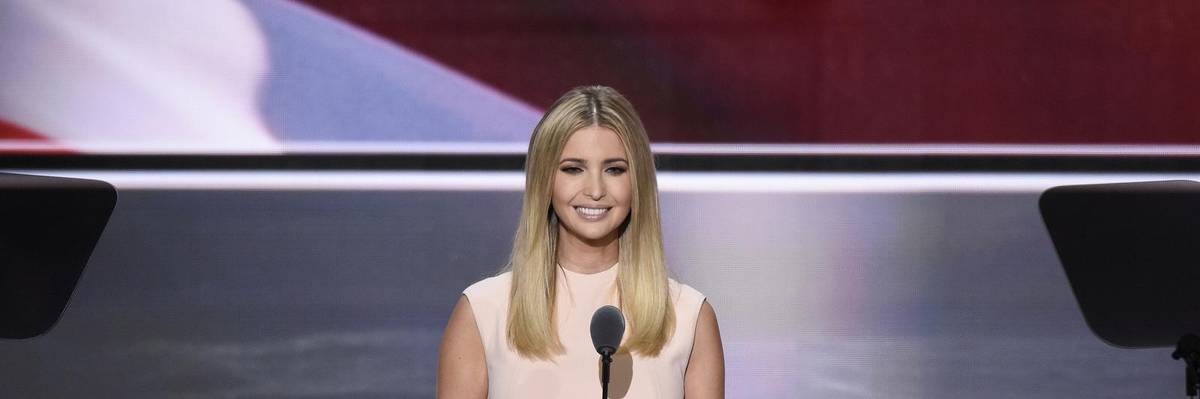
At the Republican National Convention in 2016, Ivanka Trump spoke about strides her father's administration would take toward furthering women's equality in the workplace. (Photo: ABC News/Flickr/cc)
Ivanka Defends Trump Administration's "All-Out Attack on Equal Pay"
Civil rights and women's groups decry "shameful" decision to nix rule to track wage discrimination
Civil rights groups spoke out on Wednesday about the Trump administration's decision to scrap a rule aimed at preventing pay discrimination.
President Obama introduced a directive that would have gone into effect early next year, requiring businesses with 100 or more employees to track wages for workers of various genders, race, and ethnicities and report the data to the Equal Employment Opportunity Commission (EEOC). In defending their decision, the Trump administration claimed the rule would put unrealistic expectations on large employers.
The Leadership Conference on Civil and Human Rights called the White House's decision "shameful."
The National Women's Law Center (NWLC) said the move represented "a clear message to employers: if you want to ignore pay inequities and sweep them under the rug, this Administration has your back."
"This is not a technical tweak as they would have you believe. Make no mistake--it's an all-out attack on equal pay."--Fatima Goss Graves, National Women's Law Center
In an interview with the Wall Street Journal, Neomi Rao of the White House Office of Information and Regulatory Affairs called the rule "enormously burdensome" and said, "We don't believe it would actually help us gather information about wage and employment discrimination."
Fatima Goss Graves of the NWLC rejected Rao's attempt to portray the White House's decision as a minor change to its own attempts to gather information about pay gaps:
We see through the Trump Administration's call to halt the equal pay rule that requires employers to collect and submit pay data by gender, race, and ethnicity to the government. This is not a technical tweak as they would have you believe. Make no mistake--it's an all-out attack on equal pay.
The EEOC has made clear why hard data on wage discrepancies is needed to combat pay gaps.
Without the measure, "we'd learn about a pay-discrimination problem because someone saw a piece of paper left on a copy machine or someone was complaining about their salary to co-workers," said chairwoman Jenny Yang when the rules were drafted by the Obama administration.
Ivanka Trump, who serves as an advisor in the White House and has been cast by many in the media as a moderating force in the Trump administration with a special interest in clearing the way for pay equality for women, supported the decision to scrap the rule.
"Ultimately, while I believe the intention was good and agree that pay transparency is important, the proposed policy would not yield the intended results," said Trump.
According to a report in The Hill, Trump also oversaw an internal review of the White House Council on Women and Girls that resulted in the office's closure in June.
An Urgent Message From Our Co-Founder
Dear Common Dreams reader, It’s been nearly 30 years since I co-founded Common Dreams with my late wife, Lina Newhouser. We had the radical notion that journalism should serve the public good, not corporate profits. It was clear to us from the outset what it would take to build such a project. No paid advertisements. No corporate sponsors. No millionaire publisher telling us what to think or do. Many people said we wouldn't last a year, but we proved those doubters wrong. Together with a tremendous team of journalists and dedicated staff, we built an independent media outlet free from the constraints of profits and corporate control. Our mission has always been simple: To inform. To inspire. To ignite change for the common good. Building Common Dreams was not easy. Our survival was never guaranteed. When you take on the most powerful forces—Wall Street greed, fossil fuel industry destruction, Big Tech lobbyists, and uber-rich oligarchs who have spent billions upon billions rigging the economy and democracy in their favor—the only bulwark you have is supporters who believe in your work. But here’s the urgent message from me today. It's never been this bad out there. And it's never been this hard to keep us going. At the very moment Common Dreams is most needed, the threats we face are intensifying. We need your support now more than ever. We don't accept corporate advertising and never will. We don't have a paywall because we don't think people should be blocked from critical news based on their ability to pay. Everything we do is funded by the donations of readers like you. When everyone does the little they can afford, we are strong. But if that support retreats or dries up, so do we. Will you donate now to make sure Common Dreams not only survives but thrives? —Craig Brown, Co-founder |
Civil rights groups spoke out on Wednesday about the Trump administration's decision to scrap a rule aimed at preventing pay discrimination.
President Obama introduced a directive that would have gone into effect early next year, requiring businesses with 100 or more employees to track wages for workers of various genders, race, and ethnicities and report the data to the Equal Employment Opportunity Commission (EEOC). In defending their decision, the Trump administration claimed the rule would put unrealistic expectations on large employers.
The Leadership Conference on Civil and Human Rights called the White House's decision "shameful."
The National Women's Law Center (NWLC) said the move represented "a clear message to employers: if you want to ignore pay inequities and sweep them under the rug, this Administration has your back."
"This is not a technical tweak as they would have you believe. Make no mistake--it's an all-out attack on equal pay."--Fatima Goss Graves, National Women's Law Center
In an interview with the Wall Street Journal, Neomi Rao of the White House Office of Information and Regulatory Affairs called the rule "enormously burdensome" and said, "We don't believe it would actually help us gather information about wage and employment discrimination."
Fatima Goss Graves of the NWLC rejected Rao's attempt to portray the White House's decision as a minor change to its own attempts to gather information about pay gaps:
We see through the Trump Administration's call to halt the equal pay rule that requires employers to collect and submit pay data by gender, race, and ethnicity to the government. This is not a technical tweak as they would have you believe. Make no mistake--it's an all-out attack on equal pay.
The EEOC has made clear why hard data on wage discrepancies is needed to combat pay gaps.
Without the measure, "we'd learn about a pay-discrimination problem because someone saw a piece of paper left on a copy machine or someone was complaining about their salary to co-workers," said chairwoman Jenny Yang when the rules were drafted by the Obama administration.
Ivanka Trump, who serves as an advisor in the White House and has been cast by many in the media as a moderating force in the Trump administration with a special interest in clearing the way for pay equality for women, supported the decision to scrap the rule.
"Ultimately, while I believe the intention was good and agree that pay transparency is important, the proposed policy would not yield the intended results," said Trump.
According to a report in The Hill, Trump also oversaw an internal review of the White House Council on Women and Girls that resulted in the office's closure in June.
Civil rights groups spoke out on Wednesday about the Trump administration's decision to scrap a rule aimed at preventing pay discrimination.
President Obama introduced a directive that would have gone into effect early next year, requiring businesses with 100 or more employees to track wages for workers of various genders, race, and ethnicities and report the data to the Equal Employment Opportunity Commission (EEOC). In defending their decision, the Trump administration claimed the rule would put unrealistic expectations on large employers.
The Leadership Conference on Civil and Human Rights called the White House's decision "shameful."
The National Women's Law Center (NWLC) said the move represented "a clear message to employers: if you want to ignore pay inequities and sweep them under the rug, this Administration has your back."
"This is not a technical tweak as they would have you believe. Make no mistake--it's an all-out attack on equal pay."--Fatima Goss Graves, National Women's Law Center
In an interview with the Wall Street Journal, Neomi Rao of the White House Office of Information and Regulatory Affairs called the rule "enormously burdensome" and said, "We don't believe it would actually help us gather information about wage and employment discrimination."
Fatima Goss Graves of the NWLC rejected Rao's attempt to portray the White House's decision as a minor change to its own attempts to gather information about pay gaps:
We see through the Trump Administration's call to halt the equal pay rule that requires employers to collect and submit pay data by gender, race, and ethnicity to the government. This is not a technical tweak as they would have you believe. Make no mistake--it's an all-out attack on equal pay.
The EEOC has made clear why hard data on wage discrepancies is needed to combat pay gaps.
Without the measure, "we'd learn about a pay-discrimination problem because someone saw a piece of paper left on a copy machine or someone was complaining about their salary to co-workers," said chairwoman Jenny Yang when the rules were drafted by the Obama administration.
Ivanka Trump, who serves as an advisor in the White House and has been cast by many in the media as a moderating force in the Trump administration with a special interest in clearing the way for pay equality for women, supported the decision to scrap the rule.
"Ultimately, while I believe the intention was good and agree that pay transparency is important, the proposed policy would not yield the intended results," said Trump.
According to a report in The Hill, Trump also oversaw an internal review of the White House Council on Women and Girls that resulted in the office's closure in June.