SUBSCRIBE TO OUR FREE NEWSLETTER
Daily news & progressive opinion—funded by the people, not the corporations—delivered straight to your inbox.
5
#000000
#FFFFFF
To donate by check, phone, or other method, see our More Ways to Give page.
Daily news & progressive opinion—funded by the people, not the corporations—delivered straight to your inbox.
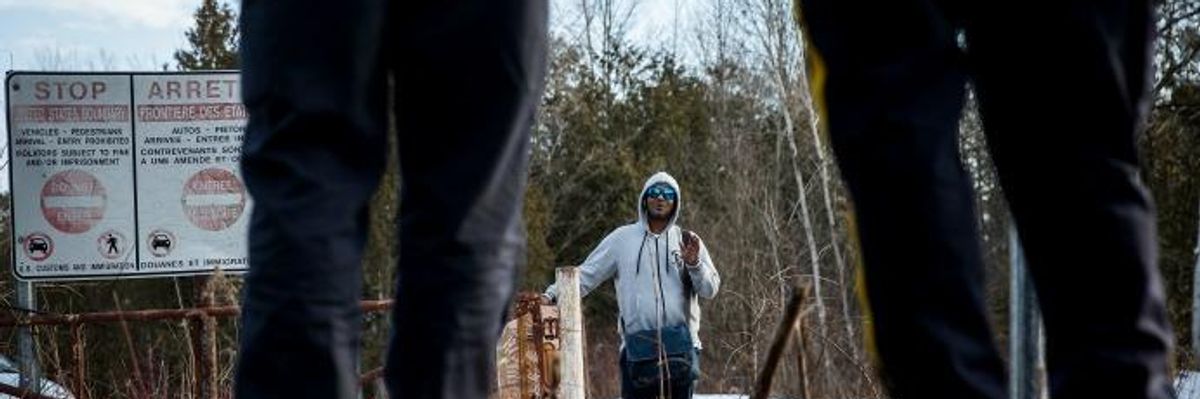
During July, as many as 2,500 asylum seekers fled the United States for Quebec, with many crossing at remote locations along Canada's border with New York State. (Photo: Drew Angerer/Getty Images)
Canada's military has troops assembling heated tents that will be capable of temporarily housing up to 500 asylum seekers who continue crossing into the country where it borders New York State.
"Around 250 asylum seekers are arriving each day in Montreal, the largest city in Canada's mainly French-speaking province of Quebec," Reuters reported on Wednesday. A spokesperson for the Canada Border Services Agency told CBC-Radio Canada there are currently 700 people waiting to be processed, and although the wait time is two or three days, the asylum seekers do not have access to beds.
To accommodate the new arrivals, "nearly 100 soldiers will be in Saint-Bernard-de-Lacolle, across the border from Champlain, New York, on Wednesday to set up the tents and add to temporary facilities already organized by the Royal Canadian Mounted Police (RCMP) and Canadian Border Services Agency," Reuters reported. Once the camp is set up, soldiers will not remain on the site.
During the first six months of the year, RCMP apprehended 3,350 asylum seekers entering Quebec at remote locations along the border, in apparent attempts to avoid a main tenet of 2004's Safe Third Country Agreement that requires asylum seekers to "request refugee protection in the first safe country they arrive in." Montreal's Mayor Denis Coderre tweeted last week that during July, as many as 2,500 asylum seekers fled the United States for Quebec.
Under pressure to provide shelter for so many people, CBC reported that Montreal's "old Royal Victoria Hospital, which closed in 2015, will also be opened up to new arrivals" and capable of hosting at 320 asylum seekers.
Just last week Montreal decided to open its Olympic stadium as a temporary welcome center to house those seeking refugee status--of which about 70 percent are Haitians who worry they will be deported if they stay in the U.S., due to changes in their protected status under the Trump administration. As Common Dreams reported when the stadium was converted:
Many Haitians fear their fate if they remain in the United States, because of the anti-immigrant rhetoric and actions by the Trump administration.
In May, then-head of the U.S. Department of Homeland Security, Gen. John Kelly, extended Temporary Protected Status (TPS) for some 59,000 Haitians affected by the catastrophic 2010 hurricane in Haiti--but only by six months, rather than the typical 18-month extension. The prospect of facing deportation as early as January 2018, coupled with mounting anti-immigrant hostility from Trump, has motivated many Haitians to cross the border into Canada.
"They think the Trump administration will fly them back to Haiti and they don't want to take a chance," said Francine Dupuis, who runs PRAIDA, a government-funded program that helps asylum claimants adjust to life in Canada.
Since the Trump administration's announcement, many asylum seekers have tried to get refugee status in Quebec. However, as BBC reported, "no such protection exists in Canada, where the assessment is done case-by-case. Haiti sent two government officials to meet the Quebec government on Tuesday, to discuss the situation."
Dear Common Dreams reader, It’s been nearly 30 years since I co-founded Common Dreams with my late wife, Lina Newhouser. We had the radical notion that journalism should serve the public good, not corporate profits. It was clear to us from the outset what it would take to build such a project. No paid advertisements. No corporate sponsors. No millionaire publisher telling us what to think or do. Many people said we wouldn't last a year, but we proved those doubters wrong. Together with a tremendous team of journalists and dedicated staff, we built an independent media outlet free from the constraints of profits and corporate control. Our mission has always been simple: To inform. To inspire. To ignite change for the common good. Building Common Dreams was not easy. Our survival was never guaranteed. When you take on the most powerful forces—Wall Street greed, fossil fuel industry destruction, Big Tech lobbyists, and uber-rich oligarchs who have spent billions upon billions rigging the economy and democracy in their favor—the only bulwark you have is supporters who believe in your work. But here’s the urgent message from me today. It's never been this bad out there. And it's never been this hard to keep us going. At the very moment Common Dreams is most needed, the threats we face are intensifying. We need your support now more than ever. We don't accept corporate advertising and never will. We don't have a paywall because we don't think people should be blocked from critical news based on their ability to pay. Everything we do is funded by the donations of readers like you. When everyone does the little they can afford, we are strong. But if that support retreats or dries up, so do we. Will you donate now to make sure Common Dreams not only survives but thrives? —Craig Brown, Co-founder |
Canada's military has troops assembling heated tents that will be capable of temporarily housing up to 500 asylum seekers who continue crossing into the country where it borders New York State.
"Around 250 asylum seekers are arriving each day in Montreal, the largest city in Canada's mainly French-speaking province of Quebec," Reuters reported on Wednesday. A spokesperson for the Canada Border Services Agency told CBC-Radio Canada there are currently 700 people waiting to be processed, and although the wait time is two or three days, the asylum seekers do not have access to beds.
To accommodate the new arrivals, "nearly 100 soldiers will be in Saint-Bernard-de-Lacolle, across the border from Champlain, New York, on Wednesday to set up the tents and add to temporary facilities already organized by the Royal Canadian Mounted Police (RCMP) and Canadian Border Services Agency," Reuters reported. Once the camp is set up, soldiers will not remain on the site.
During the first six months of the year, RCMP apprehended 3,350 asylum seekers entering Quebec at remote locations along the border, in apparent attempts to avoid a main tenet of 2004's Safe Third Country Agreement that requires asylum seekers to "request refugee protection in the first safe country they arrive in." Montreal's Mayor Denis Coderre tweeted last week that during July, as many as 2,500 asylum seekers fled the United States for Quebec.
Under pressure to provide shelter for so many people, CBC reported that Montreal's "old Royal Victoria Hospital, which closed in 2015, will also be opened up to new arrivals" and capable of hosting at 320 asylum seekers.
Just last week Montreal decided to open its Olympic stadium as a temporary welcome center to house those seeking refugee status--of which about 70 percent are Haitians who worry they will be deported if they stay in the U.S., due to changes in their protected status under the Trump administration. As Common Dreams reported when the stadium was converted:
Many Haitians fear their fate if they remain in the United States, because of the anti-immigrant rhetoric and actions by the Trump administration.
In May, then-head of the U.S. Department of Homeland Security, Gen. John Kelly, extended Temporary Protected Status (TPS) for some 59,000 Haitians affected by the catastrophic 2010 hurricane in Haiti--but only by six months, rather than the typical 18-month extension. The prospect of facing deportation as early as January 2018, coupled with mounting anti-immigrant hostility from Trump, has motivated many Haitians to cross the border into Canada.
"They think the Trump administration will fly them back to Haiti and they don't want to take a chance," said Francine Dupuis, who runs PRAIDA, a government-funded program that helps asylum claimants adjust to life in Canada.
Since the Trump administration's announcement, many asylum seekers have tried to get refugee status in Quebec. However, as BBC reported, "no such protection exists in Canada, where the assessment is done case-by-case. Haiti sent two government officials to meet the Quebec government on Tuesday, to discuss the situation."
Canada's military has troops assembling heated tents that will be capable of temporarily housing up to 500 asylum seekers who continue crossing into the country where it borders New York State.
"Around 250 asylum seekers are arriving each day in Montreal, the largest city in Canada's mainly French-speaking province of Quebec," Reuters reported on Wednesday. A spokesperson for the Canada Border Services Agency told CBC-Radio Canada there are currently 700 people waiting to be processed, and although the wait time is two or three days, the asylum seekers do not have access to beds.
To accommodate the new arrivals, "nearly 100 soldiers will be in Saint-Bernard-de-Lacolle, across the border from Champlain, New York, on Wednesday to set up the tents and add to temporary facilities already organized by the Royal Canadian Mounted Police (RCMP) and Canadian Border Services Agency," Reuters reported. Once the camp is set up, soldiers will not remain on the site.
During the first six months of the year, RCMP apprehended 3,350 asylum seekers entering Quebec at remote locations along the border, in apparent attempts to avoid a main tenet of 2004's Safe Third Country Agreement that requires asylum seekers to "request refugee protection in the first safe country they arrive in." Montreal's Mayor Denis Coderre tweeted last week that during July, as many as 2,500 asylum seekers fled the United States for Quebec.
Under pressure to provide shelter for so many people, CBC reported that Montreal's "old Royal Victoria Hospital, which closed in 2015, will also be opened up to new arrivals" and capable of hosting at 320 asylum seekers.
Just last week Montreal decided to open its Olympic stadium as a temporary welcome center to house those seeking refugee status--of which about 70 percent are Haitians who worry they will be deported if they stay in the U.S., due to changes in their protected status under the Trump administration. As Common Dreams reported when the stadium was converted:
Many Haitians fear their fate if they remain in the United States, because of the anti-immigrant rhetoric and actions by the Trump administration.
In May, then-head of the U.S. Department of Homeland Security, Gen. John Kelly, extended Temporary Protected Status (TPS) for some 59,000 Haitians affected by the catastrophic 2010 hurricane in Haiti--but only by six months, rather than the typical 18-month extension. The prospect of facing deportation as early as January 2018, coupled with mounting anti-immigrant hostility from Trump, has motivated many Haitians to cross the border into Canada.
"They think the Trump administration will fly them back to Haiti and they don't want to take a chance," said Francine Dupuis, who runs PRAIDA, a government-funded program that helps asylum claimants adjust to life in Canada.
Since the Trump administration's announcement, many asylum seekers have tried to get refugee status in Quebec. However, as BBC reported, "no such protection exists in Canada, where the assessment is done case-by-case. Haiti sent two government officials to meet the Quebec government on Tuesday, to discuss the situation."