
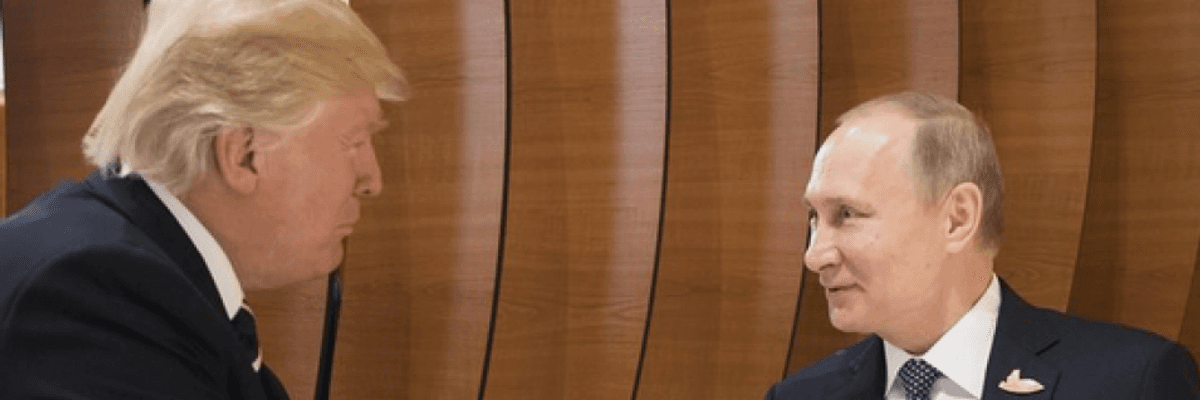
Video footage--which captured the initial in-person exchange between U.S. President Donald Trump and Russian President Vladimir Putin--was posted to Facebook by the German Cabinet on Friday ahead of a scheduled closed door meeting later in the day. (Photo: Screenshot)
It's Settled: Trump Either Did or Did Not Accept Putin's Denial of Election Interference
Presidents met, but reliable account of discussion is absent
President Donald Trump met with Russian leader Vladimir Putin Friday on the sidelines of the Group of 20 (G20) Summit in Hamburg, Germany, but what exactly was said remains unclear.
One point of clarity is that the meeting was much longer than scheduled, running for over 2 hours instead of 30 minutes.
U.S. Secretary of State Rex Tillerson and his Russian counterpart, Foreign Minister Sergey Lavrov, accompanied the two leaders for the meeting. The only other people present in the room were two translators--prompting criticism from some experts who say such an intimate meeting is not in the U.S.'s best interests.
According to Tillerson, Trump began the meeting "by raising the concerns of the American people" regarding alleged Russian interference in the U.S. elections. The two leaders, Tilerson told press after the meeting, had a "robust and lengthy exchange on the subject," and Trump "pressed President Putin on more than one occasion" on the issue, he added. Putin reportedly denied the allegation.
"The two leaders agreed that this is a substantial hindrance on the ability of us to move Russian-U.S. relationships forward and agreed to exchange further work regarding commitments of noninterference in the affairs of the United States and our democratic process as well as those of other countries," Tillerson told reporters. "So more work to be done in that regard."
In Lavrov's version of the meeting, Trump accepted Putin's denial of the allegations.
But, according to NBC News, Tillerson departed his briefing without answering whether or not that matched his understanding of the exchange.
The Washington Post notes that "[b]ecause reporters did not witness the presidents' talks firsthand, they have to rely on the accounts of the American and Russian officials in the room."
Given that situation, MSNBC's Chris Hayes said on Twitter:
David Graham similarly charges at The Atlantic: "with no single reliable version of what happened between Trump and Putin, there's effectively no truth about it at all."
Trump and Putin also reportedly discussed North Korea, cybersecurity, and, terrorism and reached an agreement on a ceasefire in Syria. In that six-year conflict, Amnesty International said of Russia and the U.S., "Both countries and their allies are responsible for the deaths and injuries of hundreds of thousands of men, women, and children."
We are at a crossroads
This country and this world are at a monumental crossroads. In a few short weeks, US voters will have an opportunity to beat back the forces of fascism and confront the billionaires who are rigging the economy, our media system, and our democracy, making it increasingly impossible for ordinary people to get by. We’re not just talking about the election. We’re talking about what must be done once these fascist elements are vanquished from power. We need a bolder set of solutions than what either major party has so far been willing to offer and a working-class movement ready to fight like hell for it. Trump didn't emerge from nowhere. The conditions that fueled MAGA authoritarianism were created by decades of radical neoliberal economic policies and a corrupt political system dominated by corporate interests. They slashed taxes on the super-rich, promising that the benefits would trickle down. They said giveaways to the corporate titans would make life more affordable for the rest of us. It was all bullshit. And when a bitter, betrayed populace searches for someone to blame, right-wing demagogues have little trouble finding scapegoats. People know when they're being lied to, but you won't hear any of this from the corporate media. Only independent journalism—powered and funded by people who believe in building a better world—can deliver truly trustworthy daily news. Our Fall Campaign is underway, and we need your help. To power our newsroom through the rest of the year, we need to raise $125,000 by midnight on October 31. So if you share our vision, please contribute whatever you can to sustain our work. |
President Donald Trump met with Russian leader Vladimir Putin Friday on the sidelines of the Group of 20 (G20) Summit in Hamburg, Germany, but what exactly was said remains unclear.
One point of clarity is that the meeting was much longer than scheduled, running for over 2 hours instead of 30 minutes.
U.S. Secretary of State Rex Tillerson and his Russian counterpart, Foreign Minister Sergey Lavrov, accompanied the two leaders for the meeting. The only other people present in the room were two translators--prompting criticism from some experts who say such an intimate meeting is not in the U.S.'s best interests.
According to Tillerson, Trump began the meeting "by raising the concerns of the American people" regarding alleged Russian interference in the U.S. elections. The two leaders, Tilerson told press after the meeting, had a "robust and lengthy exchange on the subject," and Trump "pressed President Putin on more than one occasion" on the issue, he added. Putin reportedly denied the allegation.
"The two leaders agreed that this is a substantial hindrance on the ability of us to move Russian-U.S. relationships forward and agreed to exchange further work regarding commitments of noninterference in the affairs of the United States and our democratic process as well as those of other countries," Tillerson told reporters. "So more work to be done in that regard."
In Lavrov's version of the meeting, Trump accepted Putin's denial of the allegations.
But, according to NBC News, Tillerson departed his briefing without answering whether or not that matched his understanding of the exchange.
The Washington Post notes that "[b]ecause reporters did not witness the presidents' talks firsthand, they have to rely on the accounts of the American and Russian officials in the room."
Given that situation, MSNBC's Chris Hayes said on Twitter:
David Graham similarly charges at The Atlantic: "with no single reliable version of what happened between Trump and Putin, there's effectively no truth about it at all."
Trump and Putin also reportedly discussed North Korea, cybersecurity, and, terrorism and reached an agreement on a ceasefire in Syria. In that six-year conflict, Amnesty International said of Russia and the U.S., "Both countries and their allies are responsible for the deaths and injuries of hundreds of thousands of men, women, and children."
President Donald Trump met with Russian leader Vladimir Putin Friday on the sidelines of the Group of 20 (G20) Summit in Hamburg, Germany, but what exactly was said remains unclear.
One point of clarity is that the meeting was much longer than scheduled, running for over 2 hours instead of 30 minutes.
U.S. Secretary of State Rex Tillerson and his Russian counterpart, Foreign Minister Sergey Lavrov, accompanied the two leaders for the meeting. The only other people present in the room were two translators--prompting criticism from some experts who say such an intimate meeting is not in the U.S.'s best interests.
According to Tillerson, Trump began the meeting "by raising the concerns of the American people" regarding alleged Russian interference in the U.S. elections. The two leaders, Tilerson told press after the meeting, had a "robust and lengthy exchange on the subject," and Trump "pressed President Putin on more than one occasion" on the issue, he added. Putin reportedly denied the allegation.
"The two leaders agreed that this is a substantial hindrance on the ability of us to move Russian-U.S. relationships forward and agreed to exchange further work regarding commitments of noninterference in the affairs of the United States and our democratic process as well as those of other countries," Tillerson told reporters. "So more work to be done in that regard."
In Lavrov's version of the meeting, Trump accepted Putin's denial of the allegations.
But, according to NBC News, Tillerson departed his briefing without answering whether or not that matched his understanding of the exchange.
The Washington Post notes that "[b]ecause reporters did not witness the presidents' talks firsthand, they have to rely on the accounts of the American and Russian officials in the room."
Given that situation, MSNBC's Chris Hayes said on Twitter:
David Graham similarly charges at The Atlantic: "with no single reliable version of what happened between Trump and Putin, there's effectively no truth about it at all."
Trump and Putin also reportedly discussed North Korea, cybersecurity, and, terrorism and reached an agreement on a ceasefire in Syria. In that six-year conflict, Amnesty International said of Russia and the U.S., "Both countries and their allies are responsible for the deaths and injuries of hundreds of thousands of men, women, and children."