

"What to the Slave is 4th of July?": James Earl Jones Reads Frederick Douglass's Historic Speech
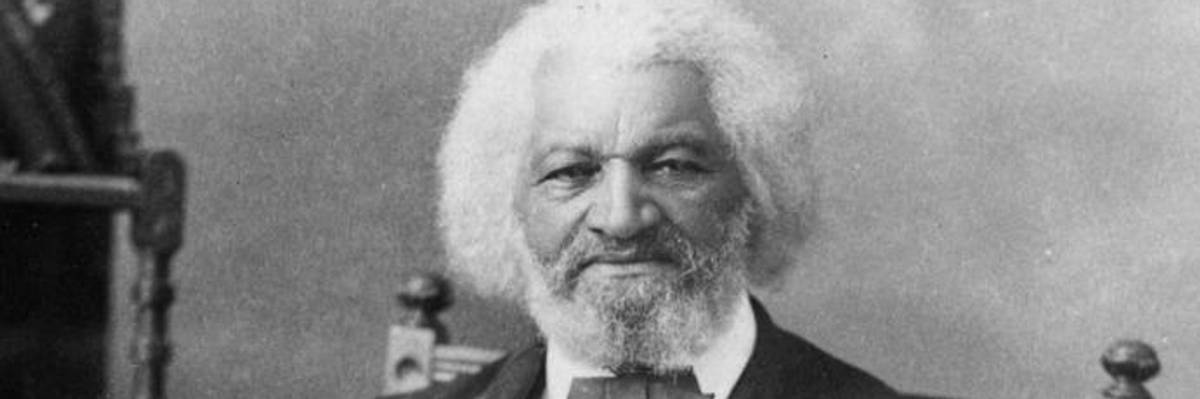
In a Fourth of July holiday special, we begin with the words of Frederick Douglass. Born into slavery around 1818, Douglass became a key leader of the abolitionist movement. On July 5, 1852, in Rochester, New York, he gave one of his most famous speeches, "The Meaning of July Fourth for the Negro." He was addressing the Rochester Ladies Antislavery Society. This is actor James Earl Jones reading the speech during a performance of historian Howard Zinn's acclaimed book, "Voices of a People's History of the United States." He was introduced by Zinn.
In a Fourth of July holiday special, we begin with the words of Frederick Douglass. Born into slavery around 1818, Douglass became a key leader of the abolitionist movement. On July 5, 1852, in Rochester, New York, he gave one of his most famous speeches, "The Meaning of July Fourth for the Negro." He was addressing the Rochester Ladies Antislavery Society. This is actor James Earl Jones reading the speech during a performance of historian Howard Zinn's acclaimed book, "Voices of a People's History of the United States." He was introduced by Zinn.
Transcript
HOWARD ZINN: Frederick Douglass, once a slave, became a brilliant and powerful leader of the anti-slavery movement. In 1852, he was asked to speak in celebration of the Fourth of July.
FREDERICK DOUGLASS: [read by James Earl Jones] Fellow-citizens, pardon me, allow me to ask, why am I called upon to speak here to-day? What have I, or those I represent, to do with your national independence? Are the great principles of political freedom and of natural justice, embodied in that Declaration of Independence, extended to us? And am I, therefore, called upon to bring our humble offering to the national altar, and to confess the benefits and express devout gratitude for the blessings resulting from your independence to us?
I am not included within the pale of this glorious anniversary! Your high independence only reveals the immeasurable distance between us. The blessings in which you this day rejoice are not enjoyed in common. The rich inheritance of justice, liberty, prosperity, and independence bequeathed by your fathers is shared by you, not by me. The sunlight that brought life and healing to you has brought stripes and death to me. This Fourth of July is yours, not mine. You may rejoice, I must mourn. To drag a man in fetters into the grand illuminated temple of liberty, and call upon him to join you in joyous anthems, were inhuman mockery and sacrilegious irony. Do you mean, citizens, to mock me, by asking me to speak today?
What, to the American slave, is your Fourth of July? I answer: a day that reveals to him, more than all other days of the year, the gross injustice and cruelty to which he is a constant victim. To him, your celebration is a sham; your boasted liberty, an unholy license; your national greatness, swelling vanity; your sounds of rejoicing are empty and heartless; your denunciation of tyrants, brass fronted impudence; your shouts of liberty and equality, hollow mockery; your prayers and hymns, your sermons and thanksgivings, with all your religious parade and solemnity, are, to Him, mere bombast, fraud, deception, impiety, and hypocrisy--a thin veil to cover up crimes that would disgrace a nation of savages. There is not a nation of the earth guilty of practices more shocking and bloody than are the people of these United States at this very hour.
At a time like this, scorching irony, not convincing argument, is needed. O! had I the ability, and could reach the nation's ear, I would, to-day, pour forth a stream, a fiery stream of biting ridicule, blasting reproach, withering sarcasm, and stern rebuke. For it is not light that is needed, but fire; it is not the gentle shower, but thunder. We need the storm, the whirlwind, the earthquake. The feeling of the nation must be quickened; the conscience of the nation must be roused; the propriety of the nation must be startled; the hypocrisy of the nation must be exposed; and the crimes against God and man must be proclaimed and denounced.
AMY GOODMAN: James Earl Jones, reading Frederick Douglass's famous 1852 Independence Day address in Rochester, New York. It was part of a performance of Howard Zinn's Voices of a People's History of the United States.
We are at a crossroads
This country and this world are at a monumental crossroads. In a few short weeks, US voters will have an opportunity to beat back the forces of fascism and confront the billionaires who are rigging the economy, our media system, and our democracy, making it increasingly impossible for ordinary people to get by. We’re not just talking about the election. We’re talking about what must be done once these fascist elements are vanquished from power. We need a bolder set of solutions than what either major party has so far been willing to offer and a working-class movement ready to fight like hell for it. Trump didn't emerge from nowhere. The conditions that fueled MAGA authoritarianism were created by decades of radical neoliberal economic policies and a corrupt political system dominated by corporate interests. They slashed taxes on the super-rich, promising that the benefits would trickle down. They said giveaways to the corporate titans would make life more affordable for the rest of us. It was all bullshit. And when a bitter, betrayed populace searches for someone to blame, right-wing demagogues have little trouble finding scapegoats. People know when they're being lied to, but you won't hear any of this from the corporate media. Only independent journalism—powered and funded by people who believe in building a better world—can deliver truly trustworthy daily news. Our Fall Campaign is underway, and we need your help. To power our newsroom through the rest of the year, we need to raise $125,000 by midnight on October 31. So if you share our vision, please contribute whatever you can to sustain our work. |
In a Fourth of July holiday special, we begin with the words of Frederick Douglass. Born into slavery around 1818, Douglass became a key leader of the abolitionist movement. On July 5, 1852, in Rochester, New York, he gave one of his most famous speeches, "The Meaning of July Fourth for the Negro." He was addressing the Rochester Ladies Antislavery Society. This is actor James Earl Jones reading the speech during a performance of historian Howard Zinn's acclaimed book, "Voices of a People's History of the United States." He was introduced by Zinn.
Transcript
HOWARD ZINN: Frederick Douglass, once a slave, became a brilliant and powerful leader of the anti-slavery movement. In 1852, he was asked to speak in celebration of the Fourth of July.
FREDERICK DOUGLASS: [read by James Earl Jones] Fellow-citizens, pardon me, allow me to ask, why am I called upon to speak here to-day? What have I, or those I represent, to do with your national independence? Are the great principles of political freedom and of natural justice, embodied in that Declaration of Independence, extended to us? And am I, therefore, called upon to bring our humble offering to the national altar, and to confess the benefits and express devout gratitude for the blessings resulting from your independence to us?
I am not included within the pale of this glorious anniversary! Your high independence only reveals the immeasurable distance between us. The blessings in which you this day rejoice are not enjoyed in common. The rich inheritance of justice, liberty, prosperity, and independence bequeathed by your fathers is shared by you, not by me. The sunlight that brought life and healing to you has brought stripes and death to me. This Fourth of July is yours, not mine. You may rejoice, I must mourn. To drag a man in fetters into the grand illuminated temple of liberty, and call upon him to join you in joyous anthems, were inhuman mockery and sacrilegious irony. Do you mean, citizens, to mock me, by asking me to speak today?
What, to the American slave, is your Fourth of July? I answer: a day that reveals to him, more than all other days of the year, the gross injustice and cruelty to which he is a constant victim. To him, your celebration is a sham; your boasted liberty, an unholy license; your national greatness, swelling vanity; your sounds of rejoicing are empty and heartless; your denunciation of tyrants, brass fronted impudence; your shouts of liberty and equality, hollow mockery; your prayers and hymns, your sermons and thanksgivings, with all your religious parade and solemnity, are, to Him, mere bombast, fraud, deception, impiety, and hypocrisy--a thin veil to cover up crimes that would disgrace a nation of savages. There is not a nation of the earth guilty of practices more shocking and bloody than are the people of these United States at this very hour.
At a time like this, scorching irony, not convincing argument, is needed. O! had I the ability, and could reach the nation's ear, I would, to-day, pour forth a stream, a fiery stream of biting ridicule, blasting reproach, withering sarcasm, and stern rebuke. For it is not light that is needed, but fire; it is not the gentle shower, but thunder. We need the storm, the whirlwind, the earthquake. The feeling of the nation must be quickened; the conscience of the nation must be roused; the propriety of the nation must be startled; the hypocrisy of the nation must be exposed; and the crimes against God and man must be proclaimed and denounced.
AMY GOODMAN: James Earl Jones, reading Frederick Douglass's famous 1852 Independence Day address in Rochester, New York. It was part of a performance of Howard Zinn's Voices of a People's History of the United States.