SUBSCRIBE TO OUR FREE NEWSLETTER
Daily news & progressive opinion—funded by the people, not the corporations—delivered straight to your inbox.
5
#000000
#FFFFFF
To donate by check, phone, or other method, see our More Ways to Give page.
Daily news & progressive opinion—funded by the people, not the corporations—delivered straight to your inbox.
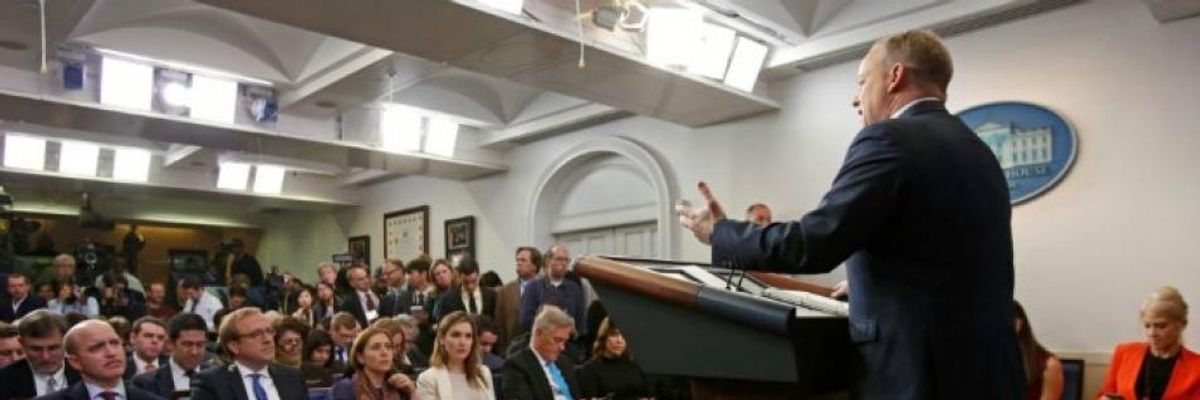
"There's a darkness spreading over Washington these days, and it might be time for everyone in the news media who cares about democracy to confront it," wrote the Baltimore Sun's David Zurawik. (Photo: Reuters)
"This is not how an elected government behaves in a true democracy."
-- Karen Hobert Flynn, president of Common Cause
The Trump administration sparked backlash once more from journalists and activists on Wednesday by continuing the "disturbing trend" of prohibiting audio and video recordings of the daily press briefing, a move that prompted many to call for more pushback from journalists and media outlets.
Some urged members of the White House press corps to boycott any briefings that did not permit audio or video, while others argued that journalists should rebel by recording briefings on their phones.
CNN reporter Jim Acosta, highlighting the Trump administration's "near-total refusal" to take questions from anyone associated with his network, posted a picture from the press briefing on Monday, with the caption: "Video of this has been banned by the USA."
Author and historian Kevin Kruse responded:
In a recent column for the Baltimore Sun, media critic David Zurawik echoed these calls for members of the White House press corps--and members of the media more broadly--to resist the Trump administration's blatant attempt to interfere with the freedom of the press.
"There's a darkness spreading over Washington these days, and it might be time for everyone in the news media who cares about democracy to confront it," Zurawik wrote. "You can only talk to a bully so long before you have to act. Maybe it's time for such collective action again in taking an administration to school."
Following Tuesday's press briefing--during which Deputy Press Secretary Sarah Huckabee Sanders was confronted by Playboy reporter Brian Karem for her "inflammatory" attacks on the media--Zurawik argued it is "past time" for someone to stand up to the White House.
"Will someone, anyone, step up and end these distressing displays of White House dysfunction and disregard for the obligation of the presidency to provide citizens with some sense of truthful information and accountability?" he wrote.
GQ's Jack Moore offered similar advice, writing: "This is a scary time. It's a crisis. The least you can do is turn your camera on."
In a statement on Tuesday, the progressive watchdog group Common Cause estimated that "there have been only five on camera briefings by White House press officials during the entire month of June."
"This is not how an elected government behaves in a true democracy," concluded Common Cause president Karen Hobert Flynn. "Hiding behind the bully pulpit is a cowardly act far beneath the dignity of the office of the president.
Dear Common Dreams reader, It’s been nearly 30 years since I co-founded Common Dreams with my late wife, Lina Newhouser. We had the radical notion that journalism should serve the public good, not corporate profits. It was clear to us from the outset what it would take to build such a project. No paid advertisements. No corporate sponsors. No millionaire publisher telling us what to think or do. Many people said we wouldn't last a year, but we proved those doubters wrong. Together with a tremendous team of journalists and dedicated staff, we built an independent media outlet free from the constraints of profits and corporate control. Our mission has always been simple: To inform. To inspire. To ignite change for the common good. Building Common Dreams was not easy. Our survival was never guaranteed. When you take on the most powerful forces—Wall Street greed, fossil fuel industry destruction, Big Tech lobbyists, and uber-rich oligarchs who have spent billions upon billions rigging the economy and democracy in their favor—the only bulwark you have is supporters who believe in your work. But here’s the urgent message from me today. It's never been this bad out there. And it's never been this hard to keep us going. At the very moment Common Dreams is most needed, the threats we face are intensifying. We need your support now more than ever. We don't accept corporate advertising and never will. We don't have a paywall because we don't think people should be blocked from critical news based on their ability to pay. Everything we do is funded by the donations of readers like you. When everyone does the little they can afford, we are strong. But if that support retreats or dries up, so do we. Will you donate now to make sure Common Dreams not only survives but thrives? —Craig Brown, Co-founder |
"This is not how an elected government behaves in a true democracy."
-- Karen Hobert Flynn, president of Common Cause
The Trump administration sparked backlash once more from journalists and activists on Wednesday by continuing the "disturbing trend" of prohibiting audio and video recordings of the daily press briefing, a move that prompted many to call for more pushback from journalists and media outlets.
Some urged members of the White House press corps to boycott any briefings that did not permit audio or video, while others argued that journalists should rebel by recording briefings on their phones.
CNN reporter Jim Acosta, highlighting the Trump administration's "near-total refusal" to take questions from anyone associated with his network, posted a picture from the press briefing on Monday, with the caption: "Video of this has been banned by the USA."
Author and historian Kevin Kruse responded:
In a recent column for the Baltimore Sun, media critic David Zurawik echoed these calls for members of the White House press corps--and members of the media more broadly--to resist the Trump administration's blatant attempt to interfere with the freedom of the press.
"There's a darkness spreading over Washington these days, and it might be time for everyone in the news media who cares about democracy to confront it," Zurawik wrote. "You can only talk to a bully so long before you have to act. Maybe it's time for such collective action again in taking an administration to school."
Following Tuesday's press briefing--during which Deputy Press Secretary Sarah Huckabee Sanders was confronted by Playboy reporter Brian Karem for her "inflammatory" attacks on the media--Zurawik argued it is "past time" for someone to stand up to the White House.
"Will someone, anyone, step up and end these distressing displays of White House dysfunction and disregard for the obligation of the presidency to provide citizens with some sense of truthful information and accountability?" he wrote.
GQ's Jack Moore offered similar advice, writing: "This is a scary time. It's a crisis. The least you can do is turn your camera on."
In a statement on Tuesday, the progressive watchdog group Common Cause estimated that "there have been only five on camera briefings by White House press officials during the entire month of June."
"This is not how an elected government behaves in a true democracy," concluded Common Cause president Karen Hobert Flynn. "Hiding behind the bully pulpit is a cowardly act far beneath the dignity of the office of the president.
"This is not how an elected government behaves in a true democracy."
-- Karen Hobert Flynn, president of Common Cause
The Trump administration sparked backlash once more from journalists and activists on Wednesday by continuing the "disturbing trend" of prohibiting audio and video recordings of the daily press briefing, a move that prompted many to call for more pushback from journalists and media outlets.
Some urged members of the White House press corps to boycott any briefings that did not permit audio or video, while others argued that journalists should rebel by recording briefings on their phones.
CNN reporter Jim Acosta, highlighting the Trump administration's "near-total refusal" to take questions from anyone associated with his network, posted a picture from the press briefing on Monday, with the caption: "Video of this has been banned by the USA."
Author and historian Kevin Kruse responded:
In a recent column for the Baltimore Sun, media critic David Zurawik echoed these calls for members of the White House press corps--and members of the media more broadly--to resist the Trump administration's blatant attempt to interfere with the freedom of the press.
"There's a darkness spreading over Washington these days, and it might be time for everyone in the news media who cares about democracy to confront it," Zurawik wrote. "You can only talk to a bully so long before you have to act. Maybe it's time for such collective action again in taking an administration to school."
Following Tuesday's press briefing--during which Deputy Press Secretary Sarah Huckabee Sanders was confronted by Playboy reporter Brian Karem for her "inflammatory" attacks on the media--Zurawik argued it is "past time" for someone to stand up to the White House.
"Will someone, anyone, step up and end these distressing displays of White House dysfunction and disregard for the obligation of the presidency to provide citizens with some sense of truthful information and accountability?" he wrote.
GQ's Jack Moore offered similar advice, writing: "This is a scary time. It's a crisis. The least you can do is turn your camera on."
In a statement on Tuesday, the progressive watchdog group Common Cause estimated that "there have been only five on camera briefings by White House press officials during the entire month of June."
"This is not how an elected government behaves in a true democracy," concluded Common Cause president Karen Hobert Flynn. "Hiding behind the bully pulpit is a cowardly act far beneath the dignity of the office of the president.