SUBSCRIBE TO OUR FREE NEWSLETTER
Daily news & progressive opinion—funded by the people, not the corporations—delivered straight to your inbox.
5
#000000
#FFFFFF
To donate by check, phone, or other method, see our More Ways to Give page.
Daily news & progressive opinion—funded by the people, not the corporations—delivered straight to your inbox.
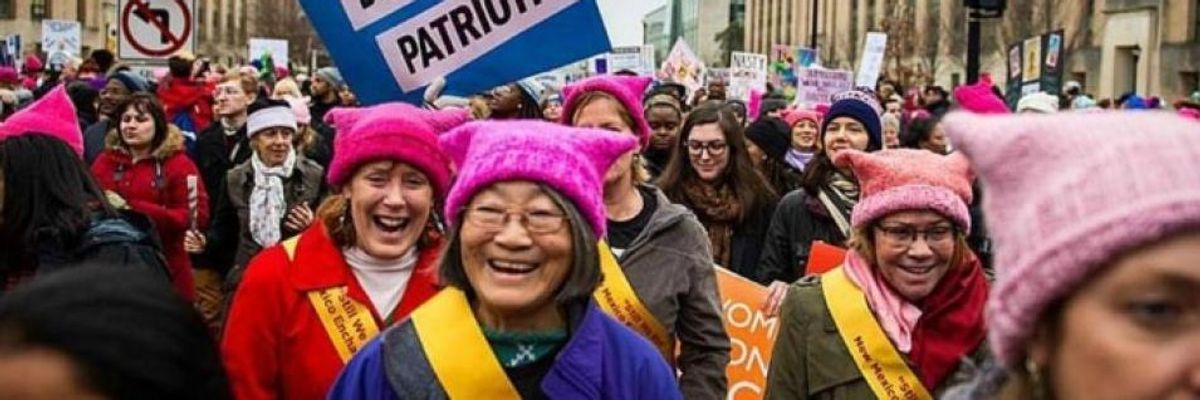
Republican lawmakers, it appears, have been emboldened by Trump's open contempt for free expression. (Photo: ACLU Nationwide/Facebook)
In what is being called the "biggest protest crackdown since the Civil Rights Era," Republicans in at least 20 states have put forward or passed laws with the intention of making protest more difficult and the punishment for expressing dissent more draconian since President Donald Trump's inauguration in January.
"The state will try to devise ways to squash opposition and chill the will of people who are willing to face risks to their liberty to further their cause."
--Chase Iron Eyes, member of the Standing Rock Sioux Tribe
Throughout his bid for the White House, Trump frequently signaled his support for taking forceful action against those who vocally opposed him at campaign rallies and speeches, once suggesting a protester who interrupted a rally "should have been roughed up."
In what was characterized as "an act of intimidation," Trump also floated the idea of "jailing journalists who publish classified information" in a private meeting with former FBI Director James Comey.
Republican lawmakers, it appears, have been emboldened by Trump's open contempt for free expression. News outlets, alarmed by the trend, have kept a running tally of states with anti-dissent laws in the works. Common Dreams reported in April that the number had reached 19, up from 10 in January. Now, according to The Daily Beast, 20 states are in the process of attempting to suppress peaceful resistance.
With such measures proliferating across the U.S., the United Nations condemned the trend as both "alarming and undemocratic."
"In my dozen years of monitoring state legislation, I've certainly not seen a wave of anti-protest bills this large," Lee Rowland, an attorney at the American Civil Liberties Union (ACLU), recently told the New York Times.
Attempts to crackdown on dissent have also begun to affect the work of the national press. In a move that sparked immediate outrage, Senate Republicans last week announced new rules making it difficult for reporters to interview lawmakers in the hallways of the Capitol.
On Monday, the White House barred reporters from making audio or video recordings of the daily press briefing, prompting an indignant reaction from CNN's Jim Acosta, who deemed it deliberate "suppression of information."
Chase Iron Eyes, an activist and member of the Standing Rock Sioux Tribe, recently characterized the White House's anti-dissent posture, as well as Republican efforts to criminalize protest, as an attempt to "send chilling effects" and delegitimize activists engaged in non-violent resistance.
"The state will try to devise ways to squash opposition and chill the will of people who are willing to face risks to their liberty to further their cause," he concluded.
Dear Common Dreams reader, It’s been nearly 30 years since I co-founded Common Dreams with my late wife, Lina Newhouser. We had the radical notion that journalism should serve the public good, not corporate profits. It was clear to us from the outset what it would take to build such a project. No paid advertisements. No corporate sponsors. No millionaire publisher telling us what to think or do. Many people said we wouldn't last a year, but we proved those doubters wrong. Together with a tremendous team of journalists and dedicated staff, we built an independent media outlet free from the constraints of profits and corporate control. Our mission has always been simple: To inform. To inspire. To ignite change for the common good. Building Common Dreams was not easy. Our survival was never guaranteed. When you take on the most powerful forces—Wall Street greed, fossil fuel industry destruction, Big Tech lobbyists, and uber-rich oligarchs who have spent billions upon billions rigging the economy and democracy in their favor—the only bulwark you have is supporters who believe in your work. But here’s the urgent message from me today. It's never been this bad out there. And it's never been this hard to keep us going. At the very moment Common Dreams is most needed, the threats we face are intensifying. We need your support now more than ever. We don't accept corporate advertising and never will. We don't have a paywall because we don't think people should be blocked from critical news based on their ability to pay. Everything we do is funded by the donations of readers like you. When everyone does the little they can afford, we are strong. But if that support retreats or dries up, so do we. Will you donate now to make sure Common Dreams not only survives but thrives? —Craig Brown, Co-founder |
In what is being called the "biggest protest crackdown since the Civil Rights Era," Republicans in at least 20 states have put forward or passed laws with the intention of making protest more difficult and the punishment for expressing dissent more draconian since President Donald Trump's inauguration in January.
"The state will try to devise ways to squash opposition and chill the will of people who are willing to face risks to their liberty to further their cause."
--Chase Iron Eyes, member of the Standing Rock Sioux Tribe
Throughout his bid for the White House, Trump frequently signaled his support for taking forceful action against those who vocally opposed him at campaign rallies and speeches, once suggesting a protester who interrupted a rally "should have been roughed up."
In what was characterized as "an act of intimidation," Trump also floated the idea of "jailing journalists who publish classified information" in a private meeting with former FBI Director James Comey.
Republican lawmakers, it appears, have been emboldened by Trump's open contempt for free expression. News outlets, alarmed by the trend, have kept a running tally of states with anti-dissent laws in the works. Common Dreams reported in April that the number had reached 19, up from 10 in January. Now, according to The Daily Beast, 20 states are in the process of attempting to suppress peaceful resistance.
With such measures proliferating across the U.S., the United Nations condemned the trend as both "alarming and undemocratic."
"In my dozen years of monitoring state legislation, I've certainly not seen a wave of anti-protest bills this large," Lee Rowland, an attorney at the American Civil Liberties Union (ACLU), recently told the New York Times.
Attempts to crackdown on dissent have also begun to affect the work of the national press. In a move that sparked immediate outrage, Senate Republicans last week announced new rules making it difficult for reporters to interview lawmakers in the hallways of the Capitol.
On Monday, the White House barred reporters from making audio or video recordings of the daily press briefing, prompting an indignant reaction from CNN's Jim Acosta, who deemed it deliberate "suppression of information."
Chase Iron Eyes, an activist and member of the Standing Rock Sioux Tribe, recently characterized the White House's anti-dissent posture, as well as Republican efforts to criminalize protest, as an attempt to "send chilling effects" and delegitimize activists engaged in non-violent resistance.
"The state will try to devise ways to squash opposition and chill the will of people who are willing to face risks to their liberty to further their cause," he concluded.
In what is being called the "biggest protest crackdown since the Civil Rights Era," Republicans in at least 20 states have put forward or passed laws with the intention of making protest more difficult and the punishment for expressing dissent more draconian since President Donald Trump's inauguration in January.
"The state will try to devise ways to squash opposition and chill the will of people who are willing to face risks to their liberty to further their cause."
--Chase Iron Eyes, member of the Standing Rock Sioux Tribe
Throughout his bid for the White House, Trump frequently signaled his support for taking forceful action against those who vocally opposed him at campaign rallies and speeches, once suggesting a protester who interrupted a rally "should have been roughed up."
In what was characterized as "an act of intimidation," Trump also floated the idea of "jailing journalists who publish classified information" in a private meeting with former FBI Director James Comey.
Republican lawmakers, it appears, have been emboldened by Trump's open contempt for free expression. News outlets, alarmed by the trend, have kept a running tally of states with anti-dissent laws in the works. Common Dreams reported in April that the number had reached 19, up from 10 in January. Now, according to The Daily Beast, 20 states are in the process of attempting to suppress peaceful resistance.
With such measures proliferating across the U.S., the United Nations condemned the trend as both "alarming and undemocratic."
"In my dozen years of monitoring state legislation, I've certainly not seen a wave of anti-protest bills this large," Lee Rowland, an attorney at the American Civil Liberties Union (ACLU), recently told the New York Times.
Attempts to crackdown on dissent have also begun to affect the work of the national press. In a move that sparked immediate outrage, Senate Republicans last week announced new rules making it difficult for reporters to interview lawmakers in the hallways of the Capitol.
On Monday, the White House barred reporters from making audio or video recordings of the daily press briefing, prompting an indignant reaction from CNN's Jim Acosta, who deemed it deliberate "suppression of information."
Chase Iron Eyes, an activist and member of the Standing Rock Sioux Tribe, recently characterized the White House's anti-dissent posture, as well as Republican efforts to criminalize protest, as an attempt to "send chilling effects" and delegitimize activists engaged in non-violent resistance.
"The state will try to devise ways to squash opposition and chill the will of people who are willing to face risks to their liberty to further their cause," he concluded.