SUBSCRIBE TO OUR FREE NEWSLETTER
Daily news & progressive opinion—funded by the people, not the corporations—delivered straight to your inbox.
5
#000000
#FFFFFF
To donate by check, phone, or other method, see our More Ways to Give page.
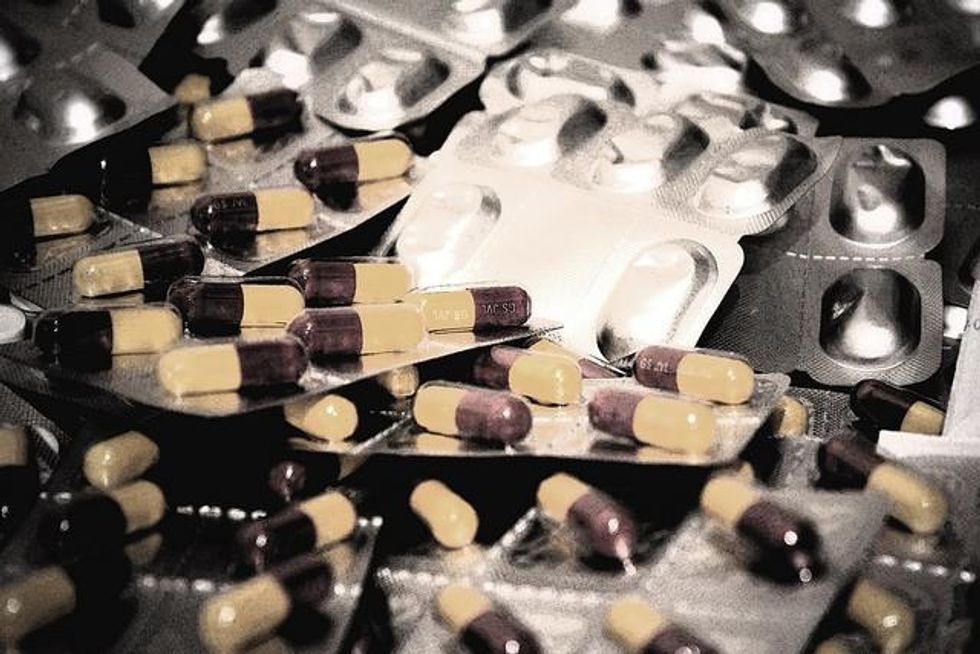
As the Times reports--much to the chagrin of the "business groups, legislators and drug makers in the United States"-- India has increasingly challenged patent protections in order to care for their impoverished population by allowing the production of less costly, generic versions of numerous drugs.
Citing just once example, in a country where roughly half those diagnosed with breast cancer die from it, in part due to the soaring cost ($18,000 per treatment) of one of the most effective drugs, India's pioneering stance against the world's largest pharmaceutical corporations has the business "world watching" as the country strives to bring more affordable medicines to its people, especially the poor.
The New York Times reports:
India, which is one of the world's leading producers of generic pharmaceuticals, has long viewed patent rights on medicines skeptically. It has already ruled invalid patents protecting exclusive sales of Novartis's Gleevec, Pfizer's Sutent and Roche's Tarceva, all cancer medicines. In a landmark decision last year, the government agreed that the patent protecting Bayer's Nexavar, also a cancer drug, was valid but overrode it anyway because a generic company promised to lower the price from $4,500 to about $140 per month of treatment.
Most recently, Roche Holdings of Switzerland has surrendered the patent rights to the drug Herceptin, one of the most effective treatments for an aggressive form of breast cancer, after deeming they would lose a legal battle in Indian courts.
And, in a move expected to "create ripples around the world," according to one Indian public health official, an Indian government committee is soon expected to announce the start of a formal process to set aside patents on 15 more medicines.
The Times continues:
For drug companies, the most worrisome aspect of India's efforts to lower drug prices is that other countries are beginning to follow its lead. Both Indonesia and the Philippines recently adopted patent laws modeled on India's, and legislators in Brazil and Colombia have proposed following suit.
"One of the concerns of the industry is not just what India is doing in India, but we realize that the whole world is watching India," Amy Hariani of the U.S. Chamber of Commerce affiliate, the U.S.-India Business Council, which is fighting India's patent policies, told the Times.
Critiquing the position represented by Hariani and the Times' presentation of the conflict being between the accessibility of generic drugs versus drug innovation, economist Dean Baker, co-director of the Center for Economic and Policy Research, proposed an alternative headline for the Times article: "U.S. Tries to Force India to Accept Medieval Patent Rules."
One problem with the Times' framing of the patent issue, he notes, is the assumption that a government-imposed patent monopoly is the only effective structure for the development of life-saving drugs.
"The patent system for financing drug research both leads to bad health outcomes and is a substantial drag on growth and job creation," Baker writes on the CEPR blog Beat the Press.
He continues:
There are other more modern mechanisms for financing research than this relic from the feudal guild system. For example, Nobel laureate Joe Stiglitz has advocated a prize system whereby innovators are compensated for breakthroughs from a public prize fund and then the patent is placed in the public domain so that the drug can be freely produced as a generic. It is also possible to simply fund the research up front, as is already done to a substantial extent with the $30 billion a year provided to the National Institutes of Health.
If we eliminated monopolies it would both reduce the cost of drugs and also likely lead to better medicine.
_____________________
As the Times reports--much to the chagrin of the "business groups, legislators and drug makers in the United States"-- India has increasingly challenged patent protections in order to care for their impoverished population by allowing the production of less costly, generic versions of numerous drugs.
Citing just once example, in a country where roughly half those diagnosed with breast cancer die from it, in part due to the soaring cost ($18,000 per treatment) of one of the most effective drugs, India's pioneering stance against the world's largest pharmaceutical corporations has the business "world watching" as the country strives to bring more affordable medicines to its people, especially the poor.
The New York Times reports:
India, which is one of the world's leading producers of generic pharmaceuticals, has long viewed patent rights on medicines skeptically. It has already ruled invalid patents protecting exclusive sales of Novartis's Gleevec, Pfizer's Sutent and Roche's Tarceva, all cancer medicines. In a landmark decision last year, the government agreed that the patent protecting Bayer's Nexavar, also a cancer drug, was valid but overrode it anyway because a generic company promised to lower the price from $4,500 to about $140 per month of treatment.
Most recently, Roche Holdings of Switzerland has surrendered the patent rights to the drug Herceptin, one of the most effective treatments for an aggressive form of breast cancer, after deeming they would lose a legal battle in Indian courts.
And, in a move expected to "create ripples around the world," according to one Indian public health official, an Indian government committee is soon expected to announce the start of a formal process to set aside patents on 15 more medicines.
The Times continues:
For drug companies, the most worrisome aspect of India's efforts to lower drug prices is that other countries are beginning to follow its lead. Both Indonesia and the Philippines recently adopted patent laws modeled on India's, and legislators in Brazil and Colombia have proposed following suit.
"One of the concerns of the industry is not just what India is doing in India, but we realize that the whole world is watching India," Amy Hariani of the U.S. Chamber of Commerce affiliate, the U.S.-India Business Council, which is fighting India's patent policies, told the Times.
Critiquing the position represented by Hariani and the Times' presentation of the conflict being between the accessibility of generic drugs versus drug innovation, economist Dean Baker, co-director of the Center for Economic and Policy Research, proposed an alternative headline for the Times article: "U.S. Tries to Force India to Accept Medieval Patent Rules."
One problem with the Times' framing of the patent issue, he notes, is the assumption that a government-imposed patent monopoly is the only effective structure for the development of life-saving drugs.
"The patent system for financing drug research both leads to bad health outcomes and is a substantial drag on growth and job creation," Baker writes on the CEPR blog Beat the Press.
He continues:
There are other more modern mechanisms for financing research than this relic from the feudal guild system. For example, Nobel laureate Joe Stiglitz has advocated a prize system whereby innovators are compensated for breakthroughs from a public prize fund and then the patent is placed in the public domain so that the drug can be freely produced as a generic. It is also possible to simply fund the research up front, as is already done to a substantial extent with the $30 billion a year provided to the National Institutes of Health.
If we eliminated monopolies it would both reduce the cost of drugs and also likely lead to better medicine.
_____________________
As the Times reports--much to the chagrin of the "business groups, legislators and drug makers in the United States"-- India has increasingly challenged patent protections in order to care for their impoverished population by allowing the production of less costly, generic versions of numerous drugs.
Citing just once example, in a country where roughly half those diagnosed with breast cancer die from it, in part due to the soaring cost ($18,000 per treatment) of one of the most effective drugs, India's pioneering stance against the world's largest pharmaceutical corporations has the business "world watching" as the country strives to bring more affordable medicines to its people, especially the poor.
The New York Times reports:
India, which is one of the world's leading producers of generic pharmaceuticals, has long viewed patent rights on medicines skeptically. It has already ruled invalid patents protecting exclusive sales of Novartis's Gleevec, Pfizer's Sutent and Roche's Tarceva, all cancer medicines. In a landmark decision last year, the government agreed that the patent protecting Bayer's Nexavar, also a cancer drug, was valid but overrode it anyway because a generic company promised to lower the price from $4,500 to about $140 per month of treatment.
Most recently, Roche Holdings of Switzerland has surrendered the patent rights to the drug Herceptin, one of the most effective treatments for an aggressive form of breast cancer, after deeming they would lose a legal battle in Indian courts.
And, in a move expected to "create ripples around the world," according to one Indian public health official, an Indian government committee is soon expected to announce the start of a formal process to set aside patents on 15 more medicines.
The Times continues:
For drug companies, the most worrisome aspect of India's efforts to lower drug prices is that other countries are beginning to follow its lead. Both Indonesia and the Philippines recently adopted patent laws modeled on India's, and legislators in Brazil and Colombia have proposed following suit.
"One of the concerns of the industry is not just what India is doing in India, but we realize that the whole world is watching India," Amy Hariani of the U.S. Chamber of Commerce affiliate, the U.S.-India Business Council, which is fighting India's patent policies, told the Times.
Critiquing the position represented by Hariani and the Times' presentation of the conflict being between the accessibility of generic drugs versus drug innovation, economist Dean Baker, co-director of the Center for Economic and Policy Research, proposed an alternative headline for the Times article: "U.S. Tries to Force India to Accept Medieval Patent Rules."
One problem with the Times' framing of the patent issue, he notes, is the assumption that a government-imposed patent monopoly is the only effective structure for the development of life-saving drugs.
"The patent system for financing drug research both leads to bad health outcomes and is a substantial drag on growth and job creation," Baker writes on the CEPR blog Beat the Press.
He continues:
There are other more modern mechanisms for financing research than this relic from the feudal guild system. For example, Nobel laureate Joe Stiglitz has advocated a prize system whereby innovators are compensated for breakthroughs from a public prize fund and then the patent is placed in the public domain so that the drug can be freely produced as a generic. It is also possible to simply fund the research up front, as is already done to a substantial extent with the $30 billion a year provided to the National Institutes of Health.
If we eliminated monopolies it would both reduce the cost of drugs and also likely lead to better medicine.
_____________________