

SUBSCRIBE TO OUR FREE NEWSLETTER
Daily news & progressive opinion—funded by the people, not the corporations—delivered straight to your inbox.
5
#000000
#FFFFFF
To donate by check, phone, or other method, see our More Ways to Give page.
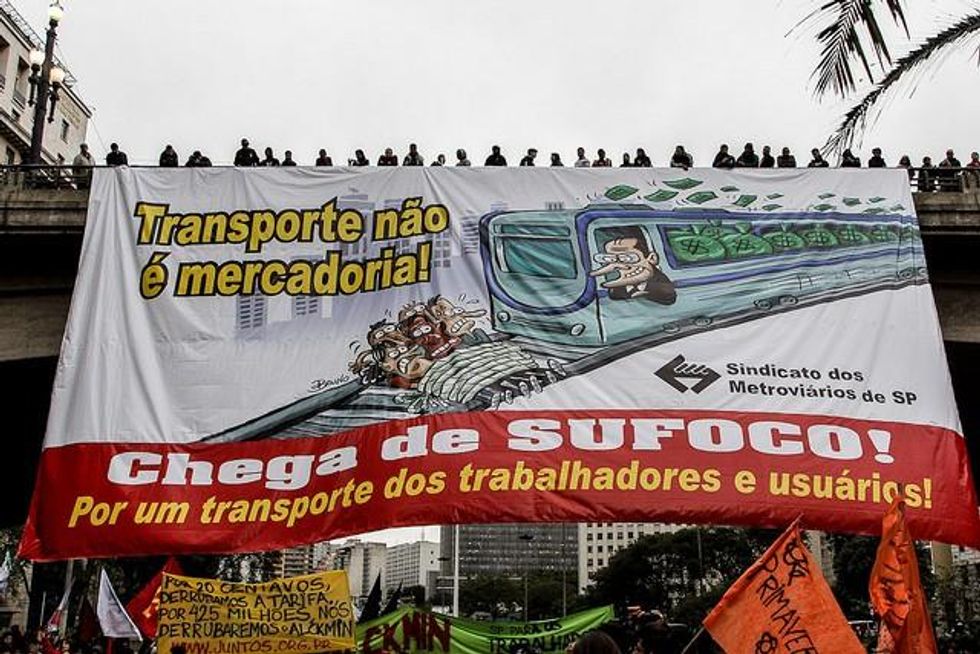
Thousands of people hit the streets of Brazil's largest city of Sao Paulo on Wednesday following news of a public transportation price rigging cartel, adding fuel to a grassroots uprising that began in June.
On Tuesday the Brazilian state of Sao Paulo announced that it was suing Germany-based engineering behemoth Siemens to recover money lost during years of alleged price fixing of the city's public transportation construction and maintenance.
Agence France-Presse reports that
The daily Estado de Sao Paulo Wednesday alleged that Siemens paid $10.3 million to two Brazilian officials as part of a vast corruption scheme in public contracts with the CPTM [Sao Paulo Metropolitan Train Company].
Brazilian paper Folha de Sao Paulo reported that in addition to Siemens, the lawsuit alleges that CAF of Spain, Mitsui of Japan, Bombardier of Canada and Alstom of France were also involved in the cartel, according to the Associated Press.
Euronews has video of Wednesday's protests:
Brazil protesters back on streets of Sao Paulo over public transportThe movement at the origin of the recent wave of social unrest in Brazil has been back on the... euronews, the most watched news ...
Reuters adds this background:
Sao Paulo, Brazil's most populous and economically developed state, has been spending billions of dollars a year to expand overcrowded roads, transit links and other public infrastructure.
But rising subway and bus fares combined with poor service for the 20 million people of greater Sao Paulo city, the state's capital, sparked nationwide protests in June and July against political corruption and inadequate public services.
"This is not just about bus fares any more. We pay high taxes and we are a rich country, but we can't see this in our schools, hospitals and roads," charged Jamaime Schmitt, a Brazilian engineer, as the wave of protests was getting underway in June.
In her post "From Lower Bus Fares to a Fair Society," Laura Carlsen of the Americas Policy Program highlighted how the public transportation system is symbolic of the country's inequality:
Brazil has among the most expensive public transportation systems in the world, as well as being aggravatingly inefficient. Privatized years ago, the buses get stuck in traffic and take up inordinate amounts of people's time and money.
Demonstrations started in Sao Paulo, the financial center of the country. There the contrast between the majority of the population and the elite shows in their way of getting around. The rich fly in private helicopters that buzz through the airways over the congested streets below.
That sense of being stuck below, with the wealthy few above, has played a huge role in igniting protests. The PT government, beginning with former President Lula da Silva, initiated social programs that greatly reduced poverty and hunger throughout the nation. But Brazil's strict adherence to neoliberal growth places a priority on maintaining the privileges of the wealthy, and widely publicized corruption scandals have created an image of at least part of the political elite partaking of those privileges--all at the expense of the majority. Inequality continues to plague Brazil, and recent increases in the cost of living have gouged the middle class.
Thousands of people hit the streets of Brazil's largest city of Sao Paulo on Wednesday following news of a public transportation price rigging cartel, adding fuel to a grassroots uprising that began in June.
On Tuesday the Brazilian state of Sao Paulo announced that it was suing Germany-based engineering behemoth Siemens to recover money lost during years of alleged price fixing of the city's public transportation construction and maintenance.
Agence France-Presse reports that
The daily Estado de Sao Paulo Wednesday alleged that Siemens paid $10.3 million to two Brazilian officials as part of a vast corruption scheme in public contracts with the CPTM [Sao Paulo Metropolitan Train Company].
Brazilian paper Folha de Sao Paulo reported that in addition to Siemens, the lawsuit alleges that CAF of Spain, Mitsui of Japan, Bombardier of Canada and Alstom of France were also involved in the cartel, according to the Associated Press.
Euronews has video of Wednesday's protests:
Brazil protesters back on streets of Sao Paulo over public transportThe movement at the origin of the recent wave of social unrest in Brazil has been back on the... euronews, the most watched news ...
Reuters adds this background:
Sao Paulo, Brazil's most populous and economically developed state, has been spending billions of dollars a year to expand overcrowded roads, transit links and other public infrastructure.
But rising subway and bus fares combined with poor service for the 20 million people of greater Sao Paulo city, the state's capital, sparked nationwide protests in June and July against political corruption and inadequate public services.
"This is not just about bus fares any more. We pay high taxes and we are a rich country, but we can't see this in our schools, hospitals and roads," charged Jamaime Schmitt, a Brazilian engineer, as the wave of protests was getting underway in June.
In her post "From Lower Bus Fares to a Fair Society," Laura Carlsen of the Americas Policy Program highlighted how the public transportation system is symbolic of the country's inequality:
Brazil has among the most expensive public transportation systems in the world, as well as being aggravatingly inefficient. Privatized years ago, the buses get stuck in traffic and take up inordinate amounts of people's time and money.
Demonstrations started in Sao Paulo, the financial center of the country. There the contrast between the majority of the population and the elite shows in their way of getting around. The rich fly in private helicopters that buzz through the airways over the congested streets below.
That sense of being stuck below, with the wealthy few above, has played a huge role in igniting protests. The PT government, beginning with former President Lula da Silva, initiated social programs that greatly reduced poverty and hunger throughout the nation. But Brazil's strict adherence to neoliberal growth places a priority on maintaining the privileges of the wealthy, and widely publicized corruption scandals have created an image of at least part of the political elite partaking of those privileges--all at the expense of the majority. Inequality continues to plague Brazil, and recent increases in the cost of living have gouged the middle class.
Thousands of people hit the streets of Brazil's largest city of Sao Paulo on Wednesday following news of a public transportation price rigging cartel, adding fuel to a grassroots uprising that began in June.
On Tuesday the Brazilian state of Sao Paulo announced that it was suing Germany-based engineering behemoth Siemens to recover money lost during years of alleged price fixing of the city's public transportation construction and maintenance.
Agence France-Presse reports that
The daily Estado de Sao Paulo Wednesday alleged that Siemens paid $10.3 million to two Brazilian officials as part of a vast corruption scheme in public contracts with the CPTM [Sao Paulo Metropolitan Train Company].
Brazilian paper Folha de Sao Paulo reported that in addition to Siemens, the lawsuit alleges that CAF of Spain, Mitsui of Japan, Bombardier of Canada and Alstom of France were also involved in the cartel, according to the Associated Press.
Euronews has video of Wednesday's protests:
Brazil protesters back on streets of Sao Paulo over public transportThe movement at the origin of the recent wave of social unrest in Brazil has been back on the... euronews, the most watched news ...
Reuters adds this background:
Sao Paulo, Brazil's most populous and economically developed state, has been spending billions of dollars a year to expand overcrowded roads, transit links and other public infrastructure.
But rising subway and bus fares combined with poor service for the 20 million people of greater Sao Paulo city, the state's capital, sparked nationwide protests in June and July against political corruption and inadequate public services.
"This is not just about bus fares any more. We pay high taxes and we are a rich country, but we can't see this in our schools, hospitals and roads," charged Jamaime Schmitt, a Brazilian engineer, as the wave of protests was getting underway in June.
In her post "From Lower Bus Fares to a Fair Society," Laura Carlsen of the Americas Policy Program highlighted how the public transportation system is symbolic of the country's inequality:
Brazil has among the most expensive public transportation systems in the world, as well as being aggravatingly inefficient. Privatized years ago, the buses get stuck in traffic and take up inordinate amounts of people's time and money.
Demonstrations started in Sao Paulo, the financial center of the country. There the contrast between the majority of the population and the elite shows in their way of getting around. The rich fly in private helicopters that buzz through the airways over the congested streets below.
That sense of being stuck below, with the wealthy few above, has played a huge role in igniting protests. The PT government, beginning with former President Lula da Silva, initiated social programs that greatly reduced poverty and hunger throughout the nation. But Brazil's strict adherence to neoliberal growth places a priority on maintaining the privileges of the wealthy, and widely publicized corruption scandals have created an image of at least part of the political elite partaking of those privileges--all at the expense of the majority. Inequality continues to plague Brazil, and recent increases in the cost of living have gouged the middle class.

