

SUBSCRIBE TO OUR FREE NEWSLETTER
Daily news & progressive opinion—funded by the people, not the corporations—delivered straight to your inbox.
5
#000000
#FFFFFF
To donate by check, phone, or other method, see our More Ways to Give page.
Daily news & progressive opinion—funded by the people, not the corporations—delivered straight to your inbox.
Voters in Catalonia on Sunday proved overwhelmingly in favor of claiming their independence from Spain with more than 80 percent of those who turned out for the non-binding resolution declaring their desire to separate themselves formally from Spain.
Though a Spanish court declared the vote invalid even before it took place, proponents of the referendum in the autonomous north-east region declared the vote a great success and said it proves that a full and binding election on indepence should now take place.
Indications were well over two million people out of an estimated 5.4 million eligible voters took part in the ballot. And the results were clear.
According to Reuters:
The "consultation of citizens" in the wealthy northeastern region follows a legal block by the central government against a more formal, albeit still non-binding ballot which regional leaders had been pushing for originally.
Because of the legal restrictions set on it, the ballot was set up and manned by grassroots pro-independence organizations, and Spanish unionist parties argue that, even for that reason alone, it could not legitimately reflect the wishes of anyone.
The restrictions on the vote also means that the turnout number, more than 2 million of 5.4 million potential voters according to the regional government head Artur Mas, will likely be considered more important than the results of the vote itself, expected on Monday.
"We have earned the right to a referendum," Mas told cheering supporters. He qualified the vote as a historic success, setting the stage for a full referendum.
"Once again Catalonia has shown that it wants to rule itself."
And Euronews reports:
Majority support independence in Catalonia voteOrganisers of Catalonia's informal vote on independence have declared it a great success after 80 percent supported the idea.
And the New York Times adds:
Even after being ordered by the Constitutional Court of Spain to suspend the vote, the regional government allowed the straw poll. It has insisted that such a court ban could not override the right of Catalonia's 7.5 million citizens, who include 5.4 million voters, to decide whether to secede.
The Catalan secessionist standoff comes after Scotland voted in September not to break away from Britain. That referendum, however, was authorized by the British government in London. The fight over Catalonia's future is proving far more contentious and has turned into the biggest political challenge for Prime Minister Mariano Rajoy since he took office in late 2011.
He and Mr. Mas have been at loggerheads for two years, initially over fiscal issues. Tensions came to the fore in September when Mr. Mas, who is a late but staunch convert to the secessionist cause, signed a decree approving an independence vote on Nov. 9.
In a televised news conference late Sunday, Mr. Mas argued the vote was "a total success," held despite a central government that had displayed "political short-sightedness and indifference, if not intolerance."
He urged Mr. Rajoy to allow Catalans to hold a formal referendum soon. "Like Quebec and Scotland, Catalonia also wants to decide its political future," he said.
A 24-hour general strike gripped Argentina on Thursday, bringing many public services to a halt.
Unions say over one million workers took part in this second strike the administration of Cristina Fernandez has faced. The strike's focus was to denounce the country's low wage increases in the face of high inflation, as well as other policies, like cuts in utility subsidies and salary caps, critics say are unfair to workers and are fomenting social unrest.
The strike stopped public transportation, forced the cancellation of flights, blockaded roads, and resulted in some clashes between police and protesters.
From Spanish news agency EFE:
"The strike has been a success from the outset," labor leader and congressman Nestor Pitrola said, adding that "a new stage has been launched" in the unions' struggle, "which began with the teachers strike and continues with this strike that seeks to define where the country is heading."
Spearheading the strike was Hugo Moyano, head of the General Confederation of Labor, and former Fernandez ally.
Moyano said the strike was a sign of people's "anger and disenchantment," and that the president must respond to this message from the people.
Euronews and TeleSur (in Spanish with English subtitles) have video below:
Argentina general strike brings Buenos Aires to a haltProtesters brought Buenos Aires to a standstill on Thursday during a 24 hour general strike against high inflation and taxes.
Strike in Argentina blocks access and paralyzes transport systemThe national strike in Argentina, which was organized by the main opposition unions and workers, began on Thursday at midnight ...
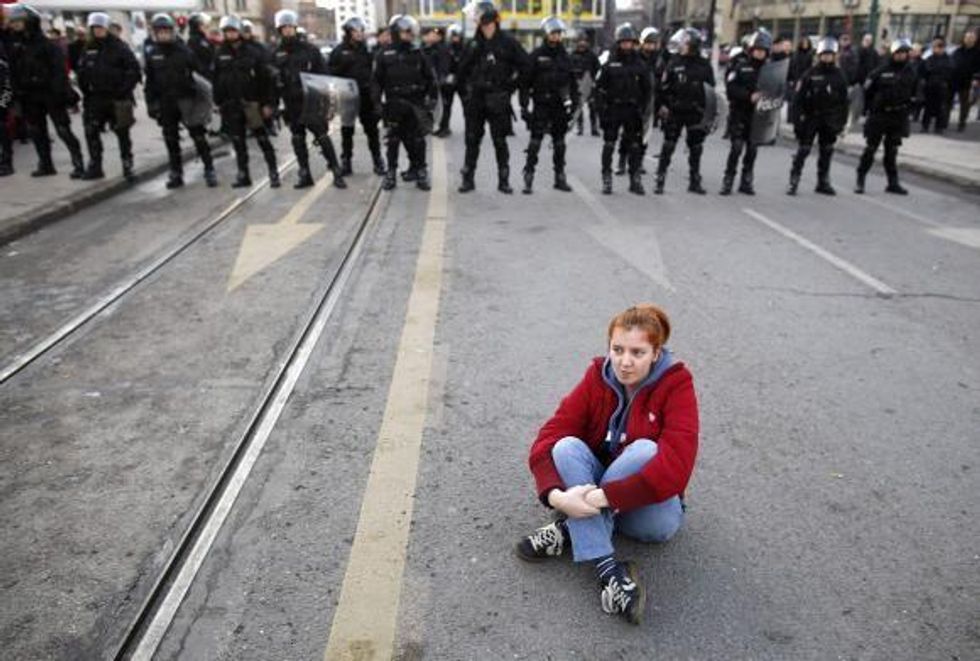
A localized protest movement against the failed privatization of key state-owned companies in Bosnia appears to be growing across the country as anger spreads over workers were left unpaid when the new owners declared bankruptcy and closed their doors.
What began in the city of Tuzla earlier this week as a small-scale protest by workers angered about their lost jobs and wages is now spreading, according to reports, as the anger aimed at the ruling government over its economic and social policies has seemingly catalyzed a brewing resentment among the people.
As EuroNews reports:
Tuzla is the third largest city in the former Yugoslav republic and the industrial heart of the north. But many of its once thriving chemical factories halted production after being privatised, leaving hundreds of workers without jobs.
With unemployment sky-high and tension building, one of the hundreds of protesters in the city said: "This is the start of the Bosnian Spring."
Watch the video:
Factory closures trigger clashes in BosniaThe closure of factories and firms has sparked clashes in Bosnia, as economic and social woes deepen almost 20 years since the ...
According to Associated Press coverage:
Residents of buildings in Tuzla yelled insults and threw buckets of water at the officers who passed by in full riot gear. Elderly neighbors were seen banging cooking pots on their windows and balconies.
The four former state-owned companies, which included furniture and washing powder factories, employed most of the population of Tuzla. After they were privatized, contracts obliged them to invest in them and make them profitable. But the owners sold the assets, stopped paying workers and filed for bankruptcy between 2000 and 2008.
The leader of the Tuzla region, Sead Causevic, told Bosnian state TV that the "rip-off privatization" was already concluded when his government took power and that the workers' demands are legitimate. He blamed the courts for obstructing justice, saying the workers have turned to them years ago, but no judgment has ever been passed.
And as Reuters adds, the protests appear to be spreading:
Hundreds of people turned out in solidarity in the capital Sarajevo, the central town of Zenica and Bihac in the west. Teenagers threw eggs and stones at a government building and fought with police. Four officers were taken to hospital, officials said.
Some of the Sarajevo protesters were heard chanting "Killers!" and "Revolution!"
"It was our government that sold state assets for peanuts and left the people without pensions, jobs or health insurance," said 24-year-old Hana Obradovic, an unemployed graduate. "Their families have nothing to eat while (the politicians) sit in the institutions and steal from the people."
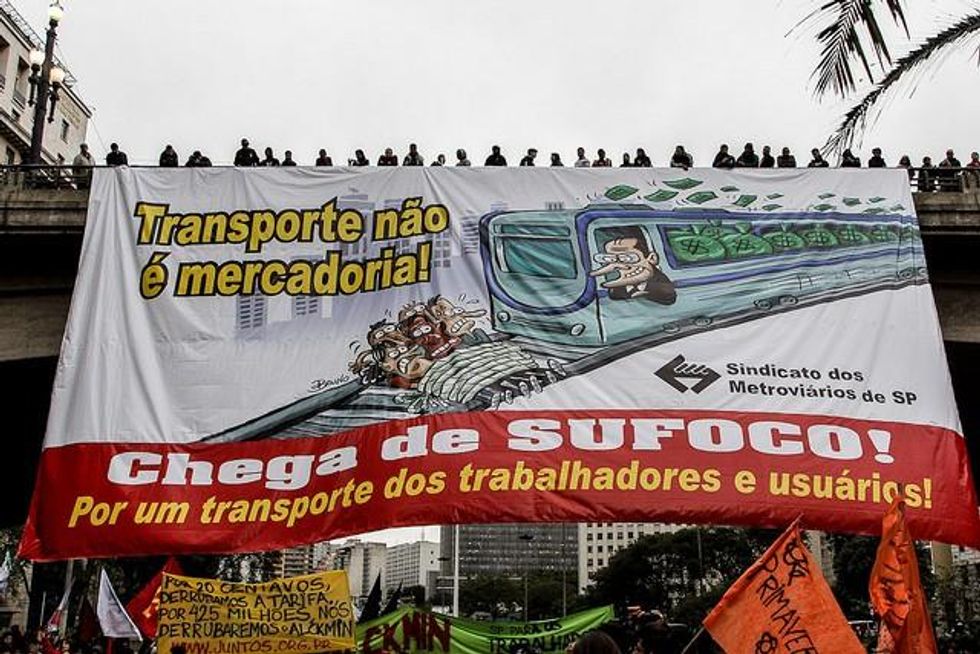
Thousands of people hit the streets of Brazil's largest city of Sao Paulo on Wednesday following news of a public transportation price rigging cartel, adding fuel to a grassroots uprising that began in June.
On Tuesday the Brazilian state of Sao Paulo announced that it was suing Germany-based engineering behemoth Siemens to recover money lost during years of alleged price fixing of the city's public transportation construction and maintenance.
Agence France-Presse reports that
The daily Estado de Sao Paulo Wednesday alleged that Siemens paid $10.3 million to two Brazilian officials as part of a vast corruption scheme in public contracts with the CPTM [Sao Paulo Metropolitan Train Company].
Brazilian paper Folha de Sao Paulo reported that in addition to Siemens, the lawsuit alleges that CAF of Spain, Mitsui of Japan, Bombardier of Canada and Alstom of France were also involved in the cartel, according to the Associated Press.
Euronews has video of Wednesday's protests:
Brazil protesters back on streets of Sao Paulo over public transportThe movement at the origin of the recent wave of social unrest in Brazil has been back on the... euronews, the most watched news ...
Reuters adds this background:
Sao Paulo, Brazil's most populous and economically developed state, has been spending billions of dollars a year to expand overcrowded roads, transit links and other public infrastructure.
But rising subway and bus fares combined with poor service for the 20 million people of greater Sao Paulo city, the state's capital, sparked nationwide protests in June and July against political corruption and inadequate public services.
"This is not just about bus fares any more. We pay high taxes and we are a rich country, but we can't see this in our schools, hospitals and roads," charged Jamaime Schmitt, a Brazilian engineer, as the wave of protests was getting underway in June.
In her post "From Lower Bus Fares to a Fair Society," Laura Carlsen of the Americas Policy Program highlighted how the public transportation system is symbolic of the country's inequality:
Brazil has among the most expensive public transportation systems in the world, as well as being aggravatingly inefficient. Privatized years ago, the buses get stuck in traffic and take up inordinate amounts of people's time and money.
Demonstrations started in Sao Paulo, the financial center of the country. There the contrast between the majority of the population and the elite shows in their way of getting around. The rich fly in private helicopters that buzz through the airways over the congested streets below.
That sense of being stuck below, with the wealthy few above, has played a huge role in igniting protests. The PT government, beginning with former President Lula da Silva, initiated social programs that greatly reduced poverty and hunger throughout the nation. But Brazil's strict adherence to neoliberal growth places a priority on maintaining the privileges of the wealthy, and widely publicized corruption scandals have created an image of at least part of the political elite partaking of those privileges--all at the expense of the majority. Inequality continues to plague Brazil, and recent increases in the cost of living have gouged the middle class.
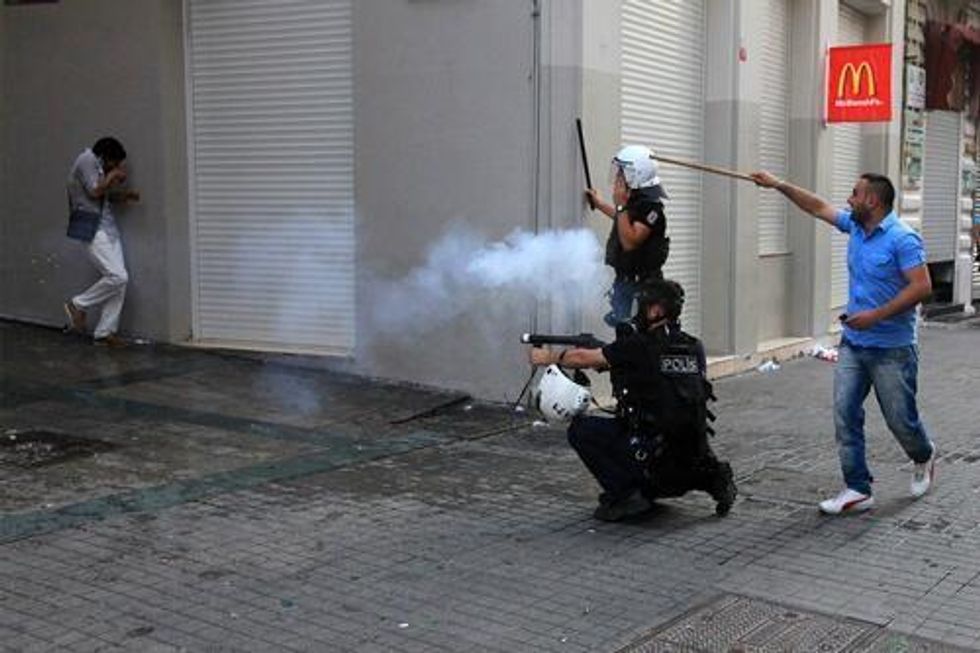
Tear gas and water cannons rained down on roughly 3,000 protesters Saturday as Turkish police attacked a group of demonstrators assembled in Istanbul's Taksim Square.
The demonstrators were attempting to enter the adjacent Gezi Park, a section of green space that the government had planned to raze and replace with a shopping center sparking a month of protests and fierce backlash by law enforcement.
According to AFP, Saturday's organizers were planning to break through police cordons of the park and serve a notice to authorities of a court decision that has annulled the redevelopment plans--what many are considering a victory for the protests, though the court's decision is not yet final.
AFP continues:
The nationwide protests have largely dwindled although thousands of demonstrators have been gathering at Taksim every Saturday for the past three weeks, demanding justice for a protester who was killed by police fire.
This time, some protesters argued with police standing guard at the entrance of Gezi Park. Police then pushed protesters away from the square with pressurized water and tear gas. They also chased protesters down two main streets off Taksim, firing tear gas.
This video from Italy's Euro News shows police vehicles bulldozing through the crowds:
Torna la protesta a Istanbul, polizia caccia manifestanti da TaksimTorna la tensione nel centro di Istanbul. La polizia turca ha disperso con gas lacrimogeni e... Euronews, il canale all news più ...
Meanwhile, Al Jazeera reports that following the police attack, an amateur video surfaced showing two men armed with machetes attacking protesters who were fleeing from the tear gas near Taksim Square.
"One of the men was seen kicking a woman on her back while holding a machete in his hand," they write, adding that--following the video's release--Turkish security forces were criticized for not intervening against the machete-wielding attackers.
The video has since gone viral and according to Istanbul governor Huseyin Avni Mutlu, the two men pictures have been found and arrested.
According to the Turkish Medical Association, four people were killed and about 7,500 wounded in the police crackdown since demonstrations began in late May.