

SUBSCRIBE TO OUR FREE NEWSLETTER
Daily news & progressive opinion—funded by the people, not the corporations—delivered straight to your inbox.
5
#000000
#FFFFFF
To donate by check, phone, or other method, see our More Ways to Give page.
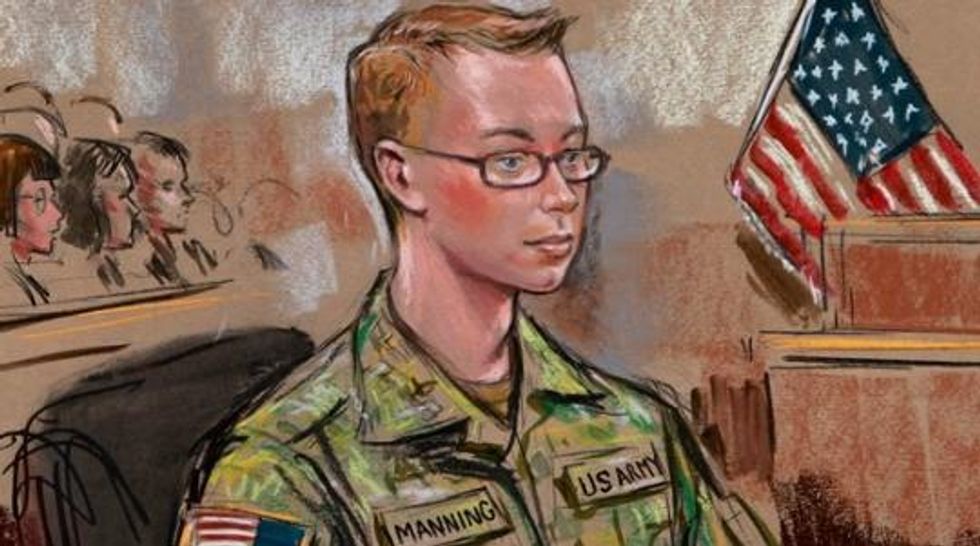
As Pilkington, present in the courtroom for the reading of Manning's statement, reports:
While he was on leave from Iraq and staying in the Washington area in January 2010 he contacted the Washington Post and asked would it be interested in receiving information that he said would be "enormously important to the American people". He spoke to a woman who said she was a reporter but "she didn't seem to take me seriously".
The woman said, according to Manning's account, that the paper would only be interested subject to vetting by senior editors.
Despairing of that route, Manning turned to the New York Times. He called the public editor of the paper but only got voicemail.
He then tried other numbers on the paper but also got put through to voicemail, and though he left a message with his Skype contact details, nobody called him back. Manning added he had also contemplated going to the website Politico, but harsh weather prevented him.
Such testimony belies the US government's ongoing insinuation that Wikileaks--which specifically describes itself as a "not-for-profit media organization"--somehow played a role in compelling Manning to leak the documents. It further provides evidence that Manning was acting in the capacity of a true government or military whistleblower by proactively seeking out the media in hopes of bringing to light what he considered information vital to the public interest.
"I believed if the public, particularly the American public, could see this it could spark a debate on the military and our foreign policy in general as it applied to Iraq and Afghanistan. It might cause society to reconsider the need to engage in counter terrorism while ignoring the human situation of the people we engaged with every day." -Bradley Manning
Manning also explained his deeper motivations, which included hopes that the leaks documents would expose the "true costs of war". According to Pilkington's account, Manning stated:
"I felt we were risking so much for people who seemed to be unwilling to cooperate with us leading to frustration and hostility on both sides. I began to get depressed about he situation we were mired in year after year.
"We were obsessed with capturing and killing human targets on lists and ignoring goals and missions. I believed if the public, particularly the American public, could see this it could spark a debate on the military and our foreign policy in general as it applied to Iraq and Afghanistan. It might cause society to reconsider the need to engage in counter terrorism while ignoring the human situation of the people we engaged with every day."
Thursday's courtroom proceedings were covered best on Twitter:
Tweets from @commondreams/bradley-manning-trial
Thursday's revelations came as Manning read a prepared statement--reportedly handwritten over 35 pages--before a packed military courtroom. The statement is Manning's first complete account of what government and military information he leaked to Wikileaks, and an explanation of why he chose to do so.
Manning pled guilty to a series of charges, including providing Wikileaks with confidential military information, but denied the most serious charge against him, that of "aiding the enemy."
According to FireDogLake's Kevin Gosztola, reporting live from the courtroom, Manning's plea makes possible two rulings by the presiding judge: "guilty to lesser-included offenses pursuant to the plea" or "guilty of the greater offenses in the original charges." The court cannot find him "not guilty" based on his plea.
Pilkington also reported that Manning "confirmed he wants to be tried by military judge [Colonel Denise Lind] alone," with no military equivalent of a jury.
In addition to revealign his attempts to contact other outlets first, Manning also told the courtroom that once he'd established communication with Wikileaks, "No one associated with [the outlet] pressured me into sending more information."
In regards to his leak of the collateral murder video, Manning said, "I was disturbed by the response to injured children" and that the soldiers captured in the video "seemed to not value human life by referring to [their targets] as 'dead bastards.'"
He also said that he released the intelligence because he wanted to "spark a domestic public debate about our foreign policy and the war in general," and added: "At the time I believed, and I still believe, these are ... [among] ... the most significant documents of our time."
Pilkington continues:
Through his lawyer, David Coombs, the soldier pleaded guilty to 10 lesser charges that included possessing and wilfully communicating to an unauthorised person all the main elements of the WikiLeaks disclosure. That covered the so-called "collateral murder" video of an Apache helicopter attack in Iraq; some US diplomatic cables including one of the early WikiLeaks publications the Reykjavik cable; portions of the Iraq and Afghanistan warlogs, some of the files on detainees in Guantanamo; and two intelligence memos.
These lesser charges each carry a two-year maximum sentence, committing Manning to a possible upper limit of 20 years in prison.
Manning also pleaded not guilty to 12 counts, including to the largest charge of "aiding the enemy," which would have supposed that he knowingly gave help to al-Qaida either by leaking secret intelligence directly or via its publication on the internet. He also denied that at the time he gave the information to Wikileaks, he had "reason to believe such information could be used to the injury of the United States or to the advantage of any foreign nation".
According to Gosztola, Manning pled guilty to "all that was anticipated except he did not plead guilty to releasing the Granai air strike video."
______________________________
As Pilkington, present in the courtroom for the reading of Manning's statement, reports:
While he was on leave from Iraq and staying in the Washington area in January 2010 he contacted the Washington Post and asked would it be interested in receiving information that he said would be "enormously important to the American people". He spoke to a woman who said she was a reporter but "she didn't seem to take me seriously".
The woman said, according to Manning's account, that the paper would only be interested subject to vetting by senior editors.
Despairing of that route, Manning turned to the New York Times. He called the public editor of the paper but only got voicemail.
He then tried other numbers on the paper but also got put through to voicemail, and though he left a message with his Skype contact details, nobody called him back. Manning added he had also contemplated going to the website Politico, but harsh weather prevented him.
Such testimony belies the US government's ongoing insinuation that Wikileaks--which specifically describes itself as a "not-for-profit media organization"--somehow played a role in compelling Manning to leak the documents. It further provides evidence that Manning was acting in the capacity of a true government or military whistleblower by proactively seeking out the media in hopes of bringing to light what he considered information vital to the public interest.
"I believed if the public, particularly the American public, could see this it could spark a debate on the military and our foreign policy in general as it applied to Iraq and Afghanistan. It might cause society to reconsider the need to engage in counter terrorism while ignoring the human situation of the people we engaged with every day." -Bradley Manning
Manning also explained his deeper motivations, which included hopes that the leaks documents would expose the "true costs of war". According to Pilkington's account, Manning stated:
"I felt we were risking so much for people who seemed to be unwilling to cooperate with us leading to frustration and hostility on both sides. I began to get depressed about he situation we were mired in year after year.
"We were obsessed with capturing and killing human targets on lists and ignoring goals and missions. I believed if the public, particularly the American public, could see this it could spark a debate on the military and our foreign policy in general as it applied to Iraq and Afghanistan. It might cause society to reconsider the need to engage in counter terrorism while ignoring the human situation of the people we engaged with every day."
Thursday's courtroom proceedings were covered best on Twitter:
Tweets from @commondreams/bradley-manning-trial
Thursday's revelations came as Manning read a prepared statement--reportedly handwritten over 35 pages--before a packed military courtroom. The statement is Manning's first complete account of what government and military information he leaked to Wikileaks, and an explanation of why he chose to do so.
Manning pled guilty to a series of charges, including providing Wikileaks with confidential military information, but denied the most serious charge against him, that of "aiding the enemy."
According to FireDogLake's Kevin Gosztola, reporting live from the courtroom, Manning's plea makes possible two rulings by the presiding judge: "guilty to lesser-included offenses pursuant to the plea" or "guilty of the greater offenses in the original charges." The court cannot find him "not guilty" based on his plea.
Pilkington also reported that Manning "confirmed he wants to be tried by military judge [Colonel Denise Lind] alone," with no military equivalent of a jury.
In addition to revealign his attempts to contact other outlets first, Manning also told the courtroom that once he'd established communication with Wikileaks, "No one associated with [the outlet] pressured me into sending more information."
In regards to his leak of the collateral murder video, Manning said, "I was disturbed by the response to injured children" and that the soldiers captured in the video "seemed to not value human life by referring to [their targets] as 'dead bastards.'"
He also said that he released the intelligence because he wanted to "spark a domestic public debate about our foreign policy and the war in general," and added: "At the time I believed, and I still believe, these are ... [among] ... the most significant documents of our time."
Pilkington continues:
Through his lawyer, David Coombs, the soldier pleaded guilty to 10 lesser charges that included possessing and wilfully communicating to an unauthorised person all the main elements of the WikiLeaks disclosure. That covered the so-called "collateral murder" video of an Apache helicopter attack in Iraq; some US diplomatic cables including one of the early WikiLeaks publications the Reykjavik cable; portions of the Iraq and Afghanistan warlogs, some of the files on detainees in Guantanamo; and two intelligence memos.
These lesser charges each carry a two-year maximum sentence, committing Manning to a possible upper limit of 20 years in prison.
Manning also pleaded not guilty to 12 counts, including to the largest charge of "aiding the enemy," which would have supposed that he knowingly gave help to al-Qaida either by leaking secret intelligence directly or via its publication on the internet. He also denied that at the time he gave the information to Wikileaks, he had "reason to believe such information could be used to the injury of the United States or to the advantage of any foreign nation".
According to Gosztola, Manning pled guilty to "all that was anticipated except he did not plead guilty to releasing the Granai air strike video."
______________________________
As Pilkington, present in the courtroom for the reading of Manning's statement, reports:
While he was on leave from Iraq and staying in the Washington area in January 2010 he contacted the Washington Post and asked would it be interested in receiving information that he said would be "enormously important to the American people". He spoke to a woman who said she was a reporter but "she didn't seem to take me seriously".
The woman said, according to Manning's account, that the paper would only be interested subject to vetting by senior editors.
Despairing of that route, Manning turned to the New York Times. He called the public editor of the paper but only got voicemail.
He then tried other numbers on the paper but also got put through to voicemail, and though he left a message with his Skype contact details, nobody called him back. Manning added he had also contemplated going to the website Politico, but harsh weather prevented him.
Such testimony belies the US government's ongoing insinuation that Wikileaks--which specifically describes itself as a "not-for-profit media organization"--somehow played a role in compelling Manning to leak the documents. It further provides evidence that Manning was acting in the capacity of a true government or military whistleblower by proactively seeking out the media in hopes of bringing to light what he considered information vital to the public interest.
"I believed if the public, particularly the American public, could see this it could spark a debate on the military and our foreign policy in general as it applied to Iraq and Afghanistan. It might cause society to reconsider the need to engage in counter terrorism while ignoring the human situation of the people we engaged with every day." -Bradley Manning
Manning also explained his deeper motivations, which included hopes that the leaks documents would expose the "true costs of war". According to Pilkington's account, Manning stated:
"I felt we were risking so much for people who seemed to be unwilling to cooperate with us leading to frustration and hostility on both sides. I began to get depressed about he situation we were mired in year after year.
"We were obsessed with capturing and killing human targets on lists and ignoring goals and missions. I believed if the public, particularly the American public, could see this it could spark a debate on the military and our foreign policy in general as it applied to Iraq and Afghanistan. It might cause society to reconsider the need to engage in counter terrorism while ignoring the human situation of the people we engaged with every day."
Thursday's courtroom proceedings were covered best on Twitter:
Tweets from @commondreams/bradley-manning-trial
Thursday's revelations came as Manning read a prepared statement--reportedly handwritten over 35 pages--before a packed military courtroom. The statement is Manning's first complete account of what government and military information he leaked to Wikileaks, and an explanation of why he chose to do so.
Manning pled guilty to a series of charges, including providing Wikileaks with confidential military information, but denied the most serious charge against him, that of "aiding the enemy."
According to FireDogLake's Kevin Gosztola, reporting live from the courtroom, Manning's plea makes possible two rulings by the presiding judge: "guilty to lesser-included offenses pursuant to the plea" or "guilty of the greater offenses in the original charges." The court cannot find him "not guilty" based on his plea.
Pilkington also reported that Manning "confirmed he wants to be tried by military judge [Colonel Denise Lind] alone," with no military equivalent of a jury.
In addition to revealign his attempts to contact other outlets first, Manning also told the courtroom that once he'd established communication with Wikileaks, "No one associated with [the outlet] pressured me into sending more information."
In regards to his leak of the collateral murder video, Manning said, "I was disturbed by the response to injured children" and that the soldiers captured in the video "seemed to not value human life by referring to [their targets] as 'dead bastards.'"
He also said that he released the intelligence because he wanted to "spark a domestic public debate about our foreign policy and the war in general," and added: "At the time I believed, and I still believe, these are ... [among] ... the most significant documents of our time."
Pilkington continues:
Through his lawyer, David Coombs, the soldier pleaded guilty to 10 lesser charges that included possessing and wilfully communicating to an unauthorised person all the main elements of the WikiLeaks disclosure. That covered the so-called "collateral murder" video of an Apache helicopter attack in Iraq; some US diplomatic cables including one of the early WikiLeaks publications the Reykjavik cable; portions of the Iraq and Afghanistan warlogs, some of the files on detainees in Guantanamo; and two intelligence memos.
These lesser charges each carry a two-year maximum sentence, committing Manning to a possible upper limit of 20 years in prison.
Manning also pleaded not guilty to 12 counts, including to the largest charge of "aiding the enemy," which would have supposed that he knowingly gave help to al-Qaida either by leaking secret intelligence directly or via its publication on the internet. He also denied that at the time he gave the information to Wikileaks, he had "reason to believe such information could be used to the injury of the United States or to the advantage of any foreign nation".
According to Gosztola, Manning pled guilty to "all that was anticipated except he did not plead guilty to releasing the Granai air strike video."
______________________________

