

SUBSCRIBE TO OUR FREE NEWSLETTER
Daily news & progressive opinion—funded by the people, not the corporations—delivered straight to your inbox.
5
#000000
#FFFFFF
To donate by check, phone, or other method, see our More Ways to Give page.
Today in Portugal public services and transportation came to a halt, as unions enacted a 24-hour general strike for the second time in two months. The metros in Portugal's largest cities have closed as well as major ports. The strike was called in reaction to austerity measures agreed upon by the government in return for a European bailout.
Demonstrations and rallies are planned for the afternoon in 38 cities and towns across the country.
Today's events preclude similar strikes in both Italy and Spain among countries facing European austerity.
Spain's two main unions, the General Workers Union and the Workers Commissions, have called for a general strike on March 29 to protest the government's austerity push.
Italy's largest trade union called for a general strike over labor reforms on Wednesday, in protest of Prime Minister Mario Monti and Italy's austerity.
* * *
Portugal Hit by General Strike Against Austerity (Agence France-Presse):
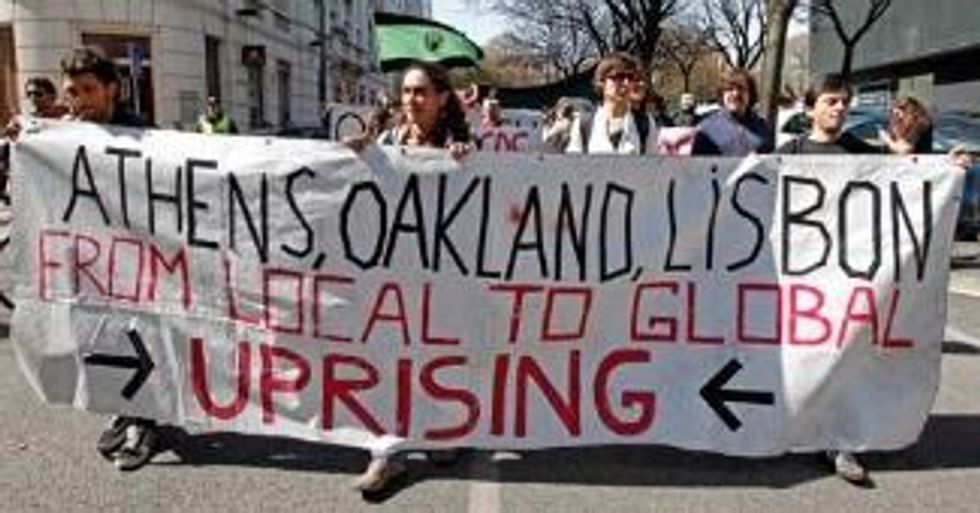
Garbage went uncollected, ports closed, trains stood still, public transportation was disrupted and other public services were affected by the country's second general strike in four months.
The metros in Lisbon and Oporto, Portugal's second-largest city, were closed because of the strike, forcing tens of thousands of commuters to find an alternative way to get to work or school.
The majority of ports, including the port of Lisbon and Viana do Castelo in the north, were closed, according to the country's biggest union -- the General Confederation of Portuguese Workers (CGTP) -- which called the strike.
About two dozen ships were forced to change their routes to go to other ports because of the action, it added. [...]
The CGTP, which is close to the Communist Party, called the strike in February to protest against a reform of the labor code that makes it easier to hire and fire workers.
It is also angry over government austerity measures such as the elimination of public employees' Christmas and vacation bonuses -- each roughly equivalent to a month's pay -- among measures to rein in the public deficit. [...]
Portugal is locked into a three-year program of debt-reduction measures and economic reforms in return for a 78 billion euro ($103 billion) financial rescue package from the European Union and the International Monetary Fund.
* * *
Italian Union Calls Strike Over Monti's Job Reforms (Reuters):
Italy's largest trade union called for a general strike over labor reforms on Wednesday, escalating a confrontation with Prime Minister Mario Monti that will test his resolve to push ahead with plans to transform the economy.
After weeks of negotiation, Monti announced late on Tuesday that the time for talking was over and he would press on with plans to overhaul employment protection laws dating back to the 1970s, despite stiff opposition from the left-wing CGIL union.
The CGIL proposed an eight-hour general strike to protest the measures, which would allow companies to lay off individual employees for disciplinary or business reasons, saying the changes risked causing massive job losses.
"This will not be a flare-up which burns out in a day as the government expects and we have a duty to get results before we see years of mass dismissals from companies," the union's secretariat said in a statement.
The strike would mark the biggest demonstration against technocrat premier Monti, a former European Commissioner who has already imposed painful cuts and tax hikes and an overhaul of the pension system since taking office in November.
# # #
Today in Portugal public services and transportation came to a halt, as unions enacted a 24-hour general strike for the second time in two months. The metros in Portugal's largest cities have closed as well as major ports. The strike was called in reaction to austerity measures agreed upon by the government in return for a European bailout.
Demonstrations and rallies are planned for the afternoon in 38 cities and towns across the country.
Today's events preclude similar strikes in both Italy and Spain among countries facing European austerity.
Spain's two main unions, the General Workers Union and the Workers Commissions, have called for a general strike on March 29 to protest the government's austerity push.
Italy's largest trade union called for a general strike over labor reforms on Wednesday, in protest of Prime Minister Mario Monti and Italy's austerity.
* * *
Portugal Hit by General Strike Against Austerity (Agence France-Presse):
Garbage went uncollected, ports closed, trains stood still, public transportation was disrupted and other public services were affected by the country's second general strike in four months.
The metros in Lisbon and Oporto, Portugal's second-largest city, were closed because of the strike, forcing tens of thousands of commuters to find an alternative way to get to work or school.
The majority of ports, including the port of Lisbon and Viana do Castelo in the north, were closed, according to the country's biggest union -- the General Confederation of Portuguese Workers (CGTP) -- which called the strike.
About two dozen ships were forced to change their routes to go to other ports because of the action, it added. [...]
The CGTP, which is close to the Communist Party, called the strike in February to protest against a reform of the labor code that makes it easier to hire and fire workers.
It is also angry over government austerity measures such as the elimination of public employees' Christmas and vacation bonuses -- each roughly equivalent to a month's pay -- among measures to rein in the public deficit. [...]
Portugal is locked into a three-year program of debt-reduction measures and economic reforms in return for a 78 billion euro ($103 billion) financial rescue package from the European Union and the International Monetary Fund.
* * *
Italian Union Calls Strike Over Monti's Job Reforms (Reuters):
Italy's largest trade union called for a general strike over labor reforms on Wednesday, escalating a confrontation with Prime Minister Mario Monti that will test his resolve to push ahead with plans to transform the economy.
After weeks of negotiation, Monti announced late on Tuesday that the time for talking was over and he would press on with plans to overhaul employment protection laws dating back to the 1970s, despite stiff opposition from the left-wing CGIL union.
The CGIL proposed an eight-hour general strike to protest the measures, which would allow companies to lay off individual employees for disciplinary or business reasons, saying the changes risked causing massive job losses.
"This will not be a flare-up which burns out in a day as the government expects and we have a duty to get results before we see years of mass dismissals from companies," the union's secretariat said in a statement.
The strike would mark the biggest demonstration against technocrat premier Monti, a former European Commissioner who has already imposed painful cuts and tax hikes and an overhaul of the pension system since taking office in November.
# # #
Today in Portugal public services and transportation came to a halt, as unions enacted a 24-hour general strike for the second time in two months. The metros in Portugal's largest cities have closed as well as major ports. The strike was called in reaction to austerity measures agreed upon by the government in return for a European bailout.
Demonstrations and rallies are planned for the afternoon in 38 cities and towns across the country.
Today's events preclude similar strikes in both Italy and Spain among countries facing European austerity.
Spain's two main unions, the General Workers Union and the Workers Commissions, have called for a general strike on March 29 to protest the government's austerity push.
Italy's largest trade union called for a general strike over labor reforms on Wednesday, in protest of Prime Minister Mario Monti and Italy's austerity.
* * *
Portugal Hit by General Strike Against Austerity (Agence France-Presse):
Garbage went uncollected, ports closed, trains stood still, public transportation was disrupted and other public services were affected by the country's second general strike in four months.
The metros in Lisbon and Oporto, Portugal's second-largest city, were closed because of the strike, forcing tens of thousands of commuters to find an alternative way to get to work or school.
The majority of ports, including the port of Lisbon and Viana do Castelo in the north, were closed, according to the country's biggest union -- the General Confederation of Portuguese Workers (CGTP) -- which called the strike.
About two dozen ships were forced to change their routes to go to other ports because of the action, it added. [...]
The CGTP, which is close to the Communist Party, called the strike in February to protest against a reform of the labor code that makes it easier to hire and fire workers.
It is also angry over government austerity measures such as the elimination of public employees' Christmas and vacation bonuses -- each roughly equivalent to a month's pay -- among measures to rein in the public deficit. [...]
Portugal is locked into a three-year program of debt-reduction measures and economic reforms in return for a 78 billion euro ($103 billion) financial rescue package from the European Union and the International Monetary Fund.
* * *
Italian Union Calls Strike Over Monti's Job Reforms (Reuters):
Italy's largest trade union called for a general strike over labor reforms on Wednesday, escalating a confrontation with Prime Minister Mario Monti that will test his resolve to push ahead with plans to transform the economy.
After weeks of negotiation, Monti announced late on Tuesday that the time for talking was over and he would press on with plans to overhaul employment protection laws dating back to the 1970s, despite stiff opposition from the left-wing CGIL union.
The CGIL proposed an eight-hour general strike to protest the measures, which would allow companies to lay off individual employees for disciplinary or business reasons, saying the changes risked causing massive job losses.
"This will not be a flare-up which burns out in a day as the government expects and we have a duty to get results before we see years of mass dismissals from companies," the union's secretariat said in a statement.
The strike would mark the biggest demonstration against technocrat premier Monti, a former European Commissioner who has already imposed painful cuts and tax hikes and an overhaul of the pension system since taking office in November.
# # #

