
Al-Jazeera: Freedom Fight Against 'Freedom Champions'
DOHA - The al-Jazeera television network could be emerging as a freedom champion against U.S. pressures on the channel, leading media figures say."I support al-Jazeera because al-Jazeera has done more to propagate democracy in the Middle East region than anybody else, certainly more than the American government has done," media specialist Hugh Miles told IPS. "It's strange to me that people refer to al-Jazeera as a 'terrorist network' because that couldn't be further from the truth."
Miles spoke to IPS at the third annual al-Jazeera forum at Doha in Qatar Mar. 31 to Apr. 2. The forum highlighted the successful recent expansion of the network while also addressing difficulties that reporters face in the Middle East hot spots.
Miles, author of 'Al Jazeera: How Arab TV News Challenged the World' and an award- winning freelance journalist said former U.S. defence secretary Donald Rumsfeld had got it wrong on al-Jazeera.
"Al-Jazeera has been called a 'terrorist network' or 'the voice of (Osama) bin Laden', but this just demonstrates deep ignorance of its history and the channel," Miles said.
The 10-year-old al-Jazeera network weathered a U.S. military attack on its Baghdad office during the U.S.-led invasion of Iraq in April 2003. It faced accusations from Rumsfeld that it promoted terrorism by airing beheadings and other attacks.
Al-Jazeera editors say that the channel has never aired a beheading, nor does it support terrorism.
Other leading voices at the forum spoke in support of the channel, that has been under frequent attack of all kinds. The forum, titled 'Media and the Middle East: Going Beyond the Headlines' brought journalists, international media leaders and scholars from around the world to discuss critical issues facing the media, with a focus on in-depth journalism.
The conference followed the launching of al-Jazeera English, a 24-hour English-language news channel that went on air in November 2006 with more than 80 million households viewing it worldwide -- an unprecedented launch in the broadcast industry.
"There has been a four, five, six-year campaign against al-Jazeera," said Aidan White, general secretary of the International Federation of Journalists at a panel discussion. "This is a prejudice we cannot ignore."
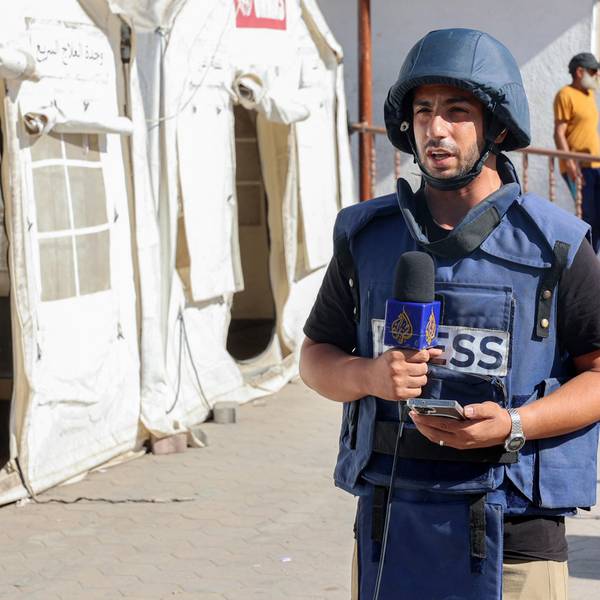
Abdul Bari Atwan, editor-in-chief of the London-based Arabic newspaper al-Quds al- Arabi told IPS that "journalists should unite and raise our voices to say no to this kind of brutal treatment by the leader of the free world, by people who are representing freedom. We should stand united against the new wave of embedded journalism because this is censorship.
"Freedom of expression is said to be a part of Western values," Atwan added. "The American administration is destroying Western values by shooting journalists, by killing the messenger."
"The largest perpetrators of murdering journalists are governments," Frank Smyth, Washington representative of the Committee to Protect Journalists (CPJ) said at the forum.
Many other journalists are detained without fair trial. Al-Jazeera cameraman Sami al-Hajj, a Sudanese national, was detained by the U.S. military in Afghanistan in December 2001. He has yet to be charged, and continues to be held as "enemy combatant" at Guantanamo Bay.
On Aug. 7, 2004, the U.S.-backed Iraqi interim government led by former CIA asset Iyad Allawi shut down the Iraq office of al-Jazeera, claiming that it was presenting a negative image of Iraq, and charging the network with "fueling anti-coalition hostilities."
Much of the difficulties governments have had with al-Jazeera have arisen because it gets stories other channels do not have.
That makes it similar to the Inter Press Service (IPS) news agency, said IPS director-general Mario Lubetkin. Al-Jazeera has much in common with IPS because the Arab network "goes for the news behind the news," and "because they cover the south," he said.
Lubetkin added that "we are working with them, they pick up a lot of stories from us in Arabic."
The forum addressed several issues such as 'parachute journalism', 'journalism of depth' and the new media. But the dominant theme remained attacks on journalists in an increasingly difficult global environment.
Copyright (c) 2007 IPS-Inter Press Service.
An Urgent Message From Our Co-Founder
Dear Common Dreams reader, It’s been nearly 30 years since I co-founded Common Dreams with my late wife, Lina Newhouser. We had the radical notion that journalism should serve the public good, not corporate profits. It was clear to us from the outset what it would take to build such a project. No paid advertisements. No corporate sponsors. No millionaire publisher telling us what to think or do. Many people said we wouldn't last a year, but we proved those doubters wrong. Together with a tremendous team of journalists and dedicated staff, we built an independent media outlet free from the constraints of profits and corporate control. Our mission has always been simple: To inform. To inspire. To ignite change for the common good. Building Common Dreams was not easy. Our survival was never guaranteed. When you take on the most powerful forces—Wall Street greed, fossil fuel industry destruction, Big Tech lobbyists, and uber-rich oligarchs who have spent billions upon billions rigging the economy and democracy in their favor—the only bulwark you have is supporters who believe in your work. But here’s the urgent message from me today. It's never been this bad out there. And it's never been this hard to keep us going. At the very moment Common Dreams is most needed, the threats we face are intensifying. We need your support now more than ever. We don't accept corporate advertising and never will. We don't have a paywall because we don't think people should be blocked from critical news based on their ability to pay. Everything we do is funded by the donations of readers like you. When everyone does the little they can afford, we are strong. But if that support retreats or dries up, so do we. Will you donate now to make sure Common Dreams not only survives but thrives? —Craig Brown, Co-founder |
DOHA - The al-Jazeera television network could be emerging as a freedom champion against U.S. pressures on the channel, leading media figures say."I support al-Jazeera because al-Jazeera has done more to propagate democracy in the Middle East region than anybody else, certainly more than the American government has done," media specialist Hugh Miles told IPS. "It's strange to me that people refer to al-Jazeera as a 'terrorist network' because that couldn't be further from the truth."
Miles spoke to IPS at the third annual al-Jazeera forum at Doha in Qatar Mar. 31 to Apr. 2. The forum highlighted the successful recent expansion of the network while also addressing difficulties that reporters face in the Middle East hot spots.
Miles, author of 'Al Jazeera: How Arab TV News Challenged the World' and an award- winning freelance journalist said former U.S. defence secretary Donald Rumsfeld had got it wrong on al-Jazeera.
"Al-Jazeera has been called a 'terrorist network' or 'the voice of (Osama) bin Laden', but this just demonstrates deep ignorance of its history and the channel," Miles said.
The 10-year-old al-Jazeera network weathered a U.S. military attack on its Baghdad office during the U.S.-led invasion of Iraq in April 2003. It faced accusations from Rumsfeld that it promoted terrorism by airing beheadings and other attacks.
Al-Jazeera editors say that the channel has never aired a beheading, nor does it support terrorism.
Other leading voices at the forum spoke in support of the channel, that has been under frequent attack of all kinds. The forum, titled 'Media and the Middle East: Going Beyond the Headlines' brought journalists, international media leaders and scholars from around the world to discuss critical issues facing the media, with a focus on in-depth journalism.
The conference followed the launching of al-Jazeera English, a 24-hour English-language news channel that went on air in November 2006 with more than 80 million households viewing it worldwide -- an unprecedented launch in the broadcast industry.
"There has been a four, five, six-year campaign against al-Jazeera," said Aidan White, general secretary of the International Federation of Journalists at a panel discussion. "This is a prejudice we cannot ignore."
Abdul Bari Atwan, editor-in-chief of the London-based Arabic newspaper al-Quds al- Arabi told IPS that "journalists should unite and raise our voices to say no to this kind of brutal treatment by the leader of the free world, by people who are representing freedom. We should stand united against the new wave of embedded journalism because this is censorship.
"Freedom of expression is said to be a part of Western values," Atwan added. "The American administration is destroying Western values by shooting journalists, by killing the messenger."
"The largest perpetrators of murdering journalists are governments," Frank Smyth, Washington representative of the Committee to Protect Journalists (CPJ) said at the forum.
Many other journalists are detained without fair trial. Al-Jazeera cameraman Sami al-Hajj, a Sudanese national, was detained by the U.S. military in Afghanistan in December 2001. He has yet to be charged, and continues to be held as "enemy combatant" at Guantanamo Bay.
On Aug. 7, 2004, the U.S.-backed Iraqi interim government led by former CIA asset Iyad Allawi shut down the Iraq office of al-Jazeera, claiming that it was presenting a negative image of Iraq, and charging the network with "fueling anti-coalition hostilities."
Much of the difficulties governments have had with al-Jazeera have arisen because it gets stories other channels do not have.
That makes it similar to the Inter Press Service (IPS) news agency, said IPS director-general Mario Lubetkin. Al-Jazeera has much in common with IPS because the Arab network "goes for the news behind the news," and "because they cover the south," he said.
Lubetkin added that "we are working with them, they pick up a lot of stories from us in Arabic."
The forum addressed several issues such as 'parachute journalism', 'journalism of depth' and the new media. But the dominant theme remained attacks on journalists in an increasingly difficult global environment.
Copyright (c) 2007 IPS-Inter Press Service.
DOHA - The al-Jazeera television network could be emerging as a freedom champion against U.S. pressures on the channel, leading media figures say."I support al-Jazeera because al-Jazeera has done more to propagate democracy in the Middle East region than anybody else, certainly more than the American government has done," media specialist Hugh Miles told IPS. "It's strange to me that people refer to al-Jazeera as a 'terrorist network' because that couldn't be further from the truth."
Miles spoke to IPS at the third annual al-Jazeera forum at Doha in Qatar Mar. 31 to Apr. 2. The forum highlighted the successful recent expansion of the network while also addressing difficulties that reporters face in the Middle East hot spots.
Miles, author of 'Al Jazeera: How Arab TV News Challenged the World' and an award- winning freelance journalist said former U.S. defence secretary Donald Rumsfeld had got it wrong on al-Jazeera.
"Al-Jazeera has been called a 'terrorist network' or 'the voice of (Osama) bin Laden', but this just demonstrates deep ignorance of its history and the channel," Miles said.
The 10-year-old al-Jazeera network weathered a U.S. military attack on its Baghdad office during the U.S.-led invasion of Iraq in April 2003. It faced accusations from Rumsfeld that it promoted terrorism by airing beheadings and other attacks.
Al-Jazeera editors say that the channel has never aired a beheading, nor does it support terrorism.
Other leading voices at the forum spoke in support of the channel, that has been under frequent attack of all kinds. The forum, titled 'Media and the Middle East: Going Beyond the Headlines' brought journalists, international media leaders and scholars from around the world to discuss critical issues facing the media, with a focus on in-depth journalism.
The conference followed the launching of al-Jazeera English, a 24-hour English-language news channel that went on air in November 2006 with more than 80 million households viewing it worldwide -- an unprecedented launch in the broadcast industry.
"There has been a four, five, six-year campaign against al-Jazeera," said Aidan White, general secretary of the International Federation of Journalists at a panel discussion. "This is a prejudice we cannot ignore."
Abdul Bari Atwan, editor-in-chief of the London-based Arabic newspaper al-Quds al- Arabi told IPS that "journalists should unite and raise our voices to say no to this kind of brutal treatment by the leader of the free world, by people who are representing freedom. We should stand united against the new wave of embedded journalism because this is censorship.
"Freedom of expression is said to be a part of Western values," Atwan added. "The American administration is destroying Western values by shooting journalists, by killing the messenger."
"The largest perpetrators of murdering journalists are governments," Frank Smyth, Washington representative of the Committee to Protect Journalists (CPJ) said at the forum.
Many other journalists are detained without fair trial. Al-Jazeera cameraman Sami al-Hajj, a Sudanese national, was detained by the U.S. military in Afghanistan in December 2001. He has yet to be charged, and continues to be held as "enemy combatant" at Guantanamo Bay.
On Aug. 7, 2004, the U.S.-backed Iraqi interim government led by former CIA asset Iyad Allawi shut down the Iraq office of al-Jazeera, claiming that it was presenting a negative image of Iraq, and charging the network with "fueling anti-coalition hostilities."
Much of the difficulties governments have had with al-Jazeera have arisen because it gets stories other channels do not have.
That makes it similar to the Inter Press Service (IPS) news agency, said IPS director-general Mario Lubetkin. Al-Jazeera has much in common with IPS because the Arab network "goes for the news behind the news," and "because they cover the south," he said.
Lubetkin added that "we are working with them, they pick up a lot of stories from us in Arabic."
The forum addressed several issues such as 'parachute journalism', 'journalism of depth' and the new media. But the dominant theme remained attacks on journalists in an increasingly difficult global environment.
Copyright (c) 2007 IPS-Inter Press Service.