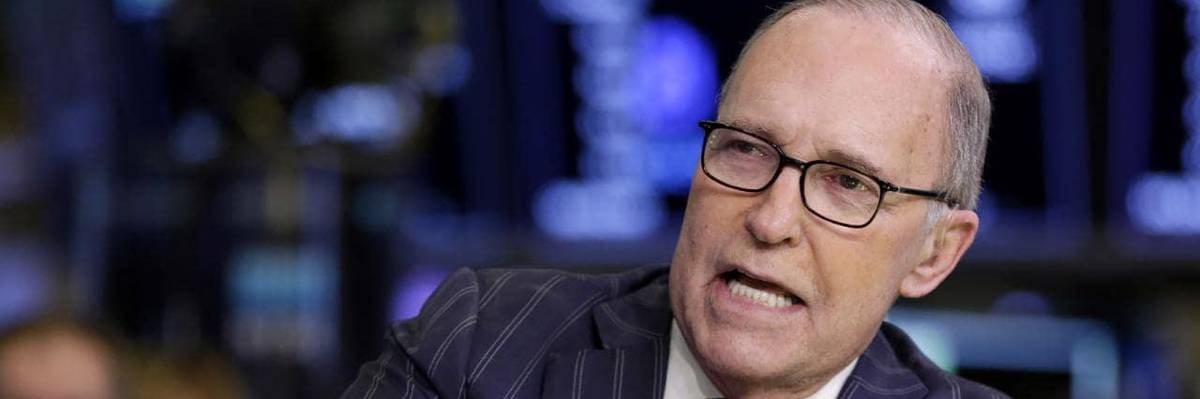
'So yes Kudlow really blew it,' writes Baker, 'but so did pretty much the whole economics profession.' (Image: Screenshot/CNBC)
In Defense of Larry Kudlow (Sort of)
Of course he was wrong about a host of key economic events. However, let's not forget that so were most business-page economists
A lot of folks are running around making a big point of the fact that Larry Kudlow, Trump's new head of the National Economic Council, has gotten a lot of things about the economy wrong, and in particular missed the coming of the Great Recession. For example, here's Dana Milbank's column in the Washington Post this morning.
While Kudlow has gotten a lot of things wrong and completely missed the housing bubble and the implications its collapse would have for the economy, he was hardly alone in this category. Just about the whole economics profession was there along with Kudlow, even if they may not have been quite as outspoken in their optimism.
In January of 2008 the Congressional Budget Office, which consciously tries to place itself in the center of professional opinion, projected 1.7 percent economic growth for 2008 and 2.8 percent for 2009. Even a year later, Christina Romer and my friend Jared Bernstein hugely underestimated the severity of the recession in their report outlining President Obama' stimulus package.
The commentary of the time is full of great lines from distinguished economists. My favorite was when then Federal Reserve Chair Ben Bernanke said that the problems in financial markets will be restricted to the subprime market. After Bear Stearns went under he also famously commented that he didn't see another Bear Stearns out there. It subsequently turned out that there were nothing but Bear Stearns out there, as virtually the whole banking system faced collapse as trillions of dollars of mortgage debt went bad.
I could go on, but the point is that Kudlow was hardly alone in his mistake here. I spent years being derided by many of the country's leading economists for suggesting that there was a housing bubble and its collapse could sink the economy. So yes Kudlow really blew it, but so did pretty much the whole economics profession. (Fortunately for economists, economics is not a profession where people are evaluated based on their performance.)
To Kudlow's credit, he was at least prepared to allow people like me, who warned of the bubble, appear on his show. That was not the case with Mr. Milbank's paper, The Washington Post, which pretty much excluded anyone warning of the bubble until after it burst. (The Post was busy hyping fears about the budget deficit.)
An Urgent Message From Our Co-Founder
Dear Common Dreams reader, It’s been nearly 30 years since I co-founded Common Dreams with my late wife, Lina Newhouser. We had the radical notion that journalism should serve the public good, not corporate profits. It was clear to us from the outset what it would take to build such a project. No paid advertisements. No corporate sponsors. No millionaire publisher telling us what to think or do. Many people said we wouldn't last a year, but we proved those doubters wrong. Together with a tremendous team of journalists and dedicated staff, we built an independent media outlet free from the constraints of profits and corporate control. Our mission has always been simple: To inform. To inspire. To ignite change for the common good. Building Common Dreams was not easy. Our survival was never guaranteed. When you take on the most powerful forces—Wall Street greed, fossil fuel industry destruction, Big Tech lobbyists, and uber-rich oligarchs who have spent billions upon billions rigging the economy and democracy in their favor—the only bulwark you have is supporters who believe in your work. But here’s the urgent message from me today. It's never been this bad out there. And it's never been this hard to keep us going. At the very moment Common Dreams is most needed, the threats we face are intensifying. We need your support now more than ever. We don't accept corporate advertising and never will. We don't have a paywall because we don't think people should be blocked from critical news based on their ability to pay. Everything we do is funded by the donations of readers like you. When everyone does the little they can afford, we are strong. But if that support retreats or dries up, so do we. Will you donate now to make sure Common Dreams not only survives but thrives? —Craig Brown, Co-founder |
A lot of folks are running around making a big point of the fact that Larry Kudlow, Trump's new head of the National Economic Council, has gotten a lot of things about the economy wrong, and in particular missed the coming of the Great Recession. For example, here's Dana Milbank's column in the Washington Post this morning.
While Kudlow has gotten a lot of things wrong and completely missed the housing bubble and the implications its collapse would have for the economy, he was hardly alone in this category. Just about the whole economics profession was there along with Kudlow, even if they may not have been quite as outspoken in their optimism.
In January of 2008 the Congressional Budget Office, which consciously tries to place itself in the center of professional opinion, projected 1.7 percent economic growth for 2008 and 2.8 percent for 2009. Even a year later, Christina Romer and my friend Jared Bernstein hugely underestimated the severity of the recession in their report outlining President Obama' stimulus package.
The commentary of the time is full of great lines from distinguished economists. My favorite was when then Federal Reserve Chair Ben Bernanke said that the problems in financial markets will be restricted to the subprime market. After Bear Stearns went under he also famously commented that he didn't see another Bear Stearns out there. It subsequently turned out that there were nothing but Bear Stearns out there, as virtually the whole banking system faced collapse as trillions of dollars of mortgage debt went bad.
I could go on, but the point is that Kudlow was hardly alone in his mistake here. I spent years being derided by many of the country's leading economists for suggesting that there was a housing bubble and its collapse could sink the economy. So yes Kudlow really blew it, but so did pretty much the whole economics profession. (Fortunately for economists, economics is not a profession where people are evaluated based on their performance.)
To Kudlow's credit, he was at least prepared to allow people like me, who warned of the bubble, appear on his show. That was not the case with Mr. Milbank's paper, The Washington Post, which pretty much excluded anyone warning of the bubble until after it burst. (The Post was busy hyping fears about the budget deficit.)
A lot of folks are running around making a big point of the fact that Larry Kudlow, Trump's new head of the National Economic Council, has gotten a lot of things about the economy wrong, and in particular missed the coming of the Great Recession. For example, here's Dana Milbank's column in the Washington Post this morning.
While Kudlow has gotten a lot of things wrong and completely missed the housing bubble and the implications its collapse would have for the economy, he was hardly alone in this category. Just about the whole economics profession was there along with Kudlow, even if they may not have been quite as outspoken in their optimism.
In January of 2008 the Congressional Budget Office, which consciously tries to place itself in the center of professional opinion, projected 1.7 percent economic growth for 2008 and 2.8 percent for 2009. Even a year later, Christina Romer and my friend Jared Bernstein hugely underestimated the severity of the recession in their report outlining President Obama' stimulus package.
The commentary of the time is full of great lines from distinguished economists. My favorite was when then Federal Reserve Chair Ben Bernanke said that the problems in financial markets will be restricted to the subprime market. After Bear Stearns went under he also famously commented that he didn't see another Bear Stearns out there. It subsequently turned out that there were nothing but Bear Stearns out there, as virtually the whole banking system faced collapse as trillions of dollars of mortgage debt went bad.
I could go on, but the point is that Kudlow was hardly alone in his mistake here. I spent years being derided by many of the country's leading economists for suggesting that there was a housing bubble and its collapse could sink the economy. So yes Kudlow really blew it, but so did pretty much the whole economics profession. (Fortunately for economists, economics is not a profession where people are evaluated based on their performance.)
To Kudlow's credit, he was at least prepared to allow people like me, who warned of the bubble, appear on his show. That was not the case with Mr. Milbank's paper, The Washington Post, which pretty much excluded anyone warning of the bubble until after it burst. (The Post was busy hyping fears about the budget deficit.)