SUBSCRIBE TO OUR FREE NEWSLETTER
Daily news & progressive opinion—funded by the people, not the corporations—delivered straight to your inbox.
5
#000000
#FFFFFF
To donate by check, phone, or other method, see our More Ways to Give page.
Daily news & progressive opinion—funded by the people, not the corporations—delivered straight to your inbox.
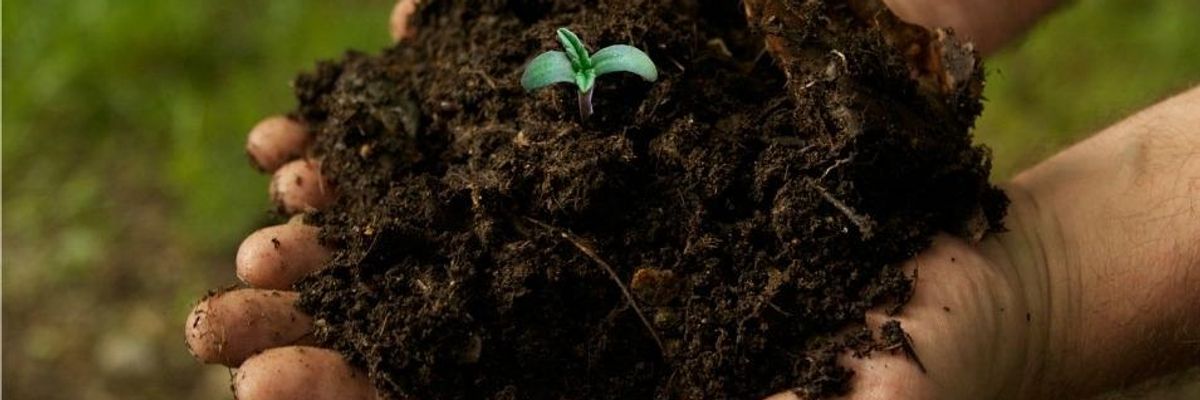
"The federal government has no problem subsidizing, to the tune of $20 billion/year --GMO monoculture crops that degrade the soil and play a significant role in making global warming worse." (Photo: File)
Another report sounding the alarm about climate change. Another missed opportunity to talk about the most promising solution: regenerative agriculture.
The New York Times yesterday cited a new report by the notoriously conservative Government Accountability Office (GAO), which said "climate change is costing taxpayers billions.
CNN also reported on the GAO study, which calls on Trump to "craft appropriate responses."
The CNN coverage noted several initiatives to combat climate change undertaken under the Obama administration, including the Environmental Protection Agency's Clean Power Plan, which sought to lower carbon emissions on a state-by-state basis, and the Paris climate agreement, which saw almost every country agree to voluntary limits on future carbon emissions.
The current climate-denying Trump administration wants to scrap those, and other climate initiatives, in favor of prioritizing corporate profits.
But that's not why I'm writing today. I'm writing because once again, a major report on the costs--financial, social, environmental, political--of doing nothing to slow runaway global warming focuses exclusively on reducing carbon emissions. As usual, this new report fails to mention that even if we achieved zero emissions tomorrow, we're still in big trouble--unless we draw down and sequester the billions of tons of carbon already in the atmosphere.
And once again, a major report on global warming fails to acknowledge that we have the tools readily at our disposal to draw down that carbon, and we know how to use them. They are regenerative agriculture and land-use practices outlined in a recent Stanford Woods Institute report, which says:
If you want to do something about global warming, look under your feet. Managed well, soil's ability to trap carbon dioxide is potentially much greater than previously estimated, according to Stanford researchers who claim the resource could "significantly" offset increasing global emissions. They call for a reversal of federal cutbacks to related research programs to learn more about this valuable resource.
The federal government has no problem subsidizing, to the tune of $20 billion/year --GMO monoculture crops that degrade the soil and play a significant role in making global warming worse.
But Congress has no problem cutting back research on how to improve soil health as a means of combatting global warming?
Fortunately, other governments are incorporating "the soil solution" into their policies and plans to combat global warming. The most significant is France's "Four for 1000: Soils for Food Security and Climate" Initiative launched by the French government at the Paris Climate Summit in December 2015.
In the U.S., some states are taking steps of their own to enact regenerative agriculture policies, notably California, Vermont and Massachusetts.
If your state isn't on the list, maybe it's time you start building a Regeneration Movement in your own community?
It's time to stop ignoring our best hope of cooling the planet. If federal lawmakers won't help, we need to make sure our local and state officials get on board.
Dear Common Dreams reader, It’s been nearly 30 years since I co-founded Common Dreams with my late wife, Lina Newhouser. We had the radical notion that journalism should serve the public good, not corporate profits. It was clear to us from the outset what it would take to build such a project. No paid advertisements. No corporate sponsors. No millionaire publisher telling us what to think or do. Many people said we wouldn't last a year, but we proved those doubters wrong. Together with a tremendous team of journalists and dedicated staff, we built an independent media outlet free from the constraints of profits and corporate control. Our mission has always been simple: To inform. To inspire. To ignite change for the common good. Building Common Dreams was not easy. Our survival was never guaranteed. When you take on the most powerful forces—Wall Street greed, fossil fuel industry destruction, Big Tech lobbyists, and uber-rich oligarchs who have spent billions upon billions rigging the economy and democracy in their favor—the only bulwark you have is supporters who believe in your work. But here’s the urgent message from me today. It's never been this bad out there. And it's never been this hard to keep us going. At the very moment Common Dreams is most needed, the threats we face are intensifying. We need your support now more than ever. We don't accept corporate advertising and never will. We don't have a paywall because we don't think people should be blocked from critical news based on their ability to pay. Everything we do is funded by the donations of readers like you. When everyone does the little they can afford, we are strong. But if that support retreats or dries up, so do we. Will you donate now to make sure Common Dreams not only survives but thrives? —Craig Brown, Co-founder |
Another report sounding the alarm about climate change. Another missed opportunity to talk about the most promising solution: regenerative agriculture.
The New York Times yesterday cited a new report by the notoriously conservative Government Accountability Office (GAO), which said "climate change is costing taxpayers billions.
CNN also reported on the GAO study, which calls on Trump to "craft appropriate responses."
The CNN coverage noted several initiatives to combat climate change undertaken under the Obama administration, including the Environmental Protection Agency's Clean Power Plan, which sought to lower carbon emissions on a state-by-state basis, and the Paris climate agreement, which saw almost every country agree to voluntary limits on future carbon emissions.
The current climate-denying Trump administration wants to scrap those, and other climate initiatives, in favor of prioritizing corporate profits.
But that's not why I'm writing today. I'm writing because once again, a major report on the costs--financial, social, environmental, political--of doing nothing to slow runaway global warming focuses exclusively on reducing carbon emissions. As usual, this new report fails to mention that even if we achieved zero emissions tomorrow, we're still in big trouble--unless we draw down and sequester the billions of tons of carbon already in the atmosphere.
And once again, a major report on global warming fails to acknowledge that we have the tools readily at our disposal to draw down that carbon, and we know how to use them. They are regenerative agriculture and land-use practices outlined in a recent Stanford Woods Institute report, which says:
If you want to do something about global warming, look under your feet. Managed well, soil's ability to trap carbon dioxide is potentially much greater than previously estimated, according to Stanford researchers who claim the resource could "significantly" offset increasing global emissions. They call for a reversal of federal cutbacks to related research programs to learn more about this valuable resource.
The federal government has no problem subsidizing, to the tune of $20 billion/year --GMO monoculture crops that degrade the soil and play a significant role in making global warming worse.
But Congress has no problem cutting back research on how to improve soil health as a means of combatting global warming?
Fortunately, other governments are incorporating "the soil solution" into their policies and plans to combat global warming. The most significant is France's "Four for 1000: Soils for Food Security and Climate" Initiative launched by the French government at the Paris Climate Summit in December 2015.
In the U.S., some states are taking steps of their own to enact regenerative agriculture policies, notably California, Vermont and Massachusetts.
If your state isn't on the list, maybe it's time you start building a Regeneration Movement in your own community?
It's time to stop ignoring our best hope of cooling the planet. If federal lawmakers won't help, we need to make sure our local and state officials get on board.
Another report sounding the alarm about climate change. Another missed opportunity to talk about the most promising solution: regenerative agriculture.
The New York Times yesterday cited a new report by the notoriously conservative Government Accountability Office (GAO), which said "climate change is costing taxpayers billions.
CNN also reported on the GAO study, which calls on Trump to "craft appropriate responses."
The CNN coverage noted several initiatives to combat climate change undertaken under the Obama administration, including the Environmental Protection Agency's Clean Power Plan, which sought to lower carbon emissions on a state-by-state basis, and the Paris climate agreement, which saw almost every country agree to voluntary limits on future carbon emissions.
The current climate-denying Trump administration wants to scrap those, and other climate initiatives, in favor of prioritizing corporate profits.
But that's not why I'm writing today. I'm writing because once again, a major report on the costs--financial, social, environmental, political--of doing nothing to slow runaway global warming focuses exclusively on reducing carbon emissions. As usual, this new report fails to mention that even if we achieved zero emissions tomorrow, we're still in big trouble--unless we draw down and sequester the billions of tons of carbon already in the atmosphere.
And once again, a major report on global warming fails to acknowledge that we have the tools readily at our disposal to draw down that carbon, and we know how to use them. They are regenerative agriculture and land-use practices outlined in a recent Stanford Woods Institute report, which says:
If you want to do something about global warming, look under your feet. Managed well, soil's ability to trap carbon dioxide is potentially much greater than previously estimated, according to Stanford researchers who claim the resource could "significantly" offset increasing global emissions. They call for a reversal of federal cutbacks to related research programs to learn more about this valuable resource.
The federal government has no problem subsidizing, to the tune of $20 billion/year --GMO monoculture crops that degrade the soil and play a significant role in making global warming worse.
But Congress has no problem cutting back research on how to improve soil health as a means of combatting global warming?
Fortunately, other governments are incorporating "the soil solution" into their policies and plans to combat global warming. The most significant is France's "Four for 1000: Soils for Food Security and Climate" Initiative launched by the French government at the Paris Climate Summit in December 2015.
In the U.S., some states are taking steps of their own to enact regenerative agriculture policies, notably California, Vermont and Massachusetts.
If your state isn't on the list, maybe it's time you start building a Regeneration Movement in your own community?
It's time to stop ignoring our best hope of cooling the planet. If federal lawmakers won't help, we need to make sure our local and state officials get on board.