SUBSCRIBE TO OUR FREE NEWSLETTER
Daily news & progressive opinion—funded by the people, not the corporations—delivered straight to your inbox.
5
#000000
#FFFFFF
To donate by check, phone, or other method, see our More Ways to Give page.
Daily news & progressive opinion—funded by the people, not the corporations—delivered straight to your inbox.
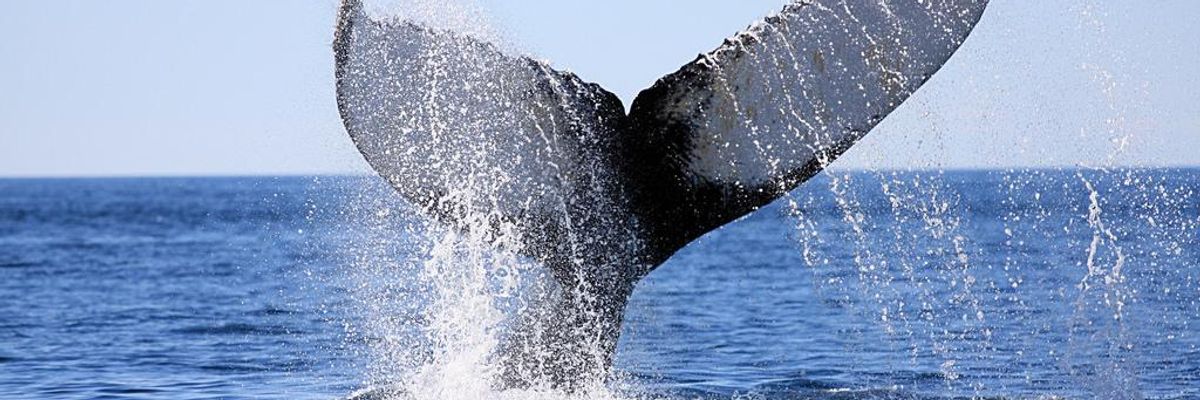
The fate of whales is discussed by stakeholders around the world every four years at meetings of the International Whaling Commission, as those in power discuss the fate of much of the world population without offering them a seat at the table. (Photo: Cyrille Humbert/Flickr/cc)
The International Whaling Commission meets every four years to decide the future of the whales. That is, it decides which nation will kill how many, and for what reasons (commercial, subsistence, "research"). Stakeholders from around the world are engaged, from whaling and non-whaling nations alike.
Notably absent in these discussions on the future of whales, are the whales themselves. But this is not just because they would have a hard time fitting into the conference room. It's an intentional omission, since whales are a part of the commons: that great, amorphous void which we draw individuals out of, pour refuse in to, and in which lives the nameless, faceless "biomass" that we refuse any real legal or political consideration on a categorical basis. According to our current paradigm, the whales, and everyone else in the oceans, are resources to be protected, conserved or exploited: divided up (albeit unequally) amongst ourselves, and consumed.
This might sound like an article about whales, but it isn't. It's really about us, and what we chose to believe about ourselves, our societies, and what our future can look like. For perhaps the first time in history, we human cultures of the world are largely united in a struggle for what comes next - an active discussion, a exercise in collective imagination that's becoming all the more urgent as we watch our current world, and worldviews, fall apart - or more aptly, being ripped apart by late-stage capitalism.
Our current system is incapable of addressing the problems within our own species because inequality is embedded within its very foundation. Strategies to dismantle plutocracy and eradicate poverty often involve new ways of managing the commons. However, as long as we try to preserve or manage "habitats" and "ecosystems" for human benefit alone, the resulting devastation of the lives of other species will reverberate into our own in increasingly disastrous and unpredictable ways.
Within capitalist models, individuals of other species are not only neglected - their very existence is denied. They are instead relegated to the realm of property, only to be considered or "conserved" when their bodies are seen as necessary for the health of an ecosystem of value; and then, they are lumped into "populations" or "stocks" rather than recognizing them as individuals with interests, deserving of their fair share of resources like any human being.
When we begin to consider this legion of individuals of other species, the commons can transform into a system for "mutualizing responsibilities" wherein other species are considered active stakeholders as they participate and benefit from those responsibilities. This can maximize the health and generative capacities of a given area, be it in the ocean or upon the grasslands or within a forest.
Let's go back into that conference room again, with its notable absence of the whales who are being discussed. The changes I'm proposing might sound extreme, but not if we begin with species that we can all agree are intelligent and sophisticated enough to have interests of their own. We can begin by considering whale's needs, desires, and perspectives as stakeholders. Rather than having conservationists advocating for whales' protection, we ought to be giving whales a seat at the table - via a representative such as a guardian ad litem - to express what's in the best interest for these individuals in matters concerning them, such as establishing Marine Protected Areas designed to protect their culturally relevant spaces in the ocean. Whales should also be considered stakeholders where industrial projects, such as salmon farms, may have adverse impacts on their lives. And, one day, whales should be considered stakeholders at the very meetings where their kin are being scheduled for slaughter.
This is no quaint idea rooted in sentimentality towards charismatic megafauna. It's an idea that can save us - all of us - because when other species thrive, we all thrive.
Any accounting of the commons without acknowledging the presence and interests of others within these spaces will lead to their continued destruction, to our human detriment as well. But when we consider the perspectives of the other species, whom we rely upon for our survival and vice versa, can we begin to work towards nurturing an environment that is actually sustainable. Doing otherwise will only doom us to repeat history. And it's already a bit late for that.
Dear Common Dreams reader, It’s been nearly 30 years since I co-founded Common Dreams with my late wife, Lina Newhouser. We had the radical notion that journalism should serve the public good, not corporate profits. It was clear to us from the outset what it would take to build such a project. No paid advertisements. No corporate sponsors. No millionaire publisher telling us what to think or do. Many people said we wouldn't last a year, but we proved those doubters wrong. Together with a tremendous team of journalists and dedicated staff, we built an independent media outlet free from the constraints of profits and corporate control. Our mission has always been simple: To inform. To inspire. To ignite change for the common good. Building Common Dreams was not easy. Our survival was never guaranteed. When you take on the most powerful forces—Wall Street greed, fossil fuel industry destruction, Big Tech lobbyists, and uber-rich oligarchs who have spent billions upon billions rigging the economy and democracy in their favor—the only bulwark you have is supporters who believe in your work. But here’s the urgent message from me today. It's never been this bad out there. And it's never been this hard to keep us going. At the very moment Common Dreams is most needed, the threats we face are intensifying. We need your support now more than ever. We don't accept corporate advertising and never will. We don't have a paywall because we don't think people should be blocked from critical news based on their ability to pay. Everything we do is funded by the donations of readers like you. When everyone does the little they can afford, we are strong. But if that support retreats or dries up, so do we. Will you donate now to make sure Common Dreams not only survives but thrives? —Craig Brown, Co-founder |
The International Whaling Commission meets every four years to decide the future of the whales. That is, it decides which nation will kill how many, and for what reasons (commercial, subsistence, "research"). Stakeholders from around the world are engaged, from whaling and non-whaling nations alike.
Notably absent in these discussions on the future of whales, are the whales themselves. But this is not just because they would have a hard time fitting into the conference room. It's an intentional omission, since whales are a part of the commons: that great, amorphous void which we draw individuals out of, pour refuse in to, and in which lives the nameless, faceless "biomass" that we refuse any real legal or political consideration on a categorical basis. According to our current paradigm, the whales, and everyone else in the oceans, are resources to be protected, conserved or exploited: divided up (albeit unequally) amongst ourselves, and consumed.
This might sound like an article about whales, but it isn't. It's really about us, and what we chose to believe about ourselves, our societies, and what our future can look like. For perhaps the first time in history, we human cultures of the world are largely united in a struggle for what comes next - an active discussion, a exercise in collective imagination that's becoming all the more urgent as we watch our current world, and worldviews, fall apart - or more aptly, being ripped apart by late-stage capitalism.
Our current system is incapable of addressing the problems within our own species because inequality is embedded within its very foundation. Strategies to dismantle plutocracy and eradicate poverty often involve new ways of managing the commons. However, as long as we try to preserve or manage "habitats" and "ecosystems" for human benefit alone, the resulting devastation of the lives of other species will reverberate into our own in increasingly disastrous and unpredictable ways.
Within capitalist models, individuals of other species are not only neglected - their very existence is denied. They are instead relegated to the realm of property, only to be considered or "conserved" when their bodies are seen as necessary for the health of an ecosystem of value; and then, they are lumped into "populations" or "stocks" rather than recognizing them as individuals with interests, deserving of their fair share of resources like any human being.
When we begin to consider this legion of individuals of other species, the commons can transform into a system for "mutualizing responsibilities" wherein other species are considered active stakeholders as they participate and benefit from those responsibilities. This can maximize the health and generative capacities of a given area, be it in the ocean or upon the grasslands or within a forest.
Let's go back into that conference room again, with its notable absence of the whales who are being discussed. The changes I'm proposing might sound extreme, but not if we begin with species that we can all agree are intelligent and sophisticated enough to have interests of their own. We can begin by considering whale's needs, desires, and perspectives as stakeholders. Rather than having conservationists advocating for whales' protection, we ought to be giving whales a seat at the table - via a representative such as a guardian ad litem - to express what's in the best interest for these individuals in matters concerning them, such as establishing Marine Protected Areas designed to protect their culturally relevant spaces in the ocean. Whales should also be considered stakeholders where industrial projects, such as salmon farms, may have adverse impacts on their lives. And, one day, whales should be considered stakeholders at the very meetings where their kin are being scheduled for slaughter.
This is no quaint idea rooted in sentimentality towards charismatic megafauna. It's an idea that can save us - all of us - because when other species thrive, we all thrive.
Any accounting of the commons without acknowledging the presence and interests of others within these spaces will lead to their continued destruction, to our human detriment as well. But when we consider the perspectives of the other species, whom we rely upon for our survival and vice versa, can we begin to work towards nurturing an environment that is actually sustainable. Doing otherwise will only doom us to repeat history. And it's already a bit late for that.
The International Whaling Commission meets every four years to decide the future of the whales. That is, it decides which nation will kill how many, and for what reasons (commercial, subsistence, "research"). Stakeholders from around the world are engaged, from whaling and non-whaling nations alike.
Notably absent in these discussions on the future of whales, are the whales themselves. But this is not just because they would have a hard time fitting into the conference room. It's an intentional omission, since whales are a part of the commons: that great, amorphous void which we draw individuals out of, pour refuse in to, and in which lives the nameless, faceless "biomass" that we refuse any real legal or political consideration on a categorical basis. According to our current paradigm, the whales, and everyone else in the oceans, are resources to be protected, conserved or exploited: divided up (albeit unequally) amongst ourselves, and consumed.
This might sound like an article about whales, but it isn't. It's really about us, and what we chose to believe about ourselves, our societies, and what our future can look like. For perhaps the first time in history, we human cultures of the world are largely united in a struggle for what comes next - an active discussion, a exercise in collective imagination that's becoming all the more urgent as we watch our current world, and worldviews, fall apart - or more aptly, being ripped apart by late-stage capitalism.
Our current system is incapable of addressing the problems within our own species because inequality is embedded within its very foundation. Strategies to dismantle plutocracy and eradicate poverty often involve new ways of managing the commons. However, as long as we try to preserve or manage "habitats" and "ecosystems" for human benefit alone, the resulting devastation of the lives of other species will reverberate into our own in increasingly disastrous and unpredictable ways.
Within capitalist models, individuals of other species are not only neglected - their very existence is denied. They are instead relegated to the realm of property, only to be considered or "conserved" when their bodies are seen as necessary for the health of an ecosystem of value; and then, they are lumped into "populations" or "stocks" rather than recognizing them as individuals with interests, deserving of their fair share of resources like any human being.
When we begin to consider this legion of individuals of other species, the commons can transform into a system for "mutualizing responsibilities" wherein other species are considered active stakeholders as they participate and benefit from those responsibilities. This can maximize the health and generative capacities of a given area, be it in the ocean or upon the grasslands or within a forest.
Let's go back into that conference room again, with its notable absence of the whales who are being discussed. The changes I'm proposing might sound extreme, but not if we begin with species that we can all agree are intelligent and sophisticated enough to have interests of their own. We can begin by considering whale's needs, desires, and perspectives as stakeholders. Rather than having conservationists advocating for whales' protection, we ought to be giving whales a seat at the table - via a representative such as a guardian ad litem - to express what's in the best interest for these individuals in matters concerning them, such as establishing Marine Protected Areas designed to protect their culturally relevant spaces in the ocean. Whales should also be considered stakeholders where industrial projects, such as salmon farms, may have adverse impacts on their lives. And, one day, whales should be considered stakeholders at the very meetings where their kin are being scheduled for slaughter.
This is no quaint idea rooted in sentimentality towards charismatic megafauna. It's an idea that can save us - all of us - because when other species thrive, we all thrive.
Any accounting of the commons without acknowledging the presence and interests of others within these spaces will lead to their continued destruction, to our human detriment as well. But when we consider the perspectives of the other species, whom we rely upon for our survival and vice versa, can we begin to work towards nurturing an environment that is actually sustainable. Doing otherwise will only doom us to repeat history. And it's already a bit late for that.