SUBSCRIBE TO OUR FREE NEWSLETTER
Daily news & progressive opinion—funded by the people, not the corporations—delivered straight to your inbox.
5
#000000
#FFFFFF
To donate by check, phone, or other method, see our More Ways to Give page.
There have been many disturbing images that have resulted from the desperate plight of Syrians searching for refuge in Europe. The picture of the little body of Alan Kurdi, washed up on the shores of Turkey, was as powerful and heartbreaking as any I will ever see (and ever wish to see). To many media outlets and social media users, the picture of Alan represented more than a single death (and more than the broader tragedy that is Syria), it represented both the global apathy toward the plight of the Syrians and the moral cost of that apathy.
So, when images of Hungarian TV photographer Petra Laszlo kicking and tripping Syrian refugees -- including Osama Abdul Muhsen and his 7-year-old son, Zaid -- began to flow across our computer screens, my thoughts went back to Alan Kurdi. If the picture of Alan reminded us of our collective responsibility, what did the picture of Laszlo humiliating desperate Syrians tell us?
Of course, at the most obvious level, Laszlo's act was one of pure cruelty and hate, illustrating the depths to which some people will stoop to satisfy their basest instincts. Her desperate claims to have been acting out of fear and confusion ring very, very hollow. But, whether fellow news workers like it or not, Laszlo is a journalist, and I could not help but see her act as the physical manifestation of what many journalists have done -- in rhetorical and symbolic terms -- to migrants and refugees in the form of stereotyping, mud-slinging, xenophobia and racism.
By comparing Laszlo's act to the act of writing an article, I am aware that I am comparing an act of physical violence to the act of publishing. It would be easy, of course, for columnists who have made a living vilifying "immigrants" and "refugees" to watch what the Hungarian TV photographer did and to say, "I might not care for refugees, but I would never advocate physical violence against them."
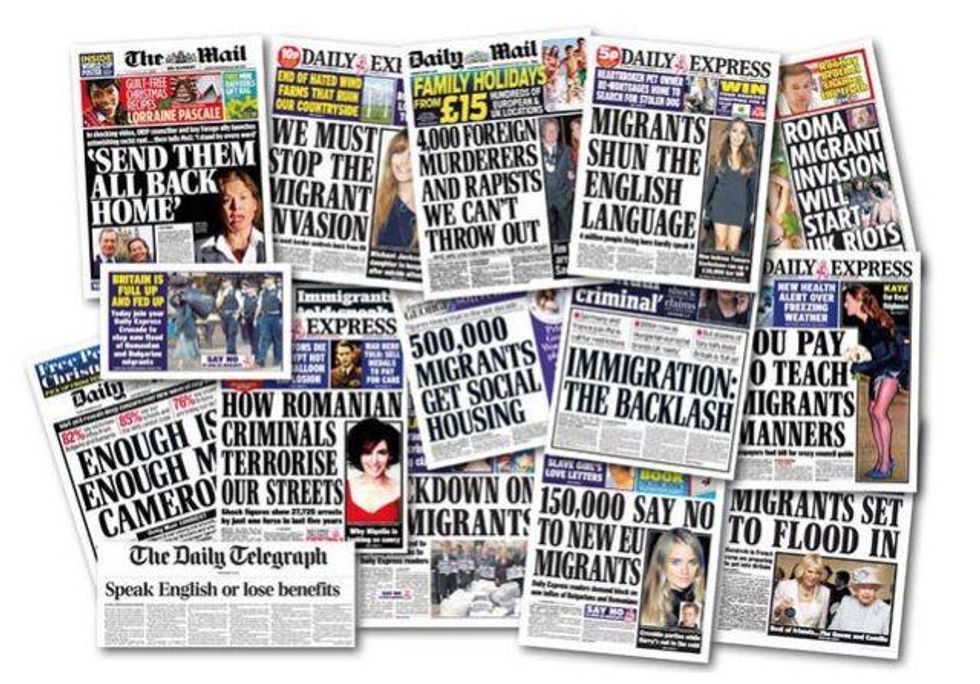
Yet, such a response begs the question: what is the relationship between Laszlo's act and a mediated context in which refugees are regularly portrayed in sub-human terms, and described as "flooding" into and "swamping" other countries? Just as we ask what kind of environment allows a US police officer to feel justified in shooting an unarmed suspect in the back -- and in broad daylight -- as he runs away, so we should ask about the environment that allows a journalist to trip and kick fleeing asylum seekers, in full view of other journalists, as they run with their children and think they can get away with it?
As the #JeSuisCharlie movement demonstrated, there is often a groundswell of support for the free press and free speech when freedoms are perceived to be "under attack." In the case of the Paris killings, the Charlie Hebdo cartoonists came to represent Western Enlightenment writ large, even if such a representation was, to be diplomatic, a stretch.
Of course, Laszlo is not all journalists. The vast majority of journalists don't write xenophobic articles and consider Laszlo's behavior utterly repulsive.
But, if we are quick to crown a handful of news workers as symbolic representatives of not only their entire profession, but also of freedoms of press and speech, then it is contradictory to simply dismiss Laszlo, and all journalists who peddle xenophobia, as nothing more than distasteful, inconvenient aberrations. They are out there. Our newspapers and television shows are evidence of that.
Laszlo's act was the physical manifestation of the unseemly side of free speech and free expression: a side that is often ignored in the self-congratulatory rhetoric on Western press and democracy.
The end results of freedom can cut both ways.
There have been many disturbing images that have resulted from the desperate plight of Syrians searching for refuge in Europe. The picture of the little body of Alan Kurdi, washed up on the shores of Turkey, was as powerful and heartbreaking as any I will ever see (and ever wish to see). To many media outlets and social media users, the picture of Alan represented more than a single death (and more than the broader tragedy that is Syria), it represented both the global apathy toward the plight of the Syrians and the moral cost of that apathy.
So, when images of Hungarian TV photographer Petra Laszlo kicking and tripping Syrian refugees -- including Osama Abdul Muhsen and his 7-year-old son, Zaid -- began to flow across our computer screens, my thoughts went back to Alan Kurdi. If the picture of Alan reminded us of our collective responsibility, what did the picture of Laszlo humiliating desperate Syrians tell us?
Of course, at the most obvious level, Laszlo's act was one of pure cruelty and hate, illustrating the depths to which some people will stoop to satisfy their basest instincts. Her desperate claims to have been acting out of fear and confusion ring very, very hollow. But, whether fellow news workers like it or not, Laszlo is a journalist, and I could not help but see her act as the physical manifestation of what many journalists have done -- in rhetorical and symbolic terms -- to migrants and refugees in the form of stereotyping, mud-slinging, xenophobia and racism.
By comparing Laszlo's act to the act of writing an article, I am aware that I am comparing an act of physical violence to the act of publishing. It would be easy, of course, for columnists who have made a living vilifying "immigrants" and "refugees" to watch what the Hungarian TV photographer did and to say, "I might not care for refugees, but I would never advocate physical violence against them."
Yet, such a response begs the question: what is the relationship between Laszlo's act and a mediated context in which refugees are regularly portrayed in sub-human terms, and described as "flooding" into and "swamping" other countries? Just as we ask what kind of environment allows a US police officer to feel justified in shooting an unarmed suspect in the back -- and in broad daylight -- as he runs away, so we should ask about the environment that allows a journalist to trip and kick fleeing asylum seekers, in full view of other journalists, as they run with their children and think they can get away with it?
As the #JeSuisCharlie movement demonstrated, there is often a groundswell of support for the free press and free speech when freedoms are perceived to be "under attack." In the case of the Paris killings, the Charlie Hebdo cartoonists came to represent Western Enlightenment writ large, even if such a representation was, to be diplomatic, a stretch.
Of course, Laszlo is not all journalists. The vast majority of journalists don't write xenophobic articles and consider Laszlo's behavior utterly repulsive.
But, if we are quick to crown a handful of news workers as symbolic representatives of not only their entire profession, but also of freedoms of press and speech, then it is contradictory to simply dismiss Laszlo, and all journalists who peddle xenophobia, as nothing more than distasteful, inconvenient aberrations. They are out there. Our newspapers and television shows are evidence of that.
Laszlo's act was the physical manifestation of the unseemly side of free speech and free expression: a side that is often ignored in the self-congratulatory rhetoric on Western press and democracy.
The end results of freedom can cut both ways.
There have been many disturbing images that have resulted from the desperate plight of Syrians searching for refuge in Europe. The picture of the little body of Alan Kurdi, washed up on the shores of Turkey, was as powerful and heartbreaking as any I will ever see (and ever wish to see). To many media outlets and social media users, the picture of Alan represented more than a single death (and more than the broader tragedy that is Syria), it represented both the global apathy toward the plight of the Syrians and the moral cost of that apathy.
So, when images of Hungarian TV photographer Petra Laszlo kicking and tripping Syrian refugees -- including Osama Abdul Muhsen and his 7-year-old son, Zaid -- began to flow across our computer screens, my thoughts went back to Alan Kurdi. If the picture of Alan reminded us of our collective responsibility, what did the picture of Laszlo humiliating desperate Syrians tell us?
Of course, at the most obvious level, Laszlo's act was one of pure cruelty and hate, illustrating the depths to which some people will stoop to satisfy their basest instincts. Her desperate claims to have been acting out of fear and confusion ring very, very hollow. But, whether fellow news workers like it or not, Laszlo is a journalist, and I could not help but see her act as the physical manifestation of what many journalists have done -- in rhetorical and symbolic terms -- to migrants and refugees in the form of stereotyping, mud-slinging, xenophobia and racism.
By comparing Laszlo's act to the act of writing an article, I am aware that I am comparing an act of physical violence to the act of publishing. It would be easy, of course, for columnists who have made a living vilifying "immigrants" and "refugees" to watch what the Hungarian TV photographer did and to say, "I might not care for refugees, but I would never advocate physical violence against them."
Yet, such a response begs the question: what is the relationship between Laszlo's act and a mediated context in which refugees are regularly portrayed in sub-human terms, and described as "flooding" into and "swamping" other countries? Just as we ask what kind of environment allows a US police officer to feel justified in shooting an unarmed suspect in the back -- and in broad daylight -- as he runs away, so we should ask about the environment that allows a journalist to trip and kick fleeing asylum seekers, in full view of other journalists, as they run with their children and think they can get away with it?
As the #JeSuisCharlie movement demonstrated, there is often a groundswell of support for the free press and free speech when freedoms are perceived to be "under attack." In the case of the Paris killings, the Charlie Hebdo cartoonists came to represent Western Enlightenment writ large, even if such a representation was, to be diplomatic, a stretch.
Of course, Laszlo is not all journalists. The vast majority of journalists don't write xenophobic articles and consider Laszlo's behavior utterly repulsive.
But, if we are quick to crown a handful of news workers as symbolic representatives of not only their entire profession, but also of freedoms of press and speech, then it is contradictory to simply dismiss Laszlo, and all journalists who peddle xenophobia, as nothing more than distasteful, inconvenient aberrations. They are out there. Our newspapers and television shows are evidence of that.
Laszlo's act was the physical manifestation of the unseemly side of free speech and free expression: a side that is often ignored in the self-congratulatory rhetoric on Western press and democracy.
The end results of freedom can cut both ways.