SUBSCRIBE TO OUR FREE NEWSLETTER
Daily news & progressive opinion—funded by the people, not the corporations—delivered straight to your inbox.
5
#000000
#FFFFFF
To donate by check, phone, or other method, see our More Ways to Give page.
Daily news & progressive opinion—funded by the people, not the corporations—delivered straight to your inbox.
The New York Times (4/17/15) has a post by Neil Irwin headlined "Why Americans Don't Want to Soak the Rich." Irwin suggests a couple of different answers to this question, depending on your ideological point of view:
The New York Times (4/17/15) has a post by Neil Irwin headlined "Why Americans Don't Want to Soak the Rich." Irwin suggests a couple of different answers to this question, depending on your ideological point of view:
If you're conservative, a compelling answer might be this: Americans are seeking less redistribution because they have come to their senses.... If you're a liberal, the answer might be more like this: Americans have been hoodwinked by conservative politicians and media outlets, and have come to view redistribution as a dirty word because they don't recognize the ways it benefits them.
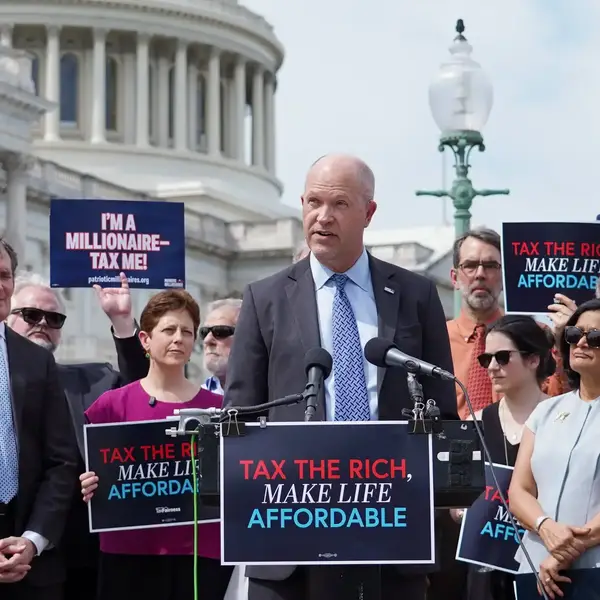
I would suggest a third answer, though: American do want to "soak the rich."
There's something of a sleight-of-hand here, as Irwin asserts
that Americans' views on whether the government should work to redistribute income -- to tax the rich, for example, and funnel the proceeds to the poor and working class -- have, depending on which survey answers you look at, either been little changed, or shifted toward greater skepticism about redistribution.
He doesn't cite any examples of these surveys showing either little change or greater skepticism, but when I look at polling over time on taxing the wealthy, what's striking to me is how consistently popular it is. Gallup has asked 17 times since 1992 whether upper-income people pay too much, too little or their fair share of federal taxes, and every time a majority has said they pay too little. Only twice-in 2010 and 2011-have less than 60 percent said they thought the rich were not paying enough federal taxes.
The same series of Gallup polls found people saying that lower-income and middle-income people were paying either their fair share or too much in taxes. Corporations, like the wealthy, were seen as paying too little, by an even wider margin-only twice in 11 repetitions of the question did less than 66 percent say corporate taxes were not high enough.
And the Gallup results are no outlier. An AP/GfK poll from February (AP, 2/22/15) found 68 percent saying that wealthy households pay too little in federal taxes. Politifact (4/25/11) cited a handful of polls, with findings that range from 59 percent to 72 percent, in support of Paul Krugman's claim that "large majorities support higher, not lower, taxes on the wealthy."
And it's not just taxes on the wealthy; on the relatively rare occasions when they're asked to pick a side in the class conflict, the American people generally choose the left side of the field:
So how does Irwin get away with claiming there is "flat or declining support for redistribution"? Part of it, as I said, is by not citing any actual polls; if he did, I suspect that even those that show "declining support" would still be indicating a high level of support, undermining the whole point of the column.
Another trick is to segue from (unnamed) polls to politicians' platforms-as if both are equally valid methods of gauging public opinion: "It's not just public opinion polls, either. It shows up in the actual policies espoused by candidates for office and enacted by Congress."
A more on-point topic for a column would be, "Why Politicians Don't Soak the Rich-Even Though Voters Want Them To." Clearly, the billions of dollars that flow to candidates from the wealthy are a major factor. But I wouldn't underestimate the role of hoodwinking by corporate media outlets-especially those owned by billionaires who have no desire to be soaked.
Take Action: You can send a message to the New York Times at letters@nytimes.com, or to public editor Margaret Sullivan at public@nytimes.com. Please remember that respectful communication is the most effective.
Dear Common Dreams reader, It’s been nearly 30 years since I co-founded Common Dreams with my late wife, Lina Newhouser. We had the radical notion that journalism should serve the public good, not corporate profits. It was clear to us from the outset what it would take to build such a project. No paid advertisements. No corporate sponsors. No millionaire publisher telling us what to think or do. Many people said we wouldn't last a year, but we proved those doubters wrong. Together with a tremendous team of journalists and dedicated staff, we built an independent media outlet free from the constraints of profits and corporate control. Our mission has always been simple: To inform. To inspire. To ignite change for the common good. Building Common Dreams was not easy. Our survival was never guaranteed. When you take on the most powerful forces—Wall Street greed, fossil fuel industry destruction, Big Tech lobbyists, and uber-rich oligarchs who have spent billions upon billions rigging the economy and democracy in their favor—the only bulwark you have is supporters who believe in your work. But here’s the urgent message from me today. It's never been this bad out there. And it's never been this hard to keep us going. At the very moment Common Dreams is most needed, the threats we face are intensifying. We need your support now more than ever. We don't accept corporate advertising and never will. We don't have a paywall because we don't think people should be blocked from critical news based on their ability to pay. Everything we do is funded by the donations of readers like you. When everyone does the little they can afford, we are strong. But if that support retreats or dries up, so do we. Will you donate now to make sure Common Dreams not only survives but thrives? —Craig Brown, Co-founder |
The New York Times (4/17/15) has a post by Neil Irwin headlined "Why Americans Don't Want to Soak the Rich." Irwin suggests a couple of different answers to this question, depending on your ideological point of view:
If you're conservative, a compelling answer might be this: Americans are seeking less redistribution because they have come to their senses.... If you're a liberal, the answer might be more like this: Americans have been hoodwinked by conservative politicians and media outlets, and have come to view redistribution as a dirty word because they don't recognize the ways it benefits them.
I would suggest a third answer, though: American do want to "soak the rich."
There's something of a sleight-of-hand here, as Irwin asserts
that Americans' views on whether the government should work to redistribute income -- to tax the rich, for example, and funnel the proceeds to the poor and working class -- have, depending on which survey answers you look at, either been little changed, or shifted toward greater skepticism about redistribution.
He doesn't cite any examples of these surveys showing either little change or greater skepticism, but when I look at polling over time on taxing the wealthy, what's striking to me is how consistently popular it is. Gallup has asked 17 times since 1992 whether upper-income people pay too much, too little or their fair share of federal taxes, and every time a majority has said they pay too little. Only twice-in 2010 and 2011-have less than 60 percent said they thought the rich were not paying enough federal taxes.
The same series of Gallup polls found people saying that lower-income and middle-income people were paying either their fair share or too much in taxes. Corporations, like the wealthy, were seen as paying too little, by an even wider margin-only twice in 11 repetitions of the question did less than 66 percent say corporate taxes were not high enough.
And the Gallup results are no outlier. An AP/GfK poll from February (AP, 2/22/15) found 68 percent saying that wealthy households pay too little in federal taxes. Politifact (4/25/11) cited a handful of polls, with findings that range from 59 percent to 72 percent, in support of Paul Krugman's claim that "large majorities support higher, not lower, taxes on the wealthy."
And it's not just taxes on the wealthy; on the relatively rare occasions when they're asked to pick a side in the class conflict, the American people generally choose the left side of the field:
So how does Irwin get away with claiming there is "flat or declining support for redistribution"? Part of it, as I said, is by not citing any actual polls; if he did, I suspect that even those that show "declining support" would still be indicating a high level of support, undermining the whole point of the column.
Another trick is to segue from (unnamed) polls to politicians' platforms-as if both are equally valid methods of gauging public opinion: "It's not just public opinion polls, either. It shows up in the actual policies espoused by candidates for office and enacted by Congress."
A more on-point topic for a column would be, "Why Politicians Don't Soak the Rich-Even Though Voters Want Them To." Clearly, the billions of dollars that flow to candidates from the wealthy are a major factor. But I wouldn't underestimate the role of hoodwinking by corporate media outlets-especially those owned by billionaires who have no desire to be soaked.
Take Action: You can send a message to the New York Times at letters@nytimes.com, or to public editor Margaret Sullivan at public@nytimes.com. Please remember that respectful communication is the most effective.
The New York Times (4/17/15) has a post by Neil Irwin headlined "Why Americans Don't Want to Soak the Rich." Irwin suggests a couple of different answers to this question, depending on your ideological point of view:
If you're conservative, a compelling answer might be this: Americans are seeking less redistribution because they have come to their senses.... If you're a liberal, the answer might be more like this: Americans have been hoodwinked by conservative politicians and media outlets, and have come to view redistribution as a dirty word because they don't recognize the ways it benefits them.
I would suggest a third answer, though: American do want to "soak the rich."
There's something of a sleight-of-hand here, as Irwin asserts
that Americans' views on whether the government should work to redistribute income -- to tax the rich, for example, and funnel the proceeds to the poor and working class -- have, depending on which survey answers you look at, either been little changed, or shifted toward greater skepticism about redistribution.
He doesn't cite any examples of these surveys showing either little change or greater skepticism, but when I look at polling over time on taxing the wealthy, what's striking to me is how consistently popular it is. Gallup has asked 17 times since 1992 whether upper-income people pay too much, too little or their fair share of federal taxes, and every time a majority has said they pay too little. Only twice-in 2010 and 2011-have less than 60 percent said they thought the rich were not paying enough federal taxes.
The same series of Gallup polls found people saying that lower-income and middle-income people were paying either their fair share or too much in taxes. Corporations, like the wealthy, were seen as paying too little, by an even wider margin-only twice in 11 repetitions of the question did less than 66 percent say corporate taxes were not high enough.
And the Gallup results are no outlier. An AP/GfK poll from February (AP, 2/22/15) found 68 percent saying that wealthy households pay too little in federal taxes. Politifact (4/25/11) cited a handful of polls, with findings that range from 59 percent to 72 percent, in support of Paul Krugman's claim that "large majorities support higher, not lower, taxes on the wealthy."
And it's not just taxes on the wealthy; on the relatively rare occasions when they're asked to pick a side in the class conflict, the American people generally choose the left side of the field:
So how does Irwin get away with claiming there is "flat or declining support for redistribution"? Part of it, as I said, is by not citing any actual polls; if he did, I suspect that even those that show "declining support" would still be indicating a high level of support, undermining the whole point of the column.
Another trick is to segue from (unnamed) polls to politicians' platforms-as if both are equally valid methods of gauging public opinion: "It's not just public opinion polls, either. It shows up in the actual policies espoused by candidates for office and enacted by Congress."
A more on-point topic for a column would be, "Why Politicians Don't Soak the Rich-Even Though Voters Want Them To." Clearly, the billions of dollars that flow to candidates from the wealthy are a major factor. But I wouldn't underestimate the role of hoodwinking by corporate media outlets-especially those owned by billionaires who have no desire to be soaked.
Take Action: You can send a message to the New York Times at letters@nytimes.com, or to public editor Margaret Sullivan at public@nytimes.com. Please remember that respectful communication is the most effective.